Your Tenure Is a Chain of Records: Why Forestry Runs on the Permit Trail
A forest tenure looks like a right to harvest. In practice it is a chain of records: the licence that grants the volume, the cutting permit that says where and how much, the road permit that lets you reach it, the forest stewardship plan that governs how, and the compliance file that proves you did it within the rules. Break any link - a permit that lapsed, a plan amendment never filed, a road record that doesn't match the ground - and the right to cut stalls with it. In forestry, the paperwork isn't around the work. It is the authority to do the work at all.
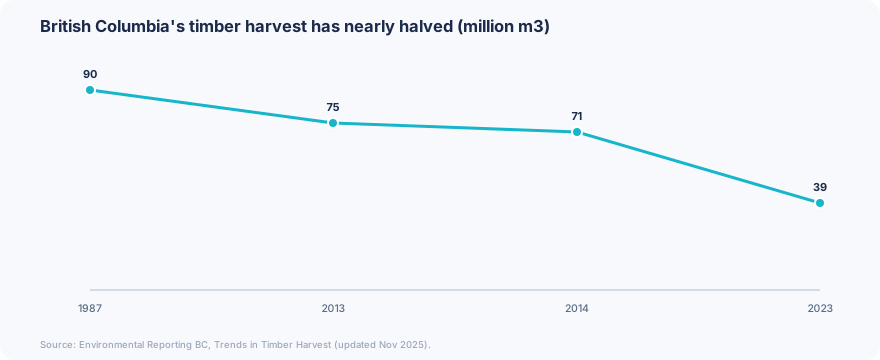
That chain has never mattered more, because the margin for error has shrunk. British Columbia's timber harvest has fallen by nearly half in a decade, mills have closed, and operators are competing for a smaller, more contested cut. When volume is tight, every authorized cubic metre counts, and the operators who keep moving are the ones who can produce a current permit, a valid plan, and a clean compliance record on demand. The ones who can't lose time chasing a missing approval, risk penalties for operating outside an expired authority, and stumble when a regulator, an auditor, or a First Nation partner asks to see the record. The tenure is only as strong as the file behind it.
Recent context
The squeeze is measurable. Environmental Reporting BC's timber-harvest indicator, updated in November 2025, shows the provincial harvest falling from about 71 million cubic metres in 2014 to roughly 39 million by 2023 - down from a peak near 90 million in the late 1980s. Over the last two decades, actual harvest has run about 22% below the allowable annual cut (a 60-million-cubic-metre average against a 77-million ceiling), and mid-term supply is forecast near 57 million. A shrinking, harder-won cut puts a premium on operating cleanly within every authority you hold.
The permit trail is a compliance system, not a filing cabinet
It is easy to treat permits as paperwork to be filed and forgotten, but in forestry the trail is the compliance system itself. Under the Forest Act and the Forest and Range Practices Act, a tenure holder's cutting permits, road permits and forest stewardship plan carry binding obligations - what can be cut, where, to what standard, and how the land is left afterward. Amendments, closures, and transfers each generate their own records, and the obligations don't end when the timber leaves: reforestation and free-growing commitments can run for years past the harvest. A record scattered across field offices, contractors, and personal drives is one you will scramble to assemble the day a compliance check or a tenure transfer demands it. A single, current trail - every permit, plan, amendment and obligation tied to the tenure - is the difference between proving compliance and hoping you can.
How XNM helps
XNM helps forestry licence holders - including First Nations forestry corporations and woodland operators - pull the whole tenure record into one auditable command centre: licences, cutting and road permits, stewardship plans, amendments, and the reforestation and compliance obligations that outlive the harvest, organized by tenure and kept current. Where it helps, the XNM-Vision platform makes the live authority for any block unmistakable, preserves the full trail behind it, and keeps the file ready for a compliance check, an audit, or a partner's review long after the cut. The aim isn't another drive to search; it's the single governed record that the active block, the regulator, and a future obligation all depend on - stood up in days, not the months a records project usually drags into.
Practical takeaways
Treat the permit trail as your licence to operate. A cut authorized by a lapsed or unfiled permit is a compliance exposure, not a harvest - keep every authority current and findable before crews mobilize.
Tie obligations to the tenure, not to a person. Reforestation and free-growing commitments outlive staff and contractors; the record has to stay with the tenure when people move on.
Keep amendments and closures in the same trail. Each change to a permit or plan is part of the compliance story - a record that captures only the original misses what a regulator will check.
Make the file audit- and transfer-ready by default. Compliance checks and tenure transfers both turn on producing a complete record fast; build it as you go so you never assemble it under pressure.
Carry one current view across every tenure. An operator running multiple blocks and licences needs a single live picture of what's authorized where - not a binder per district refreshed by memory.
FAQ
We keep all our permits on a shared drive. Isn't that enough?
A drive tells you a file exists somewhere; it doesn't tell you which authority is currently live for a given block, whether a plan amendment was filed, or whether an obligation is still open. The failures that stall a harvest or trigger a penalty happen in that gap. Real tenure control makes the live authority unambiguous and keeps every amendment and obligation tied to it - the part a folder tree can't guarantee.
Does this matter if harvest volumes are down anyway?
It matters more. When the cut is smaller and harder to win, you cannot afford to lose authorized volume to a lapsed permit or a compliance stumble. A tight market rewards the operator who can move on a clean, current record - and penalizes the one who can't prove they're onside.
The bottom line
A forest tenure is a chain of records, and a chain is only as strong as its weakest link. In a sector with less room to spare, the operators who hold their ground are the ones whose permits, plans and obligations are current, connected, and ready to show. The right to harvest is written in the records - and keeping that chain whole is how a tenure holder keeps the right.