When the Firm Changes Hands, the Engagement File Stays: Records in the Accounting Consolidation Wave
A founding partner retires, a regional practice is acquired, a private-equity platform rolls three firms into one. In each case the client relationships move, the letterhead changes, and somewhere in the transition the working papers - the engagement files that prove each audit, each tax position, each advisory opinion was done to standard - have to come along intact. For an accounting firm, the engagement file is not back-office residue. It is the evidence of the work, the defence if that work is ever challenged, and increasingly, part of what a buyer is actually paying for. Consolidation puts all of it in motion at once.
The accounting profession is in a consolidation wave, and the engagement record is the thing every deal quietly depends on. When two firms merge, their files have to converge into one defensible standard. When private-equity capital comes in, due diligence runs on the quality and completeness of the book of work. When a partner who carried decades of client history walks out the door, that history either lives in the firm's records or it leaves with them. A firm that cannot produce a clean, complete engagement file for any client, on demand, is a firm carrying a hidden liability into every transaction - and into every future professional claim, which can surface years after the engagement closed.
Recent context
The deal pressure is building. KPMG reported in January 2026 that 33% of Canadian organizations plan a major acquisition in the next 18 months - rising to 36% among private and private-equity-backed companies - driven by succession-led M&A and a wave of private-equity dry powder looking for steady, recurring-revenue businesses. Professional-services firms, with their predictable cash flows, sit squarely in that target. The same forces reshaping the profession are the ones moving its records from one owner to the next.
The engagement file is the asset changing hands
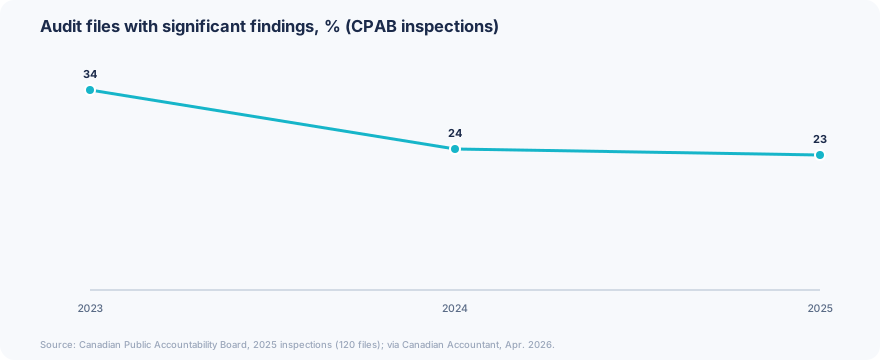
Quality is also under a brighter light. Canada's audit regulator reported that of 120 audit files it inspected in 2025, 23% had significant findings - down from 24% in 2024 and 34% in 2023, a real improvement, but still nearly one file in four. The regulator's recurring themes - the use of technology in audits, fraud-risk response, group-audit documentation - all come back to one question: can the file actually show the work that was done? In a merger or a private-equity deal, that question is asked of every file at once, and the answer is only as good as the records the firm kept along the way. A reconstructed file assembled under deal pressure is the weakest possible position; a complete, retained, time-stamped engagement record is the strongest.
How XNM helps
XNM helps accounting and audit firms put the whole engagement record into one auditable command centre - engagement letters, working papers and their version history, supporting documents, sign-offs and reviews, and the retention clock on each file - organized by client and engagement and kept current. Where it helps, XNM-Vision makes any engagement file producible on demand, preserves the full trail behind it, and keeps the record defensible long after the work closes - so the firm walks into a merger or a diligence room able to show its book of work rather than scramble to rebuild it, and meets a professional claim years later with a file, not a search. The aim is not another drive to comb through; it is the single governed record that the active engagement, the next owner, and a future challenge all depend on - stood up in days, not the months a records overhaul usually drags into.
Practical takeaways
Treat the engagement file as the firm's asset, not its exhaust. In a consolidation, buyers pay for a clean, complete book of work; the file's condition is part of the firm's value, not an afterthought.
Keep the retention clock on every file. Professional and regulatory retention periods are long; let the record track each file's clock so nothing is purged early or kept in limbo.
Make any file producible on demand. Mergers, inspections, and claims all ask the same thing: show me the work. Build the record so the answer is one query, not a week of reconstruction.
Capture partner history before the partner leaves. Decades of client context shouldn't walk out with a retirement; keep it in the firm's record so the relationship and the file survive the handover.
Converge on one standard early. When firms combine, mismatched filing habits become tomorrow's liability; agree on one governed engagement record before the work piles up.
FAQ
We keep our working papers in our audit software. Isn't the record already handled?
Audit tools hold the file for an engagement; the gap shows up across engagements, across years, and across a transition - when files have to be produced together, retention has to be proven, and a merging firm's records have to reconcile with yours. The discipline is not just storing each file but governing the whole book of work so any of it is complete, retained, and producible when a deal or a claim asks.
Does this matter for a firm that isn't being acquired?
Yes - the same record that protects a deal protects against a claim. Professional liability has a long tail; a demand can arrive years after the engagement closed, and your defence is the file you can produce. A firm staying independent still benefits every time it answers an inspection, onboards a successor partner, or has to stand behind old work without a scramble.
The bottom line
Consolidation is reshaping the accounting profession, and through every merger, investment, and retirement, the engagement file is what carries the firm's evidence and its value forward. The firms that come through it strongest are not the ones with the cleverest deal - they are the ones whose records were never in doubt. The work is the product; the file is the proof - and in a year of changing hands, the proof has to travel intact.