From Drill Core to Permit: Why Critical-Minerals Readiness Is a Records Problem
A mineral project is a decade-long argument made of records. It begins with exploration - drill holes, core logs, assay results, geophysical surveys - and every later stage builds on that evidence. The resource estimate cites the drill data. The environmental assessment cites the baseline studies. The permit applications cite the resource estimate and the environmental work. The financing cites the permits. By the time a project reaches a construction decision, its credibility rests on an unbroken chain of data and documents stretching back years, often across changes of ownership, consultants, and management. When that chain has gaps, the project doesn't just lose paperwork - it loses time and capital at exactly the moment both are scarcest.
This has always been true, but it matters more now because Canada is moving fast on critical minerals and the reward goes to projects that are ready. Permitting reform, streamlined federal review, and large pools of capital are all converging on a single question asked of each proponent: can you show that your project is sound, permittable, and supported by the record? A project whose exploration data, environmental baseline, community and consultation records, and permit history are continuous and retrievable can answer that question in days. A project whose record is scattered across old drives, departed consultants, and a previous owner's filing system answers it slowly, if at all - and in a fast-moving environment, slow is expensive.
Recent context
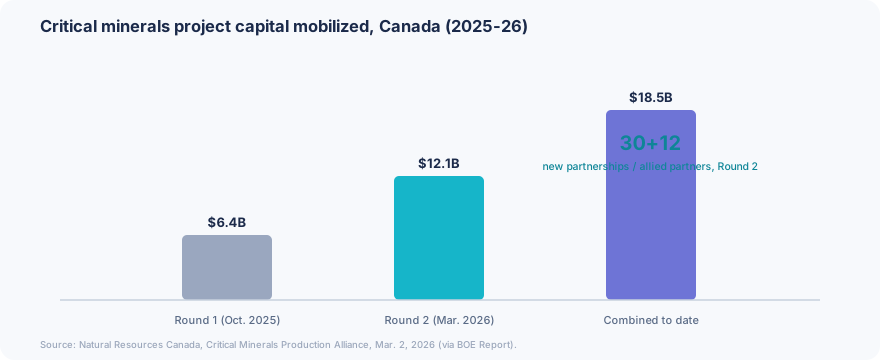
The capital is real and the pace is set. Natural Resources Canada announced on March 2, 2026 that a second round of the Critical Minerals Production Alliance unlocked $12.1 billion in critical-minerals projects, with 30 new partnerships and 12 allied partners, bringing the total mobilized since October 2025 to $18.5 billion. Money at that scale moves toward projects that can demonstrate readiness - and readiness is, in large part, a question of whether the project's technical and regulatory record holds together.
Streamlined permitting rewards the project whose file is in order
The permitting side is moving just as fast. As McCarthy Tetrault summarized in June 2026, Ontario's "One Project, One Process" framework set up a dedicated permitting team and aims to cut government review times by half, while the federal Building Canada Act created a Major Projects Office to act as a single point of contact for nation-building projects, with a Mine Permit Navigator mapping the federal approvals a developer needs. Faster review is an opportunity, but it raises the bar on the proponent's side: a single point of contact and a compressed timeline reward the company that can hand over a complete, current, internally consistent file - and expose the one whose data and disclosures don't line up. Streamlined permitting doesn't reduce the need for a good record; it makes a good record the thing that lets you move at the new speed.
How XNM helps
XNM helps mining and exploration companies hold the whole project record in one auditable command centre - exploration and drill data, assays and technical reports, the environmental baseline, community and consultation records, permit applications and their status, contracts and change orders, and the disclosures that have to stay consistent across stages - organized by project and kept current. Where it helps, the XNM-Vision platform keeps the data chain continuous from exploration through development, so a resource update, a permit submission, or a diligence request draws on the same trustworthy record rather than a reconstruction. Because the record survives changes of consultant, owner, and management, the project's history doesn't walk out the door with the people who built it. And because it stands up in days, the readiness is there for the permitting window and the capital that are open now, not the next cycle.
Practical takeaways
Keep the data chain continuous from the first drill hole. Every later stage cites the exploration data; a gap early becomes a credibility problem at financing and permitting, when it is hardest to fix.
Hold the record so it survives a change of owner or consultant. Mineral projects change hands and advisors often - keep the file with the project so its history doesn't leave with the people who created it.
Make the project producible on demand. Streamlined review and diligence both ask the same thing: show me the project. Build the record so the answer is one retrieval, not a months-long reassembly.
Keep technical work and disclosures consistent. Resource estimates, environmental work, and public disclosures all reference each other - an internally consistent record is what stands up to a regulator and an investor alike.
Treat readiness as a record, not a sprint. Capital and permits flow to projects that can prove they are ready; a continuous record is the difference between answering in days and scrambling for weeks.
FAQ
We keep our exploration data in specialized geology software. Isn't the record handled?
Geology tools hold the drill and assay data well; the gap is everything around them - the environmental baseline, the consultation records, the permit applications, the contracts, and the disclosures that all have to reference the same facts across years and stages. The discipline is governing the whole project record so the technical data, the regulatory file, and the public disclosures stay consistent and producible together when a permit office or an investor asks.
Our project is early-stage. Does this matter yet?
Especially then. The exploration record you keep now is the foundation everything later cites - the resource estimate, the environmental work, the permits, the financing. A clean, continuous record built from the first drill program is far cheaper than reconstructing one under permitting or diligence pressure later, and it is exactly what lets an early project move quickly when the window opens.
The bottom line
Canada is putting real capital and faster permitting behind critical minerals, and both flow to projects that can prove they are ready. The ore is the prize; the record is what shows the project is sound, permittable, and yours to advance. From the first drill core to the final permit, the project that keeps its record continuous is the one that can move at the speed the moment now demands.