Proving the Build: How a Non-Profit's Housing Record Outlasts Board Turnover
A community housing non-profit is, on any given day, a developer, a landlord, and a charity at once. It runs construction projects with permits, drawings, contracts, and change orders; it manages tenancies and conditions; and it answers to funders, members, and a volunteer board for every dollar and every outcome. The work is real - families housed, buildings standing - but the proof of it lives in records. And in a sector run largely by part-time boards and rotating volunteers, those records are the one thing that has to outlast the people who happened to be in the room when a building went up.
That is the quiet vulnerability of mission-driven housing. The capital project produces a paper trail - the funding agreement, the build documentation, the as-builts, the occupancy and outcome data a funder will later want to see. But the institutional memory of why a decision was made, where a document sits, and how an outcome was measured too often lives in a long-serving executive director or a board treasurer. When they move on - and in this sector, turnover is constant - a charity can lose the thread on its own buildings. The next funder doesn't lower the bar because the person who knew the file retired; the report is still due, and the record either supports it or it doesn't.
Recent context
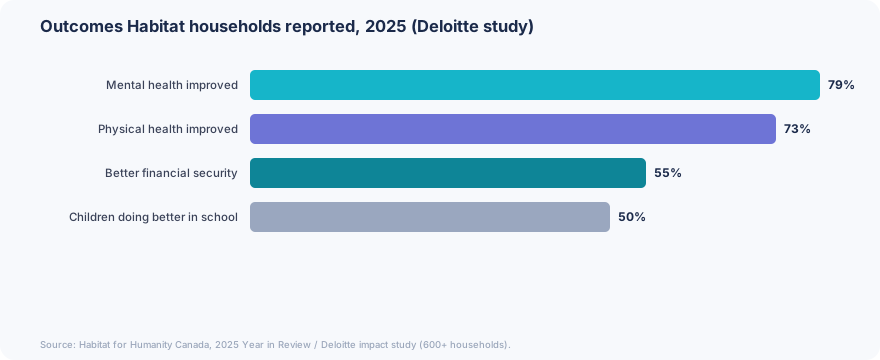
The outcome evidence is getting more sophisticated, which raises the records bar. Habitat for Humanity Canada's 2025 Year in Review, drawing on a Deloitte study of more than 600 households, reported that 79% of families saw improved mental health, 73% improved physical health, and that Habitat households contribute roughly $35 million to GDP annually, with a five-year economic footprint of $311 million. Working across 44 local Habitats and mobilizing 15,938 volunteers for over 500,000 hours, the organization can show its impact precisely because it kept the records to measure it. That bar - prove the outcome, not just the activity - is now what funders across the sector expect.
Turnover is the test the record has to pass
The governance reality makes continuity harder. Imagine Canada reported in January 2026, from a survey of 963 organizations, that 80% of nonprofits now use AI in some way, yet 64% of those have no governing policy and aren't developing one - a snapshot of a sector adopting new tools faster than the governance to manage the data behind them. The same gap shows up in records generally: when the board and the volunteers turn over but the policy and the system don't keep the file, the organization's memory walks out the door. A non-profit that cannot produce a clean record of what it built and what resulted is one retirement away from being unable to make its own case.
How XNM helps
XNM helps community housing non-profits and foundations pull the whole delivery and governance record into one auditable command centre - project permits, drawings, contracts, and change orders; unit inventories and conditions; the funding agreements and the outcome data behind each report; and the board minutes, decisions, and audit trails that hold it together, kept current. Where it helps, the XNM-Vision platform gives an executive director and board a single line of sight across projects and grants, so funder reporting draws on the same governed record rather than a year-end reconstruction, and so the file survives when a key staffer or board member moves on. Because the record stays with the organization and is time-stamped, the next grant application, the next audit, and the next board all start from the same trustworthy base. And because it stands up in days rather than the many months a records overhaul usually takes, the continuity is there for the projects underway now.
Practical takeaways
Treat the record as the organization's memory, not the staff's. In a sector built on rotating boards and volunteers, the file is what survives turnover - keep it with the organization so a departure doesn't erase years of context.
Build the outcome record as you build. Funders now want proven outcomes, not just activity; capture the occupancy and result data as the project runs, not in a scramble when the report is due.
Keep the funding agreement and the build in one place. Every grant comes with reporting - build the record where the report is already half-written, not in a binder reconstructed each cycle.
Govern the data, not just collect it. Adopting tools without a policy leaves the record exposed; agree on who owns it, where it lives, and how it is kept before the next board change.
Make the next grant application a by-product. A current, governed record turns the next funding case from a research project into a query - the proof is already assembled.
FAQ
We already file reports with every funder. Isn't that the record?
A funder report is a snapshot built for one funder's question at one moment. The record is the living file underneath - every project, decision, contract, and outcome - that lets you answer the next funder's question, and your own board's, without rebuilding from scratch. The report is the output; the record is what makes the output trustworthy, repeatable, and survivable when the people change.
We're a small organization with a volunteer board. Isn't this too much?
It is less, not more, once the record is in one place. The administrative weight today is in the year-end scramble, the hunt for last year's numbers, and the rebuild every time a board or a key staffer changes. A single current record removes those frictions, so a small team and its volunteers spend their time on housing rather than on reassembling the organization's own history.
The bottom line
Community housing non-profits do real, lasting work, and the record is how they prove it - to funders deciding the next dollar, and to themselves across the people who come and go. The buildings are the goal; the file behind them is what carries the mission past any one board, treasurer, or executive director. You can only prove what you can produce - and in a sector built on turnover, the record is the part of the organization that has to stay.