Building for the Next Cohort: Why Enrolment-Driven Campus Builds Are a Records Test

A province decides it needs more doctors, more skilled trades, more student beds in the cities where enrolment is climbing - and the answer arrives as buildings. British Columbia's 2026 budget is a clear example: it funds a new School of Medicine in Surrey, a new student residence at Kwantlen, and a program of thousands of new student-housing beds, all inside a capital plan of nearly $38 billion. The political story is access - a seat in a classroom, a bed near campus, a doctor in a growing region. The delivery story underneath it is quieter and harder: each of these is a multi-year construction project, and a project is only as deliverable as the record behind it.
Enrolment-driven building is different from patching what already exists. A deferred-maintenance backlog is about assets you already own and can already see; a growth program is about assets that do not exist yet, funded on a forecast and a timeline. That makes the record the spine of the whole effort. The design drawings and their revisions, the contracts and change orders, the funding agreement and its reporting conditions, the schedule and the approvals that move it forward - these are not paperwork around the building. They are the means by which a campus or a district actually delivers it, on budget and on time, while the cohort it was built for is still arriving.
Recent context
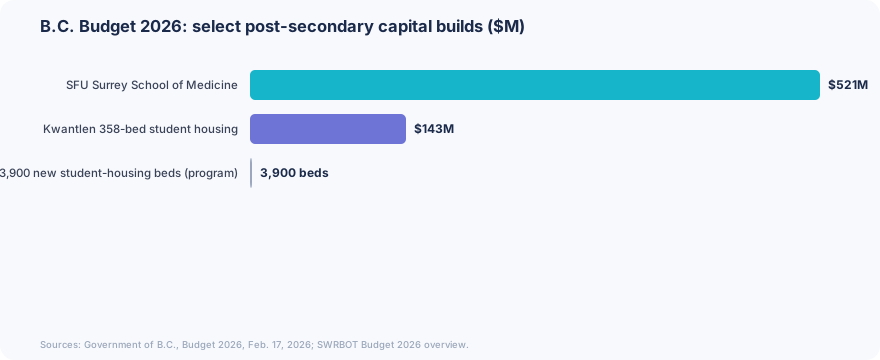
The growth is concrete and dated. B.C.'s 2026 budget, tabled in February 2026, funds the first new medical school in Western Canada in nearly 60 years - the $521-million Simon Fraser University School of Medicine in Surrey, slated for completion in 2030 - alongside a $143-million, 358-bed student residence at Kwantlen Polytechnic and a broader program adding 3,900 new student-housing beds in communities from Nanaimo to New Westminster, all within a capital plan of close to $38 billion. Each of those is a distinct project with its own clock.
A growth program lives or dies on its records
Money and political will get a project announced; the record gets it built. When an institution is running several major builds at once - a medical school, a residence, a trades expansion - the binding constraint is rarely the headline funding. It is whether the people responsible can see, at any moment, the current state of each project: which drawing revision is live, what was approved and when, where the budget actually stands against commitments, which conditions the funding agreement still requires, and what the schedule says about the next milestone. When that information is scattered across consultants' servers, departmental drives, email threads, and a project manager's own notes, the institution is delivering on growth while half-blind. Delays and overruns rarely begin as construction failures; they begin as record failures - a stale drawing, a missed reporting condition, a commitment no one tracked until it was a problem.
How XNM helps
XNM helps colleges, universities, and school districts pull the whole capital-project record into one auditable command centre - drawings and their revision history, contracts and change orders, budgets against commitments, schedules and milestones, and the funding agreements and reporting conditions tied to each build, kept current. Where it helps, the XNM-Vision platform gives a VP of facilities or a director of capital planning a single line of sight across every active project at once, so a board, a ministry funder, or an auditor asking 'where does this build stand?' meets an answer that already exists rather than a week of assembly. Because the record lives in one place, a project manager moving on does not take the project's history with them. And because it stands up in days rather than the many months a records overhaul usually takes, the visibility is there for the builds underway now, not the ones after the current growth wave has passed.
Practical takeaways
Treat the project record as part of the project. A growth build is only as deliverable as the record behind it; a scattered file quietly invites the delay and the overrun.
Keep the funding conditions where the build is managed. Capital grants come with reporting and conditions; track them against the project, not in a separate binder reconstructed each quarter.
Give leadership one view across all active builds. A board or ministry overseeing several concurrent projects needs one current picture, not a status deck reassembled by hand each month.
Make the budget-against-commitments visible in real time. Overruns hide in the gap between what was approved and what has actually been committed; keep both in the same place so the gap is never a surprise.
Design for handover from day one. Multi-year builds outlast staff; keep the record with the institution so a departure never erases a project's history.
FAQ
Our project manager and consultants already track this. Isn't that enough?
They track their piece; the gap is the whole. The delays come from the seams - between the design team and the funder's conditions, between this month's budget and last month's commitments, between one project manager and the next. A single record across every build is what lets leadership see the program, not just each project, and answer for it without a scramble.
We only have one or two major builds. Does this matter at our scale?
It matters most when a single build is a large share of your capital. The record is what protects the timeline and the budget on the project you cannot afford to slip, and it is what you produce when the funder or the auditor asks how the money was spent. The point is not volume; it is being able to see and prove where the build stands at any time.
The bottom line
Building for the next cohort is one of the most hopeful things a public system does - and one of the hardest to deliver on time. The institutions that get there are not just the ones that win the funding; they are the ones that can see their own projects clearly enough to deliver them. A growth program is a delivery test, and delivery is a records test. You can only finish on time what you can see in one place.