Shared Ownership, Shared Record: Why Industrial JVs on Indigenous Land Are a Records Discipline
For decades, the relationship between a major industrial project and the Nation whose territory it crossed was defined by consultation: a proponent proposed, a Nation responded, and the records that mattered most lived on the company's side of the table. That is changing fast. Across LNG, pipelines, hydro, and mining, First Nations are becoming co-owners and equity partners, not just rights-holders to be accommodated. When a Nation holds equity and signs an impact-benefit agreement (IBA), it takes on a partner's obligations - and a partner's need to see, track, and prove everything the agreement promised. The record stops being the proponent's paperwork and becomes a shared instrument the Nation must hold its own copy of.
A joint venture or an IBA is a web of obligations that runs for the life of a project and beyond: equity contributions and distributions, employment and training targets, procurement and contracting commitments to community businesses, environmental monitoring and remediation duties, milestone payments, and reporting back to both members and funders. Each of those lines is a promise that someone has to be able to verify years from now. When the only authoritative copy lives in a proponent's system - or worse, scattered across a Nation's email, consultants' folders, and a few binders - the Nation is a partner in name but not in evidence. Shared capital projects need a shared discipline, and that discipline is the record.
Recent context
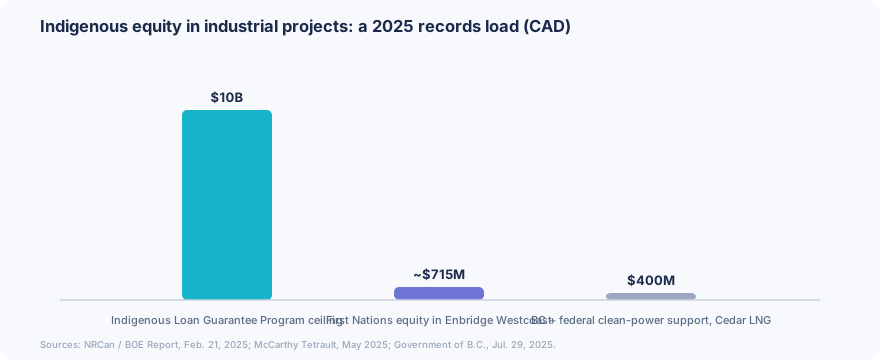
The shift to ownership is now backed by serious capital. The federal Indigenous Loan Guarantee Program launched in February 2025 with up to $5 billion in guarantees - expanded to $10 billion the following month - to help Indigenous groups buy equity in resource, energy, and infrastructure projects. The dollars are no longer hypothetical: they flow into real assets with real obligations attached, and the record is what carries those obligations from the deal table to the decades of operation that follow.
Equity turns the record into the Nation's evidence
The 2025 deals show the scale. One transaction analyzed by McCarthy Tetrault saw a group of First Nations take a 12.5% stake in Enbridge's Westcoast natural gas pipeline through an equity investment of roughly $715 million, supported by a $400 million federal guarantee. On the West Coast, the Haisla-led Cedar LNG - the world's first Indigenous majority-owned LNG project, at about 3 million tonnes per year - is being electrified with $400 million in combined B.C. and federal clean-power support, with operations targeted for 2028. In each case the Nation is now a partner with distributions to receive, commitments to enforce, and reporting to deliver - to its own members and to funders who guaranteed the loans. None of that is provable without an auditable record the Nation controls, because a partner who cannot see the deal cannot govern it.
How XNM helps
XNM helps a Nation and its economic-development arm pull the whole shared-project record into one auditable command centre they control - the JV and IBA agreements, equity and distribution schedules, employment and procurement commitments and the actuals against them, environmental and milestone obligations, and the reports owed to members and funders, tied together and kept current. Where it helps, the XNM-Vision platform gives the Nation a single, sovereign line of sight across every partnership, so it can hold a proponent to the agreement, show members exactly what the deal is delivering, and answer a funder or a loan guarantor without a year-end scramble. Because the record stays with the Nation, the institutional memory of each deal survives staff and council turnover. And because it stands up in days rather than the many months a records overhaul usually takes, the visibility is there for the projects breaking ground now.
Practical takeaways
Hold your own copy of every shared record. An equity partner who relies on the proponent's system is a partner in name only; keep an authoritative, independent record the Nation controls.
Track obligations, not just signatures. An IBA is a living list of commitments - employment, procurement, payments, monitoring; build the record so each one can be checked against what actually happened.
Make member and funder reporting a by-product. Equity comes with accountability in two directions; a current record lets you show members the benefit and satisfy a loan guarantor without rebuilding the file each time.
Keep the deal legible across council and staff turnover. Partnerships outlast terms of office; the record is how the next council picks up a decade-long agreement without losing the thread.
Treat the record as part of the asset. Equity in a project is only as governable as the Nation's ability to see and prove its side of the deal - the record is what makes ownership real.
FAQ
The proponent already keeps detailed project records. Why do we need our own?
Because a partner governs from its own evidence, not someone else's. The proponent's records are built for the proponent's questions; they may be accurate and still leave a Nation unable to independently verify a distribution, enforce a procurement commitment, or report to its members and loan guarantor. An authoritative copy the Nation controls is what turns equity from a line in a contract into something the Nation can actually steward.
Isn't this a lot of administration for a small economic-development team?
It is less once the record is in one place. The burden today is reconstructing the deal every time a member asks, a funder reports come due, or a commitment is disputed. A single current record removes that friction, so a small team spends its time advancing partnerships rather than reassembling the history of the ones it already has.
The bottom line
Indigenous co-ownership of major projects is one of the most important shifts in Canada's economy, and it changes what a record is for. When a Nation becomes a partner, the agreement's obligations run both ways, and only a shared, auditable record can prove they were met. The equity is the milestone; the record is how a Nation governs it - and a partner can only steward what it can see.