When Lawyers Move, the File Has to Move With Them: Records Retention and Matter Portability
A partner leaves to start a boutique. Two mid-size firms combine. A sole practitioner retires and a notarial practice changes hands. In Canadian legal practice these moves are constant, and each one puts a question to the files left behind: who holds them now, who can find a given matter, and who is on the hook to prove that a closed file was kept for as long as the rules demand? The matter file is not just where the work was recorded. It is the evidence the work was done to standard, the basis for a successor lawyer to continue, the client's property in large part - and a record the regulator expects to outlive the engagement by many years. When a lawyer moves and the file does not move cleanly with them, all of that is at risk.
Portability is the quiet test of a legal records system, and most are not built for it. While a matter is active, the file feels manageable - it sits in the practice-management system, the document store, and a few inboxes. The strain appears at the handover: when a closing firm has to transfer open matters to clients or successor counsel, when a merger has to reconcile two retention regimes and two filing conventions into one, when a retiring notary has to leave behind real-estate and estate files that may be needed a decade later. If the record cannot be located, proven complete, and transferred as a whole - documents, correspondence, trust history, and the retention clock attached - the move becomes a liability event. The same gap surfaces on the day a litigation hold lands or a regulator asks to see a file: a record you cannot produce intact is, for practical purposes, a record you do not have.
Recent context
The exposure is not hypothetical; it shows up in the claims data. LAWPRO reported in 2025 that it received 3,758 claims in 2024 - up from 3,272 the year before - with real estate (29%) and litigation (28%) the most costly areas, and inadequate investigation, communication errors, and time-management mistakes the leading causes. Those are records-shaped failures: the missing document, the unrecorded instruction, the deadline that lived in one person's calendar. Every one of them is harder to make and easier to defend when the matter file is complete and any of it can be produced on demand - and every handover between lawyers or firms is a moment when an incomplete file turns into a claim.
The retention clock keeps running through every move
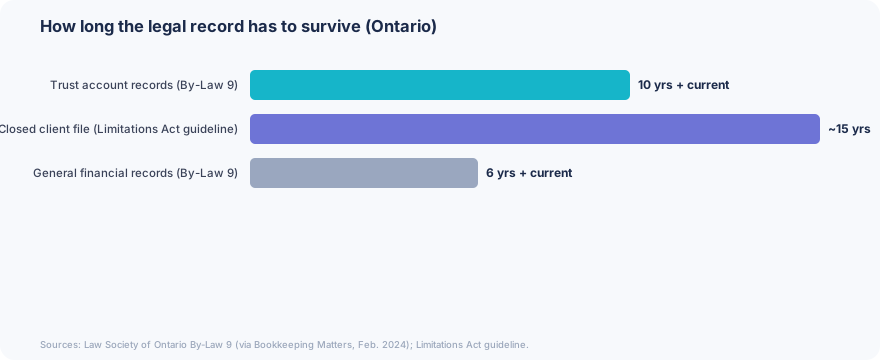
Retention is the part that does not stop when the lawyer moves on. Under the Law Society of Ontario's By-Law 9, trust-account records must be kept for ten years plus the current year and general financial records for six, while the Limitations Act points to roughly fifteen years for a closed client file. Those clocks are attached to the file, not to the lawyer who opened it - so when a firm merges or a practitioner retires, the obligation to retain, and to be able to prove retention, transfers with the record. A firm that takes on another's files inherits their retention duties; a firm that lets files scatter in a transition inherits the risk of a file it cannot produce when By-Law 9, a client, or a court comes asking. The record has to survive the move, intact and traceable, for as long as the rules say - which is far longer than most matters stay active.
How XNM helps
XNM helps law firms and notarial practices put the whole matter record into one auditable command centre - documents and correspondence, engagement and closing records, trust and financial history, and the retention clock on every file - organized by client and matter and kept current. Where it helps, XNM-Vision makes any file producible on demand for a litigation hold, an inspection, or a client request, preserves the full trail behind it, and keeps the record portable - so a merger can reconcile onto one governed standard, a departing or retiring lawyer can transfer matters cleanly, and a file is ready the day a hold or a claim arrives rather than reconstructed under pressure. The aim is not another shared drive to search; it is the single governed record that the active matter, the next custodian, and a future challenge all depend on - stood up in days, not the months a records overhaul usually drags into.
Practical takeaways
Attach the retention clock to the file, not the lawyer. By-Law 9 and limitations periods run for years past closing; keep the retention date on the record so a move never resets or loses it.
Make portability a design requirement. Files will move - between lawyers, firms, and successors; build the record so any matter can be located, proven complete, and transferred as a whole.
Treat a litigation hold as a test you can pass. When a hold lands, you must preserve and produce on demand; a governed record turns that from a fire drill into a query.
Reconcile retention regimes early in a merger. Two firms mean two filing habits and two clocks; agree on one governed standard before the combined book of files becomes tomorrow's liability.
Protect notarial and real-estate file integrity. These files are relied on years later by third parties; keep them complete and producible so a transaction or title can always be proven.
FAQ
Our matters live in our practice-management system. Isn't the record already portable?
Practice-management tools hold the active matter well; portability is tested at the edges - when files have to leave the system intact, when two firms' records must merge, when a closed file is needed years after the software changed. The discipline is governing the whole record so any matter, open or long-closed, can be located, proven complete with its retention clock, and transferred or produced as a unit - not just stored while it is current.
We are not merging or moving. Does retention and portability still matter?
Yes - the same record that survives a move survives a claim, a hold, and an inspection. Professional liability has a long tail, and By-Law 9 retention runs for years; a demand or a regulator can ask to see a file long after it closed, and your position is the file you can produce intact. A stable firm still benefits every time it answers a litigation hold, onboards a successor on an old matter, or proves a closed file was kept as the rules require.
The bottom line
Lawyers and firms will keep moving - that is the nature of practice - and the matter file has to move with them, complete and within its retention clock, every time. The firms and notaries that come through a transition strongest are not the ones that never change; they are the ones whose records were never in doubt. The work is the service; the file is the proof, the client's right, and the regulator's expectation - and it only holds its value if it can travel intact.