The Grant That Got Clawed Back

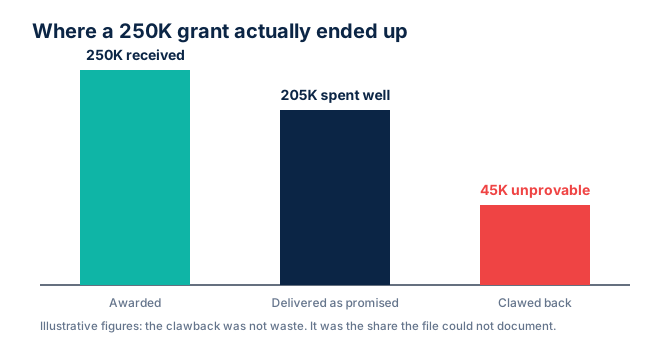
They did the work. Every dollar of the grant went where it was supposed to go: the after-school program ran, the families showed up, the outcomes were real. And two years later, the same organization wrote a cheque sending forty-five thousand dollars back to the funder. Not because they had misspent it. Because, when the funder asked them to prove how a slice of the money had been used, the file went quiet.
This is the part of grant work nobody warns a new director about. A grant is not money you received. A grant is money you can prove you spent the way you promised. Those are two very different things, and the distance between them is exactly the size of a clawback. The program can be a complete success and still cost you, if the record of it is thin.
The reporting gap is not a spending problem
It helps to be precise about what failed here, because the instinct is to assume someone wasted the money. Nobody did. The staff time was real, the supplies were bought, the venue was paid for. What went missing was the connective tissue: the receipts filed against the right budget line, the timesheets that tied an hour of work to the funded activity, the sign-in sheets that showed the funded program actually served the funded population. Each of those felt like paperwork at the time. Each of them was, in fact, the evidence.
A funder reviewing a grant is not in the room watching the program. They read the file. If the file says a coordinator spent twelve hours a week on the funded activity but there is no record tying those hours to that activity, the funder cannot count it — not because they doubt the team, but because their own auditors will not let them. Good intentions are not an allowable expense. Documentation is.
Build the report before you need it
The organizations that never get clawed back are not the ones with the most discipline. They are the ones who stopped treating the grant report as a thing you assemble at the end. They build it continuously, as a by-product of running the program, so that on reporting day there is nothing to reconstruct.
Tag every cost to a grant line as it happens. A receipt that is coded to the right budget category the day it arrives is evidence. The same receipt found in a shoebox eighteen months later is a liability.
Tie people-time to funded activities. A simple, contemporaneous record of who worked on the funded program and when is the single most commonly missing piece — and the most expensive one to fake after the fact, which is why funders weight it so heavily.
Keep proof the program reached its target. Attendance, intake forms, outcome notes. The funder paid for impact on a specific group; the file has to show that group was actually served.
Reconcile against the grant terms monthly, not annually. A small monthly check catches a missing document while the memory is fresh. A single annual scramble discovers the gap when the person who knew is already gone.
None of this requires more staff or more money. It requires that capturing the evidence and doing the work become the same motion, instead of the work happening now and the evidence being chased later, by someone, somehow, under deadline.
What the clawback was really for
When that organization sent the forty-five thousand back, they were not paying a penalty for fraud. They were paying for the difference between what they knew and what they could show. Every team carries that difference. The only question is whether anyone ever asks you to settle it — and a funder, an auditor or a board eventually will.
So run the test before they do. Pick one active grant this week and try to assemble its report from the file alone, today, without asking anyone to remember anything. Whatever you cannot find is the part you would have written a cheque for. Finding it now, while it is still findable, is the cheapest version of this lesson there is.
We take apart one of these quiet, expensive records failures every week in our records and accountability series. The story rarely changes: the work was sound, the money was well spent, and the only thing missing was the proof. A system like XNM-VISION exists to make that proof a by-product of the work rather than a scramble at the end — but the discipline matters more than the tool.