One Chart: Email vs. a Single Source of Truth

Here is a question worth sitting with. The next time you need the real, current answer to something on a project — the approved budget, the latest scope, who signed off on the change — where do you actually go to find it? Be honest. For most teams, in most organizations, the true answer is: you search your email. And email is the single worst place that answer could possibly live.
This is not a complaint about email. Email is excellent at what it was built for: sending a message from one person to another at a moment in time. The problem is what we have quietly asked it to become — the de facto filing cabinet for every decision, every approval, every version of every fact, smeared across thousands of threads and dozens of inboxes, with no way to tell which message is current and which was overtaken an hour later.
The chart that should worry you
Picture where a given project fact can be found and, more importantly, whether you can trust the copy you find. Not whether it exists somewhere — almost everything exists somewhere — but whether the version you pull up is current, attributable to a real decision, and complete. Score the usual places honestly and the same shape appears every time.
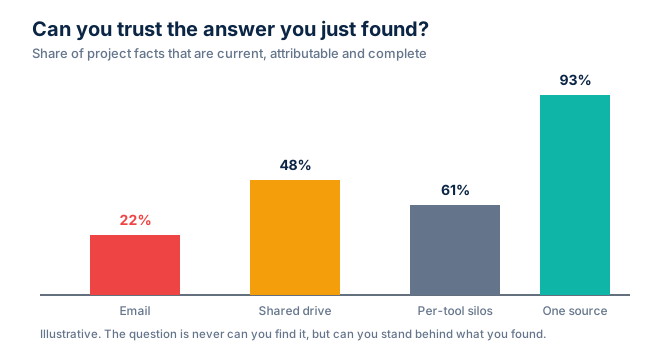
Email scores worst not because the information is not there, but because you can never be sure the message you found is the last word. A shared drive does better, until you hit five files named final, final-v2 and final-USE-THIS. Per-tool silos are better still within their lane, but they fracture the truth across systems that do not talk. Only when there is one authoritative source — one place a fact is entered, updated and read — does the trust score climb to where you can actually stand behind your answer.
What single source of truth actually means
The phrase gets used loosely, so it is worth being concrete. A single source of truth does not mean one giant folder. It means that for any given fact, there is exactly one place it lives, one place it gets updated, and everyone reads from that place rather than from a copy they made last Tuesday. The opposite is not chaos — it is something more dangerous, which is many confident, contradictory answers, each true at some point, none clearly true now.
One place a fact is entered and updated, so there is never a question of which copy is current.
Every answer carries its provenance: who set it, when, and against what decision.
Reading is from the source, not from a forwarded screenshot or a six-week-old export.
When the fact changes, it changes once, everywhere, instead of in one place and nowhere else.
None of that is exotic. It is simply the difference between information you happen to possess and information you can act on without a second, nervous check.
Stop trusting the place you look first
The uncomfortable implication of the chart is that the place most of us instinctively look first is the place we should trust last. The fix is not to ban email; it is to stop letting email be the record. Decisions, approvals and the current state of a project belong somewhere built to hold them, where the answer you find is the answer, not a candidate for it.
Try it this week. Pick one fact that matters on a live project and ask three people where the real answer lives. If they point to three different inboxes, you do not have a source of truth — you have a search problem you have been calling a filing system. A platform like XNM-VISION exists to be that one place, but the first step is simply deciding that the truth gets a home and email is not it.
We publish one of these every week in our records and accountability series, each tracing a familiar failure back to the same root: the truth never had a single place to live, so everyone kept their own.