
After the Storm, the Record Decides the Rebuild: Disaster Readiness Is a Records Test for Municipalities
In August 2024, a single hailstorm over Calgary did about $3 billion in insured damage in just over an hour. Weeks earlier, the remnants of a hurricane knocked out power to half a million homes in Quebec and left $2.7 billion in claims behind. Across the country, 2024 became the costliest year for severe weather in Canadian history. For the municipalities at the centre of each event, the emergency is only the first phase. The longer test begins when the water recedes and the rebuild starts - and that test is, quietly, a records test.
Disaster recovery runs on documentation. To claim provincial or federal recovery and mitigation funding, to settle insurance, and to rebuild defensibly, a municipality has to prove three things on a deadline: what public assets it owned, what condition they were in before the event, and what the disaster damaged or destroyed. Every one of those is a records question. A town that can produce current asset inventories, condition assessments, as-built drawings, and maintenance histories moves quickly from emergency to funded reconstruction. A town whose records are scattered across departments, old spreadsheets, and the memory of staff spends the weeks after a disaster reconstructing the past instead of rebuilding the future - and every gap in the file is a dollar of recovery funding left on the table.
Recent context
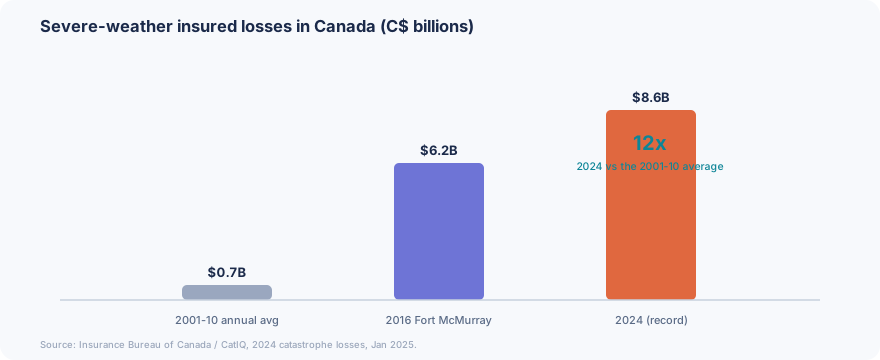
The exposure is growing fast. The federal Disaster Mitigation and Adaptation Fund has committed its full $3.7 billion - with a dedicated minimum for Indigenous beneficiaries - to resilience projects now under construction through 2035, and its application window is already closed. Meanwhile the losses keep climbing: the Insurance Bureau of Canada put 2024's insured severe-weather damage at $8.55 billion, nearly triple 2023 and roughly twelve times the annual average of the 2001-2010 decade. The money to prepare is finite and largely spoken for; the bill for being unprepared is not.
Recovery funding flows to the municipality that can prove it
It is tempting to treat disaster readiness as a matter of engineering - bigger culverts, raised dykes, hardened infrastructure - and that work is essential. But the funding to do it, and the recovery dollars after an event, are awarded on evidence. Mitigation programs ask applicants to demonstrate risk and asset condition; recovery programs ask them to document what was lost and what it was worth. A municipality that has kept a current, trustworthy record of its infrastructure can answer both quickly and defensibly. One that hasn't is forced to estimate under pressure, and estimates made in the rubble are weaker claims, slower approvals, and smaller cheques. As disasters grow more frequent, the gap between the prepared and the unprepared is measured less in seawalls than in the quality of the file each town can produce on demand.
How XNM helps
XNM helps municipalities pull the asset and infrastructure record into one auditable command centre - inventories, condition assessments, as-built drawings, maintenance and warranty histories, capital projects, and the funding files behind them, connected and kept current. Where it helps, the XNM-Vision platform gives an emergency manager or public-works director a single, defensible picture of what the community owns and its condition before disaster strikes - so a mitigation application or a recovery claim is built from a record that already exists, not assembled in the chaos after an event. The aim is not another archive to dig through; it is the one current file that proves what was there, what condition it was in, and what the storm took - stood up in days, in time to matter before the next season, not after it.
Practical takeaways
Build the asset record before the season, not after the storm. Recovery and mitigation funding is awarded on evidence of what you owned and its condition - that evidence has to exist before the event, because you cannot create it from a flooded basement.
Keep condition data current, not one-time. A ten-year-old condition assessment proves little about what the disaster actually took; a living record is what turns a claim into an approval.
Treat the funding file as part of the asset record. Mitigation and recovery applications draw on the same inventory and condition data your operations do - keep them in one place so a claim is a query, not a project.
Capture institutional memory before it leaves. When the person who knew which culverts flood retires, the knowledge should stay with the municipality - especially when the next storm won't wait for the new hire.
Make the record producible on a deadline. Disaster funding moves on tight timelines; a record you can produce in hours, not weeks, is the difference between a funded rebuild and a missed window.
FAQ
We have emergency plans and insurance. Isn't that disaster readiness?
Plans and coverage are essential, but both pay out against proof. An emergency plan tells you what to do in the moment; the asset record is what you draw on afterward to claim, fund, and rebuild. Insurers and recovery programs settle on documented value and condition - so the readiness that decides how fast and how fully you recover is the quality of the record sitting behind the plan, not the plan alone.
Isn't this just asset management by another name?
It is asset management put to a harder test. Day to day, a thin record costs you in mis-prioritized maintenance. After a disaster, the same thin record costs you in delayed recovery and forfeited funding, on a clock. The discipline is the same; the consequence of skipping it just becomes visible all at once, at the worst possible moment.
The bottom line
Severe weather is now a budget line, not a rare event, and the municipalities that weather it best are not only the ones with the strongest infrastructure - they are the ones with the strongest record of it. When the storm passes, the rebuild is awarded to whoever can prove what they had and what they lost. Disaster readiness, in the end, is a records discipline wearing rain gear: the town that kept its file is the town that recovers first.