The Business Case That Wasn't There: What a $4-Billion Hospital Overrun Says About Records
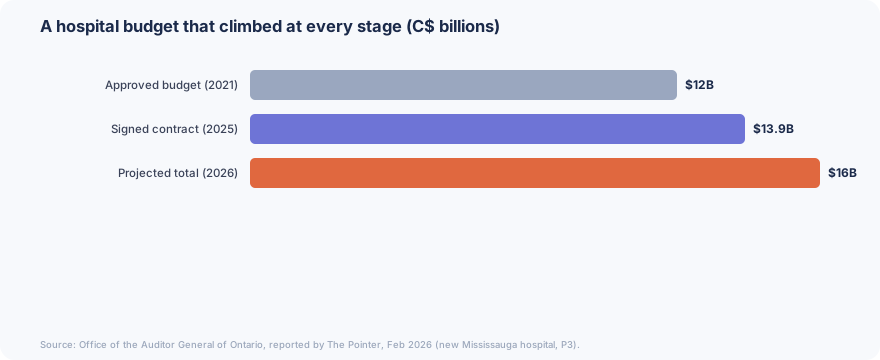
A new hospital taking shape in Mississauga is now projected to cost more than $16 billion - roughly $4 billion, about a third, beyond the $12 billion its budget was approved at. Major construction has barely begun. Following up on the file in late 2025, Ontario's Auditor General flagged something more troubling than the overrun itself: the analysis meant to justify the procurement model chosen for the build - the document explaining why this delivery method, at this cost, over this 30-year term - was never completed. The dollar figure is the headline. The record that should have backed the decision, and didn't, is the real story.
For a health authority or hospital board, a major capital build is the largest and longest-lived decision it will ever sign off on - a commitment that runs decades past the ribbon-cutting through financing and maintenance obligations. The accountability for a decision that size does not live in the building. It lives in the record of how the choice was made: the business case, the options analysis, the cost estimates and their assumptions, and the justification for the procurement route. When those records are thin, missing, or scattered across ministries, consultants, and project partners, no one can answer the only question that matters after an overrun - was this the right call at the time, on the evidence then available? Without the record, that question is unanswerable, and an unanswerable decision is indistinguishable from an indefensible one.
Recent context
The case is concrete. As The Pointer reported in February 2026, drawing on Ontario's Auditor General, the new Mississauga hospital's design and construction costs alone now exceed the approved budget by $2.337 billion, with roughly $1.7 billion more in higher financing and 30-year maintenance costs - about $4 billion in total. The $13.9-billion design-build-finance-maintain contract was awarded in June 2025 to a single bidder, with no competing proposal to test the price. And the analysis that was supposed to justify the chosen procurement model to the Treasury Board was, the audit found, never done.
An overrun you can't explain is a governance failure first
It is easy to read a number like this as a construction-cost story - steel, labour, and inflation outrunning a 2021 estimate. Some of that is real. But the harder finding is procedural: when a project this large proceeds without a completed, documented justification for how it is being delivered, the public loses the ability to judge whether the overrun was bad luck or bad process. A single-bidder award is not automatically wrong, but it demands a stronger paper trail, not a weaker one, precisely because there is no competing price to check it against. The record is what converts a defensible professional judgment into a provable one. Its absence does not just invite criticism; it removes the means to answer the criticism. For every health board watching this unfold, the lesson is not that big hospital builds are risky - they are - but that the justification record is the one asset that has to keep pace with the budget.
How XNM helps
XNM helps health authorities and hospital boards keep the capital-decision record in one auditable command centre - the business case, options analysis, cost estimates and their assumptions, procurement justification, approvals, contracts, and change orders, tied to the project and kept current as the build evolves. Where it helps, the XNM-Vision platform gives a board or a finance director a single line of sight from the original approval through every revision to the contract that was signed, so the answer to why this model, why this price, why now is assembled as the project moves, not reconstructed under audit. The point is not more paperwork; it is that the evidence behind a multi-billion-dollar, multi-decade commitment is complete, time-stamped, and producible on demand - and it stands up in days, not the many months a records overhaul usually takes.
Practical takeaways
Write the business case down - and keep it. The justification for the delivery model is the first thing an auditor asks for and the first thing that goes missing; treat it as a permanent record, not a stage gate you pass and forget.
Document the procurement route most carefully when competition is thin. A sole-source or single-bidder award needs a stronger evidence trail, not a weaker one - the record is the only check on a price nothing else is testing.
Keep the assumptions, not just the number. An estimate without its assumptions cannot be defended when reality diverges; capture what the figure was based on so a later variance can be explained rather than guessed at.
Tie every approval to the evidence behind it. A board sign-off is only as accountable as the analysis it rests on - keep the decision and its justification in the same place.
Assume the follow-up audit. Capital files get revisited years later; build the record so the answer to 'was this defensible at the time' is already on file, not assembled in a hurry.
FAQ
Isn't a multi-billion-dollar overrun just about construction inflation?
Some of it is - costs do move between a 2021 estimate and a 2025 contract. But inflation explains a variance; it does not explain a missing justification. The governance problem the auditor identified is not that the number grew, it is that the record needed to judge whether the growth was reasonable - the documented basis for the procurement model and the estimate - was never completed. Inflation you can defend with evidence. A decision with no evidence behind it you cannot defend at all.
We're a smaller health organization, not building a $16-billion hospital. Does this apply?
The scale changes; the principle does not. Any capital decision - a new wing, a diagnostic suite, a major equipment buy - rests on a business case and a procurement choice that someone will eventually ask you to justify. The discipline of writing down why, keeping the assumptions, and tying the approval to its evidence costs little on a small project and protects you on every one. The habit is what scales, not the building.
The bottom line
A $4-billion overrun is alarming; an overrun no one can fully explain is worse, because it means the records that would settle whether the decision was sound were never there to begin with. For a hospital board, the capital budget and the justification behind it have to grow together - because when the follow-up audit comes, the building speaks for the cost, but only the record can speak for the decision. The hospitals that withstand the scrutiny will be the ones whose business case was written down, kept, and ready.