Field Notes: Developers Live and Die by the Document Trail

Walk a development site and you see graded earth, survey stakes and the bones of something real. Walk into the closing on that same site and none of that is in the room. What is in the room is a stack of paper, and the entire transaction turns on whether that stack is complete. A developer does not sell land. They sell a provable, financeable, insurable claim about land — and the proof is the document trail.
That is the uncomfortable truth of the business. The dirt can be perfect. The location can be perfect. And the deal will still die if a single easement was never recorded, an entitlement lapsed, or a consent was given verbally and never signed. The buyer's lawyer, the lender's underwriter and the title insurer are all reading the same thing: the file. If the file has a hole, the project has a hole, regardless of what the ground looks like.
The documents that quietly decide everything
Developers learn, usually the hard way, that a handful of document categories carry most of the risk. They are unglamorous and easy to defer, which is exactly why they are dangerous.
Entitlements and approvals. The right to build what you intend to build. Entitlements expire, get amended, and come with conditions; an approval you cannot produce in current, valid form is, for closing purposes, an approval you do not have.
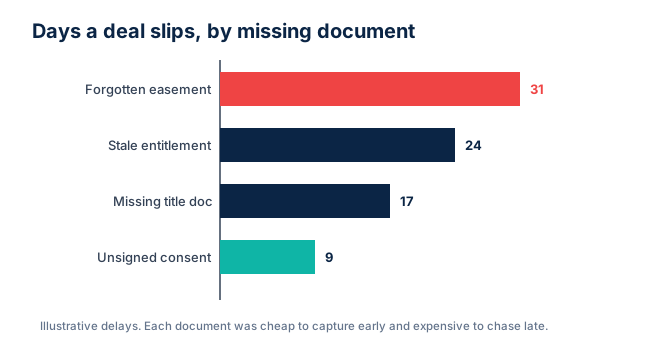
Easements and encumbrances. The rights other parties hold over the land. A forgotten access easement discovered late does not just delay a deal — it can change what the land is worth.
Title and survey. The clean chain showing you own what you are selling, with boundaries that match the plan. A gap in the chain is a gap a title insurer will price or refuse.
Consents and signed agreements. Every party who had to say yes, on the record, in signed form. A handshake from two years ago is a story; the signed consent is the asset.
Notice that none of these are about the quality of the development. They are about whether the record of the development can survive a skeptical reading by someone whose job is to find the hole before their client steps in it.
Why the trail breaks, and when
The document trail almost never breaks at the closing. It breaks two years earlier, on an ordinary afternoon, when a condition is satisfied informally and nobody captures the proof, or a key agreement is signed and the executed copy is emailed once and never properly filed. The gap is invisible while the project moves forward, because everyone involved remembers. The gap becomes a crisis the moment the project tries to close and the people who remember are not the people the file has to convince.
This is why experienced developers are almost paranoid about capturing documents at the moment they are created. They know the executed easement, filed and indexed the day it is signed, costs nothing. The same easement, missing and chased during a financing deadline, can cost the deal. The price of a document is set entirely by when you go looking for it.
Close the deal you'll have in two years, today
The practical move is to keep the closing binder open from day one, not assemble it at the end. Every entitlement, easement, consent and title document gets filed into the deal's record the moment it exists, in current and executed form, where the next person can find and trust it. By the time a closing arrives, there is no scramble, because the file has been quietly closing the deal the entire time.
Run the test on a live project this week: pick the one document a lender would demand first, and try to produce it right now in clean, executed, current form. If you can, the trail is intact. If you hesitate, you have found the hole while it is still cheap to fix — which on a development deal is the only time fixing it is cheap. A system like XNM-VISION keeps that closing binder building itself in the background, but the habit of capturing the document the day it is signed is what actually saves the deal.
We dig into one of these document-trail failures every week in our records and accountability series. On a development project the pattern is brutally simple: the deal is only ever as good as the file behind it.