Governing on the Record: Why Metis Self-Government Runs on Records
A Metis government is a distinct thing - not a First Nation, not an Inuit organization, but a nation in its own right with its own history, citizens, and institutions. And across the Prairies and Ontario, those institutions are being built out in real time: citizenship registries with tens of thousands of citizens, democratically elected councils and district structures, and economic and social programs that move serious money through Metis hands. Recognition is the headline. The quieter, harder work underneath it is operational - and an operation, especially a young and fast-growing one, runs on records. Who is a citizen, who was elected, what was funded, what was delivered, and what was reported back: each is a record a Metis government has to be able to stand behind.
Self-government makes records load-bearing in a way advocacy never did. When a Metis nation governs its own citizenship, the registry is not a mailing list - it is the foundation of who votes, who is represented, and who is accountable to whom. When it runs housing, early-learning, health, and economic-development programs, the files behind them are how it proves to citizens that the benefit reached them and proves to funders that the dollars were used as agreed. And because these governments are scaling quickly, the institutional memory is being created now, in this generation of staff and councillors. A record kept well today is the operating history a Metis government will rely on for decades; a record kept poorly is a gap that compounds as the nation grows.
Recent context
The institutions are real and measurable. In Alberta, the Metis Nation transitioned to the Otipemisiwak Metis Government in September 2023 through what it described as the largest Indigenous leadership vote in Canadian history, with over 64,000 registered citizens, a province-wide President, and 22 elected district representatives. Citizenship, elections, and government operations are now matters of Metis jurisdiction - which means the registry, the electoral record, and the council record are the nation's own to keep, govern, and defend.
Metis-led programs make the record the proof
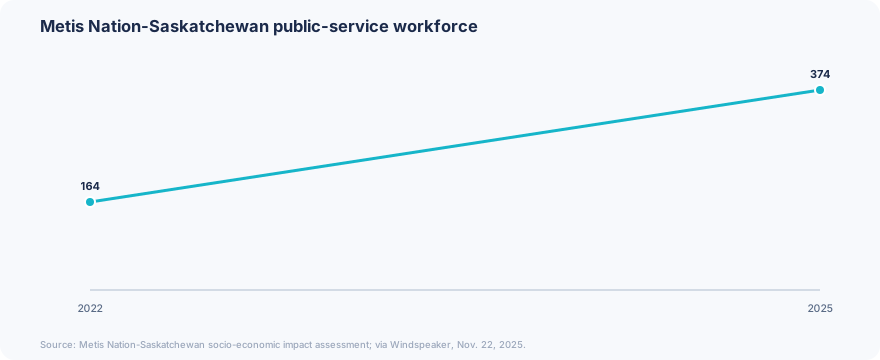
The economic footprint is just as concrete. A 2025 socio-economic assessment of Metis Nation-Saskatchewan found that $486 million in investment since 2017 generated about $740 million in economic activity across the province, supported more than 15,000 jobs, and produced an estimated $26.5 million in tax revenue - while its public service grew from 164 staff in 2022 to 374 in 2025. Behind those totals are 818 urgent home repairs, 729 first-time homebuyers supported, and programs reaching thousands of children and citizens. Every one of those numbers is a claim a Metis government makes to its citizens and to the funders who backed the work - and every claim is only as credible as the record beneath it. Self-government means that record is the nation's to own, not a contractor's to hold.
How XNM helps
XNM helps a Metis government pull its program and capital record into one auditable command centre it controls - program files and the outcomes they delivered, capital projects and their contracts and change orders, the funding agreements and the reports owed against them, and the trail tying each dollar to what it accomplished, kept current. Where it helps, the XNM-Vision platform gives a Metis government a single, sovereign line of sight across every program and project, so reporting to citizens and to funders draws on the same trustworthy record rather than a year-end reconstruction. Because the data and decisions stay with the nation, the institutional memory of a fast-growing government survives staff and council turnover. And because it stands up in days rather than the many months a records overhaul usually takes, the visibility is there for the programs running this year, not the ones after.
Practical takeaways
Treat the program record as governing infrastructure. A self-governing nation is judged by what it delivers; an out-of-date record weakens both accountability to citizens and the next funding case.
Tie every dollar to an outcome. Funders ask what the money did; build the record so each program's spend and its results - repairs, homebuyers, citizens served - live together, not in separate reports.
Design for fast growth and turnover. A public service that doubles in three years cannot keep its memory in a few people's heads; keep it in the nation's record so scale doesn't erase context.
Make citizen and funder reporting a by-product. Accountability runs in two directions; a current record lets a Metis government answer both without a special project each time.
Own the record as you own the jurisdiction. Self-government over citizenship and programs means owning their records - hold them where the nation, not a distant department or contractor, can see and prove them.
FAQ
Aren't Metis governments just like First Nations for records purposes?
No - and the distinction matters. Metis nations are a distinct people with their own governance traditions, their own citizenship criteria, and their own programs; treating their records as interchangeable with a First Nation's misses what self-government actually recognizes. The records discipline is similar in shape - a single, auditable, nation-controlled record - but the substance is the Metis nation's own, and it should be held and governed on Metis terms.
We already report to our funders. Isn't that the record?
A funder report is a snapshot built for someone else's question. The record is the living file underneath it - every program, decision, contract, and outcome - that lets a Metis government answer its own citizens too, and the next funder, without rebuilding from scratch. The report is the output; the record is what makes the output trustworthy and repeatable as the nation grows.
The bottom line
Metis self-government is a distinct achievement, and the record is part of what makes it real. The recognition is the milestone; the registries, the program files, and the funder reports behind them are how a Metis government proves to its citizens, its funders, and itself that the institutions work. You can only govern what you can see - and as a Metis nation builds its institutions, it should build the record to match.