The Change-Order Chain: Why Capital-Program Control Is a Records Discipline
On the day a capital program is approved, its budget looks like a single tidy number. It almost never stays that way. A differing site condition, a design clarification, an accelerated milestone, a scope addition the owner asked for in a meeting - each one moves money, and each one is supposed to leave a paper trail: a change directive, a price, an approval, a revised commitment. Multiply that across dozens of contracts and a multi-year schedule, and the real financial picture of a program is not the base contract value at all. It is the running chain of commitments, change orders, and spend - and whether anyone can still see the whole chain at once.
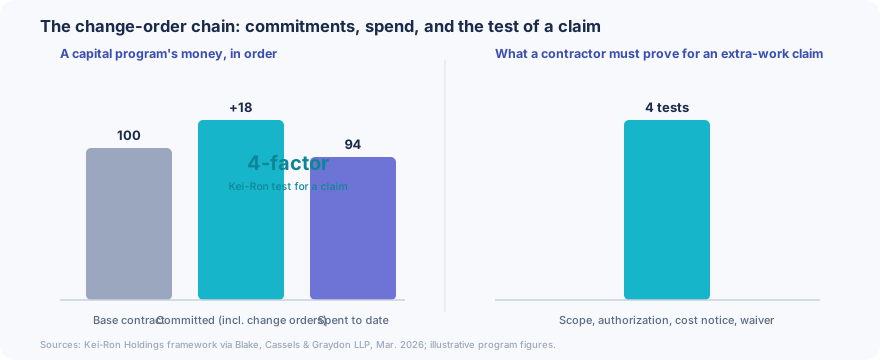
This is a cross-sector problem, not a construction-only one. A municipality renewing a water plant, a health authority building a hospital wing, a First Nation delivering housing, a university expanding a campus, a mining company sustaining its capital assets - all of them run the same chain. The base contract sets the floor; change orders raise the committed total; invoices draw it down; and somewhere a project controls lead has to reconcile committed against spent against budget, contract by contract, and answer the hard question when a contractor submits a claim: can we prove what was authorized, and what was not? When that record is scattered across email threads, PDFs, and a controls spreadsheet, the program is being run partly on memory - and memory does not hold up in a claim.
Recent context
The legal test for an extra-work claim is exacting, and it runs entirely on records. Writing in March 2026, Blake, Cassels & Graydon LLP set out the framework Canadian courts apply, drawn from Kei-Ron Holdings: a contractor claiming for extra work must show the work was genuinely beyond the original scope, that the owner expressly or implicitly authorized it, that the owner was aware it would increase costs, and whether the owner waived the written-change-order requirement. The firm's plain advice to contractors is to "maintain detailed accounts and records that clearly substantiate the costs" - labour, materials, equipment, and time impacts. For the owner, the same record is the defence.
Commitments, spend, and the cost of a thin record
The stakes are rising because the underlying costs are. RLB's Construction Cost Report for Canada, Q4 2025 put the national average year-over-year construction cost increase at about 4.39%, with several markets higher - Toronto near 5.29% and Calgary near 4.79% - and flagged a surge in institutional and governmental project intentions. When unit costs climb, the dollar value of every change order climbs with them, and a program that cannot reconcile committed against spent in something close to real time is exposed on both sides: it can over-commit without noticing, and it can lose a legitimate claim - or concede an illegitimate one - because the record is too thin to settle the question. The change-order chain is where capital programs quietly leak money, and the leak is almost always a records failure before it is a cost failure.
How XNM helps
XNM helps capital-program owners pull the whole money chain into one auditable command centre - base contracts, change directives and approved change orders with their pricing and authorization, the running committed total, invoices and spend reconciled against each commitment, and the supporting record behind every claim. Where it helps, the XNM-Vision platform lets a program director see committed-versus-spent across every contract at once, trace any change order back to the directive and approval that authorized it, and produce the substantiating record - labour, materials, equipment, time - the moment a claim arrives, rather than reconstructing it under pressure. Because capital projects and their records sit in one governed system, the program's financial picture stays current instead of being rebuilt for each board meeting. And because it stands up in days rather than the months a controls overhaul usually takes, the visibility is there for the change orders being approved this quarter.
Practical takeaways
Track the chain, not just the contract. The real number is base contract plus committed change orders minus spend; report all three together or the program is flying on a stale figure.
Tie every change order to its authorization. A change order without a traceable directive and approval is a future dispute; keep the price, the approval, and the reason in one place from the start.
Build the claim record before the claim. The Kei-Ron tests all ask for evidence; capture scope, authorization, cost notice, and correspondence as work happens, not when a demand lands.
Reconcile committed against spent continuously. Surprises live in the gap between what you have committed and what you have paid; close that gap monthly, not at year-end.
Keep one governed record across every contract. A program is many contracts; if each lives in its own silo, no one can see the whole exposure - put them under one auditable roof.
FAQ
We already use project-controls software. Isn't the chain handled?
Controls tools track the numbers; the gap is usually the evidence behind them. When a claim arrives, the question is not what the spreadsheet says - it is whether you can produce the directive, the approval, the correspondence, and the cost substantiation that prove what was authorized. The discipline is keeping the record and the numbers together, so the figure in the controls system is always backed by the file that defends it.
Does this matter if our projects rarely end up in disputes?
Yes - the same record that wins a dispute prevents most of them. A program where every change order is traceable and committed-versus-spent is always current rarely reaches a claim, because gaps get caught early and contractors know the owner can substantiate its position. The record is cheaper as prevention than as defence, and it earns its keep at every board meeting in between.
The bottom line
A capital program is not controlled at the contract; it is controlled along the chain - commitments, change orders, and spend, kept reconciled and provable from the first directive to the final claim. The owners who come through a hard cost cycle in the strongest position are not the ones with the fewest changes; they are the ones who can still see and prove every one of them. The work builds the asset; the record is what proves it was built, and paid for, on terms you can defend.