First in the Queue Is the One With the Cleanest File: Grid Connection as a Records Problem
For years, connecting a generator or a large load to the grid meant filing an application and waiting your turn in a first-come, first-served line. That model is breaking under the weight of demand. Data centres, electrification, new industry, and clean-power projects are all reaching for the same finite capacity, and grid operators are responding by triaging - allocating a limited amount of connection capacity to the projects that can prove they are ready. In that shift, the decisive asset is no longer your place in line. It is your record: the completed studies, the secured financing, and the local approvals that show your project can actually connect without breaking the system.
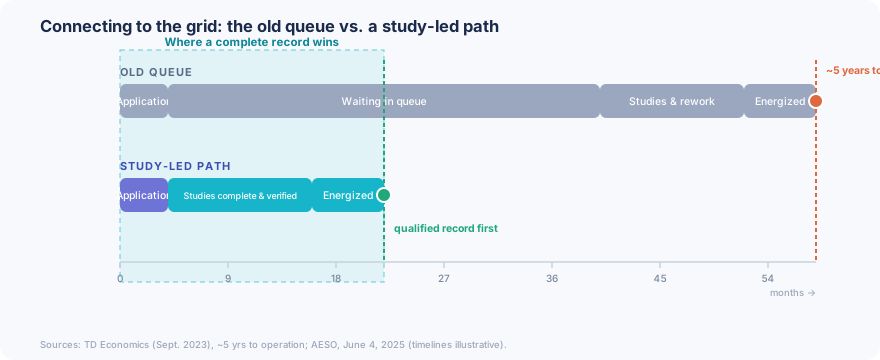
This reframes interconnection from a waiting game into a readiness test, and readiness is a documentation problem. A connection request is not a single form; it is a thick file that accumulates over years - power-flow and system-impact studies, environmental and siting evidence, financial security, municipal and stakeholder support, and the engineering that backs every assumption. When a grid operator caps available capacity and allocates it to qualified projects, the proponent who can produce a complete, current, verified record moves to the front, and the one still reconciling studies across consultants and inboxes falls behind. The queue has quietly become a contest of records, and most proponents are not organized to win it.
Recent context
Alberta made the shift explicit. The Alberta Electric System Operator announced on June 4, 2025, an interim approach capping new large-load connections - data centres and the like - at 1,200 MW through 2028, against 29 proposed projects representing more than 16 gigawatts of demand. To qualify for an allocation, a project needed completed power-flow studies confirming it would not require system reinforcement, plus financial security and municipal support. Capacity, in other words, went to the projects whose record was already done - not simply to whoever applied first.
The queue is now a contest of records
The stakes are measured in years. An analysis by TD Economics found that projects have historically taken roughly five years to move from a connection request to commercial operation, and that across one large North American sample only 14% of solar and 20% of wind projects that entered queues over a 17-year span were operating by the end of it. Most of that attrition is not a financing failure - it is projects that could not clear the studies and evidence the process demands, on the timeline it demands. As operators move from passive queues to active triage, the gap between a proponent with a complete, defensible study record and one without it stops being an inconvenience and becomes the difference between connecting and being passed over. The same record then carries forward into the regulatory and rate-recovery file the asset will answer to for decades.
How XNM helps
XNM helps utilities, independent power producers, and large-load developers pull the whole connection and regulatory record into one auditable command centre - power-flow and system-impact studies and their versions, environmental and siting evidence, financial-security and milestone documents, municipal and stakeholder approvals, and the conditions tied to each, organized by project and kept current. Where it helps, XNM-Vision makes a connection file producible on demand and keeps the full study trail behind it defensible, so a proponent meets an allocation window or a regulator's information request with a record that already holds together rather than a scramble across consultants and drives. Because the same governed record carries into the rate case and the compliance file the asset answers to for its life, the work done to qualify for connection keeps paying off. And because it stands up in days rather than the months a records overhaul usually takes, the visibility is there for the window that is open now.
Practical takeaways
Treat the study record as the asset that wins the queue. When capacity is triaged, the project that can prove readiness connects; a complete, verified study file is the proof.
Keep every study version, not just the latest. Connection and regulatory decisions turn on what was studied and when; the superseded versions are part of your evidence and have to survive.
Track conditions and milestones against the project. Allocations and approvals come with deadlines and conditions; keep them where the project is managed so none is missed under time pressure.
Build the connection file as the regulatory file. The record that qualifies you to connect is the same one a regulator and a rate case will ask for; build it once, defensibly, for the asset's whole life.
Assume an information request you cannot predict. Operators and regulators ask for the record on their schedule, not yours; keep it current so the answer is a query, not a reconstruction.
FAQ
Our engineering consultants hold the studies. Isn't the record already handled?
Consultants hold their piece, study by study; the gap is the whole file, current and reconciled, when an allocation window or a regulator asks for it at once. Studies scattered across firms and versions are a reconstruction waiting to happen under deadline. The discipline is governing the complete connection record - every study, its version, and the conditions around it - so the project can prove readiness on demand.
Does this only matter where there's a hard capacity cap?
The cap makes it visible, but the underlying shift is everywhere. Wherever demand outstrips easy capacity, operators move toward readiness-based triage, and regulators expect a defensible record behind every connection and every rate recovery. A complete study file shortens your path to connection today and stands behind the asset in front of the regulator for decades - whether or not your jurisdiction has announced a formal limit.
The bottom line
The grid-connection queue has turned from a line into a test, and the test is whether you can show your work. The projects that connect first are not always the ones that applied first; they are the ones whose record was already complete, verified, and defensible when capacity was allocated. The studies are the work; the record is the proof - and in a triaged queue, the proof is what moves you to the front.