Many Projects, One File: Portfolio Oversight for Owner-Operators
A developer who also owns and operates rarely has the luxury of one project at a time. At any given moment there is a building going up, two more in design, a dozen assets in operation, a refinancing in motion, and a capital plan that has to reconcile all of it. Each piece is manageable on its own. The difficulty is the portfolio: holding a single, trustworthy line of sight across many concurrent projects and long-held assets, when each one generates its own contracts, drawings, budgets, change orders, leases, and condition reports. The building is the easy part. The record across the buildings is where owner-operators quietly lose money and time.
The scale of what owner-operators carry is easy to underestimate. Investment in building construction in Canada runs into the tens of billions of dollars every quarter, and a single mid-sized owner-operator can have capital commitments spread across years and across assets it intends to hold for decades. That long horizon is the catch. A merchant builder can close the file when a project sells; an owner-operator never closes it - the building it puts up this year is a building it will be operating, renewing, and re-financing twenty years from now, and the record has to last that long. When the as-builts, the warranties, the reserve studies, and the original capital assumptions scatter across drives, inboxes, and departed staff, the owner is operating its own assets half-blind.
Recent context
The market is rewarding exactly this kind of discipline. RE/MAX Canada's 2026 Commercial Real Estate Report, released May 12, 2026, describes a market where capital is cautious and focused on preservation - disciplined money targeting quality, income-producing assets rather than speculative new starts. In that climate the advantage shifts to operators who can prove the condition and economics of what they already hold. Holding for income, not flipping for a quick gain, makes the long-term asset record the operating asset it always was.
The portfolio outgrows the record before any single project does
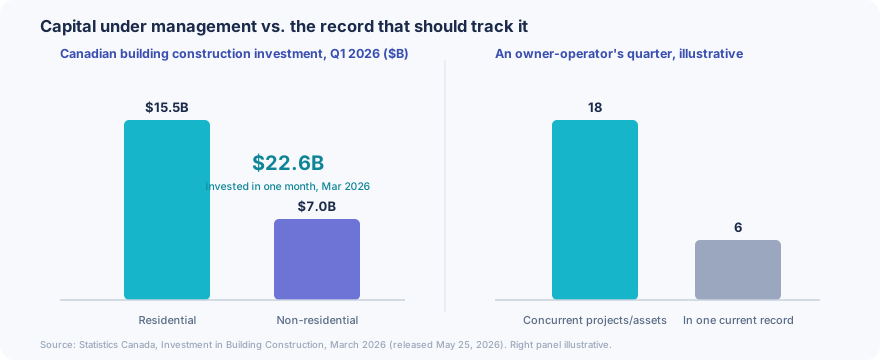
The flow of capital makes the point concrete. Statistics Canada reported that Canadians invested $22.6 billion in building construction in March 2026 alone - $15.5 billion residential and $7.0 billion non-residential - part of a first quarter near $69 billion. An owner-operator's slice of that does not arrive as one tidy project; it arrives as many overlapping ones, each with its own paperwork, on its own timeline. The failure mode is almost never a single building going wrong. It is the portfolio quietly outrunning the record: the capital plan built on last year's numbers, the asset whose warranty no one can find, the refinancing that stalls because the building's own file can't be produced on demand. By the time the gap shows, it shows everywhere at once.
How XNM helps
XNM helps developers and owner-operators pull the whole portfolio record into one auditable command centre - every project and asset, with its drawings and as-builts, contracts and change orders, budgets and draws, leases, warranties, reserve studies, and capital plans, organized and kept current. Where it helps, the XNM-Vision platform gives a principal a single line of sight across many concurrent projects and long-held assets at once, so a capital decision, a refinancing, or an acquisition draws on the same trustworthy record rather than a scramble through drives and inboxes. Because the file follows the asset for its whole life, the building you put up this year is still legible to the team operating it decades from now. And because it stands up in days rather than the months a records overhaul usually takes, the visibility is there for the portfolio you are running this quarter, not the next one.
Practical takeaways
Manage the portfolio, not just the project. Any one building is easy to track; the value leaks in the gaps between them - keep one record across all concurrent projects and assets.
Build the long-term asset file from day one. An owner-operator holds for decades; capture as-builts, warranties, and reserve assumptions while the project is live, not when you go to refinance.
Make any asset's file producible on demand. Refinancings, acquisitions, and insurance reviews all ask the same thing - show me the building - so the answer should be one query, not a week of searching.
Keep the capital plan on the same record as the work. A plan built on last year's scattered numbers misallocates capital; tie the plan to the live record so priorities reflect actual condition and spend.
Design for staff turnover. Decades of asset context shouldn't live in one person's inbox - hold it in the portfolio record so a departure doesn't blind the operation.
FAQ
We use project management software on each build. Isn't the record already handled?
Project tools hold one build while it is live and tend to go quiet once it closes. The owner-operator's gap is the opposite: it shows up across many projects at once, and across the decades an asset is held after construction ends. The discipline is not just running each project but governing the whole portfolio record so any asset's file stays complete, current, and producible long after the project team has moved on.
Does this matter for an operator that isn't actively building?
Yes - a held asset still has a record that decides what it's worth. Every refinancing, insurance renewal, capital decision, and eventual sale runs on the file: the condition, the history, the reserve study, the original capital assumptions. An operator that can produce a clean record for any asset on demand carries less risk into every transaction and makes better capital calls, building or not.
The bottom line
For an owner-operator, the project is never the whole job - the portfolio is. The buildings come and go from active construction, but the records behind them have to last as long as the assets do, and stay legible across every refinancing, renewal, and handover in between. The operators who come out ahead are not the ones with the cleverest single deal; they are the ones who can see their whole portfolio clearly, on demand. You can only steward what you can see - and an owner-operator has a lot to keep in view at once.