Own the Capital, Own the Record: First Nations Development Corporations and the Files Behind the Money
A First Nation development corporation today can do what was nearly impossible a generation ago: borrow at competitive rates to build the infrastructure, housing, and revenue-generating assets its community needs, on its own terms. The capital is real and it is large. But every dollar borrowed against a Nation's own-source revenue rests on a record - of the revenue that secures the loan, the projects the money builds, and the financial management that lets a lender and a community trust both. Owning the capital means owning the record behind it. The two arrive together, and a Nation that controls one has to be able to produce the other.
Self-determined financing changes the nature of a record. When a community's capital comes as a transfer someone else administers, the files describe a program run from outside. When the community raises and repays its own capital - through its development corporation, secured by its own revenue - those same files become the operating memory of a nation's economy: which projects were built, at what cost, against which revenue stream, under which loan, and how each is performing years later. The financial statements, the project records, the revenue ledgers, and the borrowing agreements stop being someone else's paperwork and become the community's own institutional record. That record is an asset, and like any asset it can be stewarded or it can quietly decay - except here, its condition directly affects the cost of the next loan.
Recent context
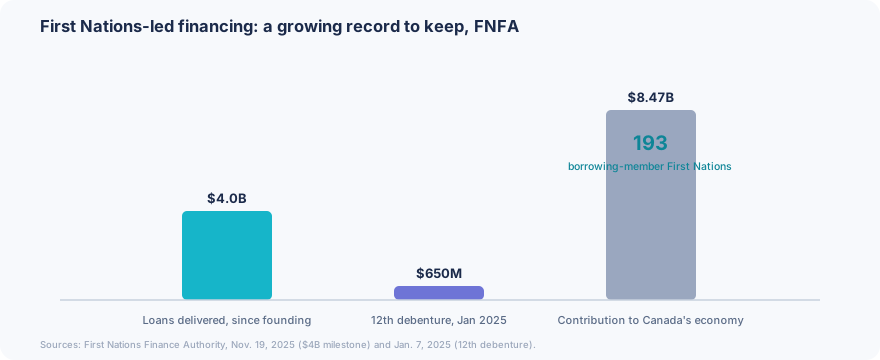
The scale of First Nations-led capital is no longer marginal. The First Nations Finance Authority announced in November 2025 that it had surpassed $4 billion in loans to borrowing-member Nations since its founding, contributing an estimated $8.47 billion to Canada's economy and helping create more than 39,000 jobs - all through a pooled-borrowing model that raises capital on markets and lends it on to member Nations at rates a single community could not get alone. It is, in its president's words, the only First Nation-led organization in the world leveraging private capital this way.
Own-source revenue makes the record a community asset
The borrowing is steady and growing. The FNFA's 12th debenture, issued in January 2025, raised $650 million at a rate well below prime, on a loan portfolio then exceeding $3 billion across a growing roster of member Nations. What makes this model work is that each loan is secured against a Nation's own-source revenue - taxation, business income, resource and economic-development earnings - rather than a federal transfer. That is genuine fiscal self-determination, and it puts the records at the center. To borrow against your own revenue, you have to be able to prove that revenue, account for what the capital built, and keep financial management strong enough that the next lender, and your own members, can trust the picture. Sovereignty over capital is only as real as the community's ability to see and prove its own financial record.
How XNM helps
XNM helps First Nation governments and development corporations pull the whole capital and financial record into one auditable command centre they control - project files and asset registers, contracts and change orders, the own-source-revenue ledgers that secure borrowing, loan and reporting obligations, and the financial-management record a certification or a lender relies on, kept current. Where it helps, the XNM-Vision platform gives a development-corporation CEO and a finance director a single, sovereign line of sight across projects and revenue at once, so reporting to members, to lenders, and to financial-management bodies draws on the same trustworthy record rather than a year-end reconstruction. Because the data and the decisions stay with the community, the institutional memory survives staff and council turnover. And because it stands up in days rather than the months a records overhaul usually takes, the visibility is there for the projects and the borrowing happening this year.
Practical takeaways
Treat the financial record as community infrastructure. Self-determined capital is only as strong as the record behind it; weak records raise the cost and the friction of every future loan.
Keep the revenue ledger and the project in the same place. Loans are secured against own-source revenue and tracked against what they build - keep both on one record so the security and the spend always reconcile.
Make the file producible for any lender or certification on demand. Borrowing and financial-management certification ask the same thing: show me the numbers and the controls. Build the record so the answer is one query.
Design for council and staff turnover. Elected terms and staff moves shouldn't erase financial memory; keep it with the corporation so a transition doesn't reset the institution's knowledge.
Own the data as you own the capital. Fiscal self-determination means holding the record where the community - not a distant department - can see, prove, and act on it.
FAQ
Our development corporation is audited every year. Isn't that the record?
An annual audit is a snapshot built to a standard, once a year. The record is the living file underneath it - every project, contract, revenue stream, and loan obligation - that lets you answer a lender's question mid-year, brief a new council, and prepare the next audit without rebuilding from scratch. The audit is an output; the record is what makes the output trustworthy, current, and repeatable between audits.
We're a small corporation with a lean team. Isn't this just more administration?
It is less, not more, once the record is in one place. The administrative weight today is in the year-end scramble, the search for last year's numbers when a lender calls, and the rebuild every time a council or a finance lead changes. A single current record removes those frictions, so a lean team spends its time on projects and revenue rather than reassembling its own financial history.
The bottom line
First Nations financing their own capital projects, secured by their own revenue, is a milestone in fiscal self-determination - and the record is part of what makes it real and keeps it affordable. The projects are the goal; the file behind them is how a community proves to its members, its lenders, and itself that the capital was raised, spent, and repaid well. You can only steward what you can see - and as the capital comes home, so should the record.