The Scanner Has a File: Aging Equipment, Recalls, and the Health Authority's Records Problem
A hospital board signs off on a multi-year capital plan, a biomedical engineering team schedules preventive maintenance across thousands of devices, and a recall notice arrives for an infusion pump model in use on three wards. Each of those moments depends on the same thing: a current, trustworthy record of what equipment the organization owns, how old it is, where it sits, when it was last serviced, and which units are affected by which notice. The clinical fleet is not just medicine in action - it is a portfolio of capital assets, each with a service history, a warranty, a maintenance log, and a recall exposure. And a health authority can only plan, maintain, and prove the safety of equipment it can actually see in its records.
That visibility is getting harder to take for granted. Diagnostic and therapeutic equipment is expensive, long-lived, and increasingly aged, which means more devices are simultaneously due for maintenance, due for replacement, and old enough to carry legacy recall and parts-availability risk. At the same time, the rules around recalls have tightened, and they run on the quality of the record. When a device is withdrawn, the question is immediate and unforgiving: exactly which units do we have, where are they, and who needs to be told today. An organization that answers from a spreadsheet last reconciled months ago is answering a patient-safety question with stale data.
Recent context
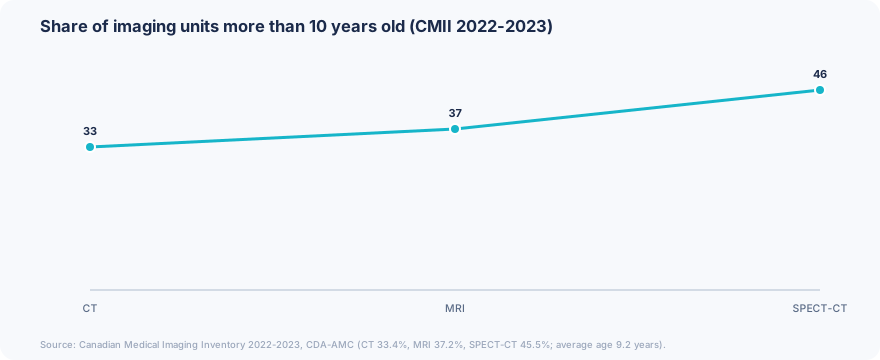
The aging trend is documented. The Canadian Medical Imaging Inventory 2022-2023 found that 33.4% of CT units, 37.2% of MRI units, and 45.5% of SPECT-CT units in Canada were more than 10 years old, with the average age of imaging equipment reaching 9.2 years - the oldest in two decades of tracking. The inventory exists precisely to inform capital planning and replacement strategies, and it counts 560 CT and 432 MRI units nationally. An aging fleet doesn't just raise replacement cost; it raises the share of devices carrying long service histories that someone has to keep straight.
Recalls turned the record into a safety obligation
Tighter recall rules raise the stakes on traceability. Under amendments that came into force on December 14, 2024, manufacturers must notify Health Canada within 24 hours of a Type I or II recall decision, submit an initial report on or before the recall day listing the quantity of affected units and who was sold them, and file a final report within 30 days. Records of the reason, the actions taken, and the outcomes must be kept for the device's projected useful life plus two years. For the hospitals on the receiving end, that regime only works if their own internal record can immediately answer the same questions - which units, where, in what condition - without a manual hunt across departments.
How XNM helps
XNM helps health authorities and hospital boards pull the whole clinical-asset and capital record into one auditable command centre - the equipment inventory and its age, location, and condition; service and preventive-maintenance histories; warranties and contracts; the capital plan and its change orders; and recall notices matched to the exact units affected, kept current. Where it helps, the XNM-Vision platform gives a biomedical or capital-planning lead a single line of sight across the fleet, so a replacement decision, a maintenance schedule, and a recall response all draw on the same record rather than a reconciliation scramble. Because the record stays governed and time-stamped, an audit, a board question, or a safety notice meets a file, not a search. And because it stands up in days rather than the many months a records overhaul usually takes, the visibility is there for this year's capital cycle, not the next.
Practical takeaways
Treat the equipment record as a patient-safety asset. A recall response is only as fast as your inventory is current; an out-of-date fleet record turns a safety notice into a manual hunt across wards.
Keep age, service, and recall status in one place. Capital planning, maintenance, and recall traceability all ask about the same devices - hold them in one record so each answer reinforces the others.
Match retention to the device, not the calendar. Recall records run to a device's useful life plus two years; let the record track each unit's clock so nothing is purged early or lost.
Make the board's capital question answerable on demand. An aging fleet forces hard replacement choices; a current record lets a board see what is due, what it costs, and what the risk is without a special data pull.
Reconcile continuously, not at year-end. A fleet record reconciled months ago is stale the moment a recall lands - keep it current so the safety answer is always the live one.
FAQ
Our biomedical team already tracks equipment in its own system. Isn't the record handled?
A maintenance system holds the service view; the gap shows up when capital planning, finance, contracts, and recall response all need the same devices reconciled together. The discipline is not just logging service but governing the whole asset record - age, location, warranty, contract, and recall status - so any of it is complete and producible the moment a board, an auditor, or a safety notice asks.
We rarely get recalls. Is this worth the effort?
The effort pays off long before a recall. The same record that answers a recall in minutes is the one that drives the capital plan, schedules preventive maintenance, and survives an inspection. A recall is the stress test; the day-to-day value is a fleet you can plan and maintain from one trustworthy view rather than a patchwork of spreadsheets and departmental systems.
The bottom line
An aging clinical fleet and a tighter recall regime have turned the equipment record from back-office bookkeeping into a safety and capital obligation. The machines deliver the care; the file behind them is how a health authority proves it can plan, maintain, and recall safely. You can only steward what you can see - and in a hospital, what you cannot see in your records is exactly what becomes a problem when a notice arrives.