The Portfolio Is Only as Accountable as Its Record: Capital Oversight at Provincial Agencies and Crown Corporations
A provincial infrastructure agency or Crown corporation sits at a peculiar pressure point. It carries a portfolio of capital projects worth tens of billions of dollars - hospitals, transit, courthouses, highways, long-term care - on behalf of a government and, ultimately, the public. It answers to a board, to a minister, to the legislature, and to a provincial Auditor General whose findings are tabled in public. And it does all of this across dozens of concurrent projects, each spanning years, each generating permits, drawings, contracts, change orders, and approvals that have to be defensible long after the people who created them have moved on. At that scale, oversight is a records problem before it is anything else.
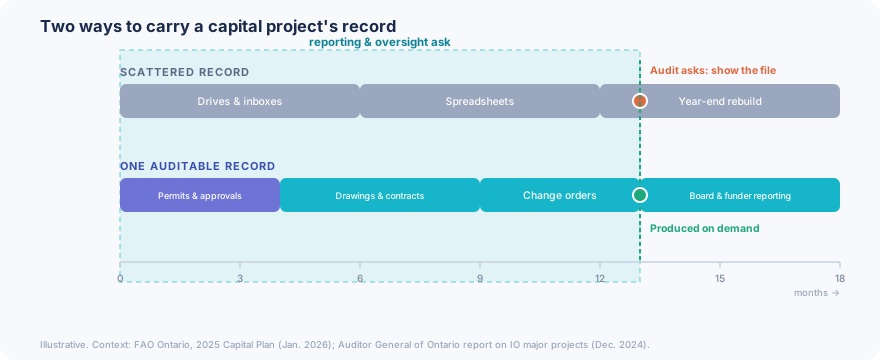
The accountability is structural, not occasional. A Crown corporation's whole reason for being is to deliver public value at arm's length while remaining answerable for every dollar. That answerability runs on records: the business case behind a project, the procurement file, the contract and its amendments, the change orders that moved the budget, the board minutes that approved them, and the reporting back to government. When those records are scattered across drives, inboxes, and a patchwork of spreadsheets, the organization is carrying a hidden liability - because the moment an auditor, a board, or a journalist asks to see how a decision was made, the answer has to be reconstructed under pressure rather than simply produced.
Recent context
The scale of provincial capital is enormous and rising. Ontario's Financial Accountability Office, in its review of the province's 2025 capital plan released in January 2026, put the 10-year plan at $223.1 billion, with $94.9 billion - roughly 43% - going to renewal and modernization of existing assets, and health and transit each accounting for about 27% of the total. A portfolio that large, delivered through agencies and Crown corporations, generates a volume of records that no binder or shared drive was designed to govern.
Oversight turns the record into evidence
Independent oversight makes the quality of that record a live question. In December 2024, the Auditor General of Ontario released a report on Infrastructure Ontario's major projects; in its response, Infrastructure Ontario noted it accepted all the recommendations and pointed to roughly $47 billion in contracts then under construction. Whatever the specific findings of any one audit, the pattern is constant: an auditor's job is to test whether the decisions, costs, and outcomes on a project are supported by the record. A cost increase that is fully documented - approved, minuted, traceable to a change order - is an explainable event. The same increase with a gap in the file is a finding. The difference between the two is not the spending; it is the record behind it.
How XNM helps
XNM helps provincial agencies and Crown corporations pull a whole capital portfolio into one auditable command centre - every project's business case, permits and approvals, drawings, contracts and amendments, change orders, board and committee decisions, and the reporting that ties them to government, organized by project and kept current. Where it helps, the XNM-Vision platform gives an executive a single line of sight across the portfolio and makes any project's file producible on demand, with the full trail intact - so an audit, a board question, or a freedom-of-information request is answered from the record rather than a scramble. XNM the firm brings the governance and delivery discipline to set it up, and because it stands up in days rather than the many months a records overhaul usually takes, the visibility is there for the projects in flight now.
Practical takeaways
Treat the record as part of the asset. A public capital asset comes with an obligation to account for it; an incomplete project file weakens both oversight and the next budget submission.
Build for the audit you can't schedule. Auditors, boards, and access requests arrive on their own timing - keep the record so any project file is producible on demand, not reconstructed under deadline.
Keep the decision and its evidence together. A change order, the approval behind it, and the board minute that authorized it belong in one traceable place - that chain is what turns a cost increase into an explainable event.
Govern the whole portfolio, not one project at a time. Oversight asks portfolio-level questions; a record that spans every project lets you answer them without stitching dozens of systems together.
Make government reporting a by-product. Answerability to a minister and the legislature is constant - a current record lets the agency report without a quarterly fire drill.
FAQ
We already have project management systems. Isn't the record handled?
Project tools run the work; the gap shows up across projects, across years, and across an audit - when files have to be produced together, decisions traced to their approvals, and the whole portfolio answered for at once. The discipline is not just managing each project but governing the record so any of it is complete, traceable, and producible when oversight asks. That is a different job from scheduling and budgeting a single build.
Does this matter between audits?
Yes - the same record that survives an audit serves the organization every day. Board reporting, government submissions, access-to-information requests, and the handover when a project lead changes all draw on the same file. An agency that keeps the record current isn't preparing for the next audit so much as removing the scramble from everything else it has to do in the meantime.
The bottom line
Provincial agencies and Crown corporations are trusted with some of the largest capital portfolios in the country, and that trust is measured in public, through independent audit. The projects are the mandate; the record behind them is how the organization proves to its board, its government, and the public that the work was delivered well and accountably. A portfolio is only as accountable as its record - and at this scale, the record has to be one you can actually see.