Self-Government Builds the Record: Why Inuit Housing in Nunavut Is a Records Mandate
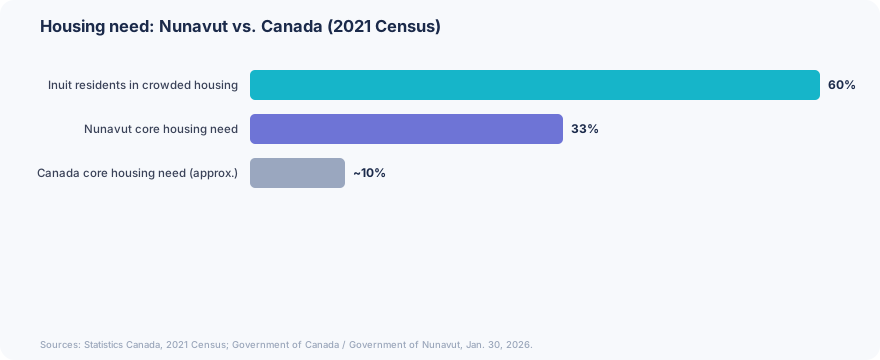
On January 30, 2026, Canada and the Government of Nunavut signed an agreement in principle to deliver up to 750 homes across the territory - public, affordable, and supportive - with Build Canada Homes putting in up to $250 million and Nunavut up to $230 million. Twenty-five of those homes will be delivered and managed by Nunavut Tunngavik Incorporated through the newly launched, Inuit-led Igluvut Corporation. The headline is the housing, and in a territory where roughly a third of households are in core housing need, every unit matters. The quieter story is who now holds the record behind those homes - and increasingly, the answer is Inuit organizations themselves.
Self-government changes the nature of a record. When housing is delivered for a community, the files describe a program someone else runs. When housing is delivered by the community - through its own treaty organization and its own housing corporation - those same files become the operating memory of a nation: which homes were built, where, for whom, at what cost, under which funding agreement, and in what condition years later. As authority moves to Inuit institutions, the as-builts, the allocation decisions, the maintenance histories, the grant agreements, and the reporting back to members stop being someone else's paperwork and become the community's own institutional record. That record is an asset, and like any asset it can be stewarded or it can quietly decay.
Recent context
The shift to Inuit-led delivery is already underway. Canada and Nunavut announced on January 30, 2026 an agreement to build up to 750 homes, with up to 30% using factory-built components to beat the territory's short construction season, and with Inuit self-determination built in through the Igluvut Corporation and the Inuit Nunangat Policy. It follows the Budget 2022 commitment of $845.1 million over seven years in distinctions-based Inuit housing, delivered directly to Inuit Treaty Organizations through flexible grant agreements that let Inuit decide how homes get built.
Self-determination makes the record an Inuit asset
Flexible, distinctions-based funding is a real gain - it lets Inuit partners design housing that fits the land, the climate, and the community rather than a template written in Ottawa. But that same flexibility raises the stakes on the record. When you control the design and the dollars, you also own the accounting: the report to your own members on what was built and what it cost, the file a funder will ask to see, and the institutional memory that lets the next housing manager pick up where the last one left off. In small organizations carrying large mandates, that memory too often lives in one or two people's heads and a scatter of spreadsheets and email. When a key staffer leaves, a community can lose years of context on its own homes. Sovereignty over housing is only as real as the community's ability to see and prove its own record.
How XNM helps
XNM helps Inuit and First Nations housing organizations pull the whole housing and capital record into one auditable command centre they control - unit inventories and conditions, allocation and tenancy decisions, as-builts and warranties, contracts and change orders, and the funding agreements and reports that tie them together, kept current. Where it helps, the XNM-Vision platform gives a housing director a single, sovereign line of sight across the portfolio, so reporting to members and to funders draws on the same trustworthy record rather than a year-end scramble. Because the data and the decisions stay with the community, the institutional memory survives staff turnover. And because it stands up in days rather than the many months a records overhaul usually takes, the visibility is there for the homes being built this season, not the ones after.
Practical takeaways
Treat the housing record as community infrastructure. Self-determined housing is only as durable as the record behind it; an out-of-date inventory weakens both stewardship and the next funding case.
Keep the funding agreement and the build in the same place. Distinctions-based grants come with reporting; build the record where the report is already half-written, not in a binder reconstructed each year.
Design for staff turnover from day one. In a small organization, the record is the institutional memory - keep it with the community so a departure doesn't erase years of context.
Make member reporting a by-product, not a project. Accountability to members is the heart of self-government; a current record lets you show what was built and what it cost without a special effort.
Own the data as you own the homes. Sovereignty over housing means sovereignty over its record - hold it where the community, not a contractor or a distant department, can see and prove it.
FAQ
We already report to our funders. Isn't that the record?
A funder report is a snapshot built for someone else's question. The record is the living file underneath it - every unit, decision, contract, and condition - that lets you answer your own members' questions too, and the next funder's, without rebuilding from scratch. The report is the output; the record is what makes the output trustworthy and repeatable.
Isn't this just more administration for a small team?
It is less, not more, once the record is in one place. The administrative weight today is in the year-end scramble, the search for last year's numbers, and the rebuild every time someone leaves. A single current record removes those frictions, so a small team spends its time on housing rather than on reassembling its own history.
The bottom line
Inuit-led housing in Nunavut is a milestone in self-determination, and the record is part of what makes it real. The homes are the goal; the file behind them is how a community proves to its members, its funders, and itself that the homes were built, well and accountably. You can only steward what you can see - and as authority comes home, so should the record.