Your Records Are Your AI Strategy: Why Law Firms Can't Automate a Mess

Almost every law firm in Canada is now reaching for AI to speed up research and document review. The catch that rarely makes the pitch deck is simple: an AI tool is only as good as the records you point it at - and most firms' records are spread across a document management system, two or three generations of shared drives, partners' inboxes, and boxes of closed files in storage. You cannot automate a mess. You can only automate a clean record.
A law firm's core asset is its matter file - pleadings, contracts, correspondence, advice, and the chain of who decided what and when. That file already has to do triple duty: serve the client, satisfy the regulator's confidentiality and retention rules, and stand up years later if a claim arrives. When the file is fragmented, every one of those jobs gets harder. And now there is a fourth demand on it - feeding AI tools without leaking privilege. The firms that struggle with AI are usually the ones that were already struggling to find their own files.
Recent context
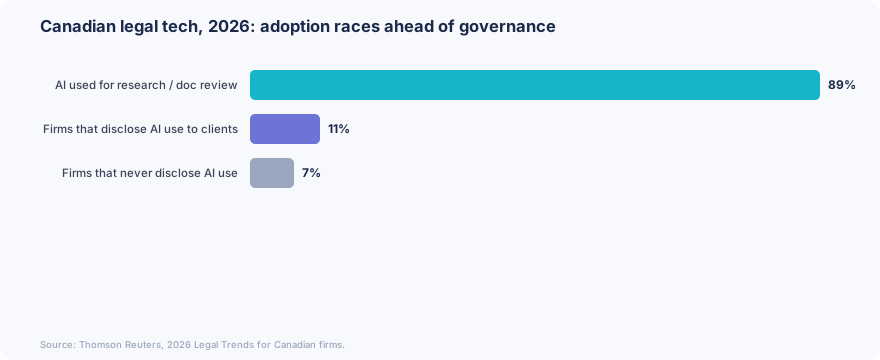
The adoption curve is steep. A March 2026 analysis of Canadian legal trends by Thomson Reuters reported that 89% of firms have begun piloting or fully integrated AI for research and document review - yet only 11% actively tell clients when they use it, 7% never disclose it at all, and lawyers' leading worries are accuracy and the confidentiality risk of pushing sensitive material through AI tools. Adoption is racing ahead of governance.
The foundation problem
Here is the uncomfortable part: the upside and the risk of AI rest on exactly the same foundation - a single, governed, access-controlled record of every matter. Point an AI assistant at a clean matter file and it summarizes, drafts, and surfaces precedent quickly and safely. Point it at scattered drives and you get fabricated citations, leaked privilege, and no audit trail of what it touched. The same foundation answers the other demands on the file. LawPRO notes that real-estate and family-law claims can surface decades after the work was done, and law firms - real-estate practices especially - are sought-after targets for cybercrime. A matter record that is fragmented cannot reliably be retained for the long tail, secured against a breach, or trusted by an AI tool. The firms getting real value from AI are the ones that fixed their records first.
How XNM helps
XNM helps firms build the foundation under all of it - one matter-based command centre where every document, email, and decision for a file lives together, access-controlled and retention-aware. Where it helps, XNM-Vision keeps the record audit-ready and secure, so the firm can adopt AI on a clean base, answer a Law Society inquiry without a scramble, and defend a claim years later with the file intact. The point is not to add another tool on top of the chaos; it is to give the firm the governed record that every tool, regulator, and client question depends on - and to do it in days, not the months a records project usually drags into.
Practical takeaways
Fix the record before you scale AI. An assistant pointed at scattered files multiplies risk; pointed at a clean matter record, it multiplies value.
File by matter, not by drive. Everything for a file in one place is the difference between answering a question and reconstructing it from fragments.
Make retention a system, not a habit. Claims can surface decades later; your retention rules should run automatically, not depend on someone remembering them.
Treat confidentiality as access control. Who can open which matter should be a setting you can prove, not a matter of trust.
Keep an audit trail of AI use. If a tool touched a file, the record should show what it touched and when.
FAQ
We already have a document management system. Isn't that enough?
A DMS stores documents; it does not always give you one governed record per matter with access control, retention, and an audit trail that an AI tool and a regulator can both rely on. The gap most firms hit is governance, not storage - and that gap is exactly where AI and cyber risk concentrate.
Can't we just adopt AI now and sort out the records later?
That is the expensive order to do it in. AI on a fragmented base bakes in the confidentiality and accuracy risks the survey flags, and you pay to unwind them later. Cleaning the record first is what makes adoption safe and the value real.
The bottom line
The firms winning with AI are not the ones with the flashiest tool; they are the ones whose records were ready for it. A governed, matter-based record is what makes AI safe to use, a regulator's question easy to answer, and a claim defensible years on. Before it is an AI strategy, it is a records strategy - and the order matters.