Doubling the Grid Means Doubling the Paperwork: The Records Test Behind Canada's Electricity Buildout

Canada has just committed to the largest electricity buildout in its history - and the quiet truth of that commitment is that it is also the largest records project in its history. Doubling generation and stringing new transmission across the country does not only pour concrete and raise towers. It generates an avalanche of paper: land agreements and easements, environmental permits, interconnection contracts, engineering drawings, equipment certifications, and inspection logs - each of which has to be found, trusted, and defended not for the duration of the project but for the 40-year operating life of the asset it documents.
Energy and utility companies already run some of the most records-intensive capital programs in the country, and they are about to run far more of them at once. A transmission line is a chain of documents as much as a chain of steel: every span sits on a negotiated right-of-way, every interconnection rests on a signed agreement, every in-service date depends on an inspection record a regulator can demand years later. When those records are scattered across consultants' servers, project inboxes, and a decade of shared drives, the utility loses the one thing a buildout at this speed most requires - a current, defensible line of sight from every asset to the documents that authorized and certified it.
Recent context
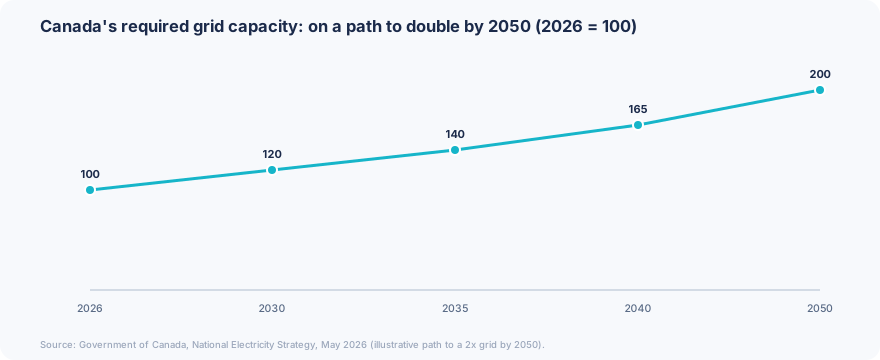
The scale is now national policy. On May 14, 2026, the Prime Minister announced a forthcoming National Electricity Strategy to double Canada's electricity generation capacity by 2050, connect the fragmented East-West-North grids, and train more than 130,000 skilled workers - alongside provincial plans of comparable ambition, including BC Hydro's roughly $36-billion ten-year capital plan and Hydro-Quebec's Action Plan 2035. The construction is the visible half of that promise; the record-keeping is the half that decides whether it holds up.
What a buildout is actually made of
A grid expansion is not one project but a portfolio of them, running in parallel, each spawning its own documentary trail and each feeding a single regulated asset base. The risk is not that any one drawing goes missing; it is that the volume outruns the system that is supposed to hold it. Easements expire and have to be renewed. Interconnection terms get amended. An inspection finding on one segment changes the maintenance obligation on another. At portfolio scale, the running total of these obligations is impossible to govern from email - and a utility that cannot produce the record on demand is a utility exposed in front of its regulator, its board, and its own future operators.
How XNM helps
XNM helps utilities bring the capital and asset record into one auditable command centre - permits, easements, interconnection agreements, drawings, certifications, and the dollars and dates they move, tied together and kept current across every project at once. Where it helps, the XNM-Vision platform gives delivery leaders a portfolio view across the whole program, so an expiring easement or an open inspection item surfaces before it becomes a schedule risk. When a regulator or a board asks what was approved, by whom, and when, the answer already exists - and because it deploys in days rather than the many months a records overhaul usually takes, the control arrives while the buildout is still being built.
Practical takeaways
Treat the record as a 40-year asset, not a project file. The drawings and permits you file this year will be demanded long after the project team has moved on.
Govern easements and permits as living obligations. An expired right-of-way or a lapsed permit can stop a line as surely as a supply shortage; track renewals automatically.
Give delivery one portfolio view. Running dozens of parallel projects from dozens of status decks is how obligations slip; one line of sight catches them early.
Keep the owner's record independent of contractors. Engineering firms and contractors rotate through; the institutional record of the asset must stay with the utility.
Make every asset audit-ready by default. Assume the regulator will ask, and keep the certification and inspection trail in a state where the answer is already there.
FAQ
We already have an asset management system. Isn't that enough?
An asset register tells you what you own; it does not always give you one governed record of the documents that authorized, permitted, and certified each asset, current and defensible on demand. The gap most utilities hit during a fast buildout is governance of the paper trail, not the asset list - and that gap is exactly where regulatory and schedule risk concentrate.
The buildout is decades long. Why fix records now?
Because the documents created in the first years are the ones hardest to reconstruct later, and the volume only grows. A record system put in place at the start governs the whole program; one bolted on at year ten inherits a decade of fragments.
The bottom line
A grid you double is a record you double. The energy and utility companies that deliver Canada's buildout on time will be the ones that treated the paperwork as seriously as the steel - every permit, easement, and certification in one place, current and defensible, for the life of the asset. Build fast, but build on a record you can find.