Faster Approvals Reward the Prepared: Why Mining's Permit Chain Is a Records Race

A mine is a permit chain before it is a hole in the ground. Between a deposit and first production lies a multi-year sequence of approvals - federal impact assessment, provincial permits, water and tailings authorizations, Indigenous consultation records, dozens of technical studies - each one resting on a body of evidence the proponent has to produce, defend, and keep current as conditions change. The deposit is the asset; the permit chain is the path to it, and that path is made of documents. Canada is now rewiring that path to run far faster, and the change quietly raises the bar on every proponent's records.
Mining companies already run some of the most document-heavy approval processes in the economy, often across a decade and dozens of agencies. The instinct is to treat the paperwork as friction to be endured. But when timelines compress, the paperwork becomes the constraint that decides who moves and who stalls. A regulator working to a two-year clock has no patience for a proponent who needs three months to assemble what should already exist. In a faster system, the company with the cleanest, most current evidence record is the company that gets to build.
Recent context
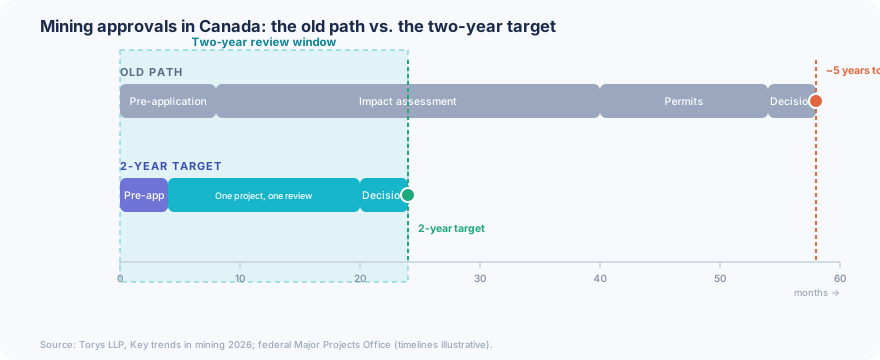
The acceleration is real and underway. Torys LLP's Key trends in mining 2026 describes a federal Major Projects Office created to streamline approvals, with five of thirteen initially referred projects being mining, alongside provincial reforms in British Columbia, Ontario and Quebec aimed at streamlined, single-window processes - and a federal target of completing major-project impact assessments within two years. BC, for its part, moved to process exploration permits within 40 to 140 days from April 2026. The direction is unmistakable: faster decisions, on the proponent's evidence.
Why speed favours the organized
Compressing a roughly five-year review into a two-year window does not reduce the evidence a mine must produce - it removes the buffer that used to absorb a disorganized file. Under the old timeline, a proponent could reconstruct a missing baseline study or chase down a consultation record while the clock ran slowly. Under a two-year target, that scramble is the difference between approval and delay. The permit chain also does not end at the decision: conditions must be tracked, monitoring commitments met, and the whole record kept audit-ready for the life of the mine. The proponents who thrive in the new system are not the ones with the best lawyers; they are the ones whose evidence record was complete, current, and instantly producible before the review even began.
How XNM helps
XNM helps mining companies bring the permit chain into one auditable command centre - impact-assessment evidence, technical studies, permits and their conditions, consultation records, and the commitments that follow approval, tied together and kept current across every project and agency. Where it helps, the XNM-Vision platform gives permitting and project leaders a single view of where every authorization stands and what evidence supports it, so a regulator's request meets a record that is already assembled rather than one chased down under a deadline. When an agency, a board, or an Indigenous partner asks what was committed and whether it was met, the answer already exists - and because it deploys in days rather than the months a records overhaul usually takes, the readiness is in place before the next review window opens.
Practical takeaways
Build the evidence record before the review, not during it. A two-year clock punishes assembly time; the file should be complete before the application is filed.
Track permit conditions as live obligations. Approval is the start of a commitment, not the end of the work; monitor and evidence every condition continuously.
Keep consultation records as carefully as technical studies. An incomplete consultation record can stall a project as surely as a missing geotechnical report.
Make every authorization traceable to its evidence. A permit you cannot link to the study that supports it is a gap waiting to surface in an audit or a challenge.
Treat the record as a life-of-mine asset. Conditions and commitments outlive the approval; the record must stay current for the operating life, not just the permitting phase.
FAQ
Faster approvals are good news. Why does this raise our risk?
Because speed only helps the prepared. A compressed timeline rewards proponents who can produce a complete record instantly and penalizes those who cannot - so the same reform that accelerates a ready company can strand a disorganized one. The reform does not lower the evidentiary bar; it removes the time that used to hide a weak record.
We use consultants to manage permitting. Isn't the record their job?
Consultants assemble pieces of it, but the record is the proponent's asset and the proponent's liability - across decades, multiple firms, and the operating life of the mine. When the institutional record lives only in rotating consultants' files, the company is one handoff away from a gap it will have to answer for itself.
The bottom line
Canada's move to faster mining approvals is a records race in disguise. The proponents who win it are the ones who treated the permit chain as the asset it is - every study, permit, condition, and commitment in one place, complete and current, before the clock even started. Speed rewards the prepared, and preparation is a record you can produce on demand.