Your Deliverable Is the Record: How Engineering Firms Scale Without Losing the Thread

For an engineering or architecture firm, the product is not the building - it is the record that produced it. Drawings, specifications, calculations, reports, change logs, and the sign-offs that make each one official: that documentary trail is what the client pays for, what the regulator relies on, and what a court examines if something goes wrong years later. A project-based firm lives or dies on the integrity of that record across many projects at once. And the firm is now being asked to produce far more of it, faster, than ever before.
The instinct in a busy firm is to treat document control as overhead - a drafting-room formality that slows the real work. But it is the real work. A drawing without clear version control is a liability; a specification no one can tie to the approval that authorized it is a gap; a deliverable trail that lives in one project lead's inbox is institutional memory waiting to walk out the door. When a firm scales into a generational pipeline, the projects multiply but the discipline does not automatically scale with them - and that is exactly when records failures turn into rework, disputes, and reputational risk.
Recent context
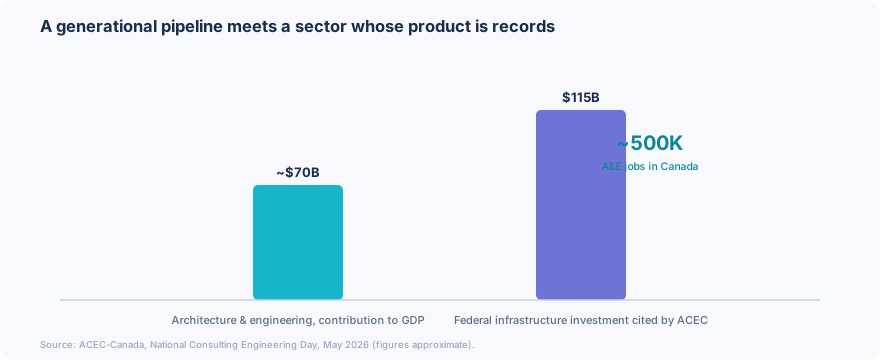
The opportunity is generational and the sector knows it. On National Consulting Engineering Day in May 2026, ACEC-Canada framed the moment as a chance to build with vision, citing an industry of nearly 500,000 jobs contributing close to $70 billion to the economy, aligned with about $115 billion in federal infrastructure investment, the Major Projects Office, and a proposed National Infrastructure Corridor. The work is there; the question for each firm is whether its delivery discipline can scale to meet it.
Why scaling exposes the record
Growth is the stress test of a firm's records. At ten projects, a capable team can hold the thread by memory and habit. At fifty, run in parallel with rotating staff and multiple sub-consultants, memory and habit fail - and the cracks show up as the wrong drawing revision issued to site, a change order missed in the deliverable set, a certification no one can locate when the client asks. The liability tail makes it worse: an engineering deliverable can be challenged a decade or more after it was issued, long after the project team has dispersed. The firms that scale cleanly are not the ones that work harder; they are the ones whose project record stays governed - versioned, traceable, and defensible - no matter how many projects run at once.
How XNM helps
XNM helps engineering and architecture firms keep the project record governed as they grow - one command centre where every drawing, specification, report, change log, and sign-off for a project lives together, version-controlled, access-aware, and retention-ready. Where it helps, the XNM-Vision platform gives principals a portfolio view across every concurrent project, so a firm can scale into the pipeline without the document discipline fraying, hand a clean record to the client at closeout, and stand behind a deliverable years later with the trail intact. The point is not another drafting tool; it is the governed record that protects the firm's quality, its margins, and its name - and it deploys in days, not the months a records project usually takes.
Practical takeaways
Treat the record as the deliverable. The drawings and reports are the product; govern them as carefully as you would any other thing you sell.
Make version control non-negotiable. The wrong revision issued to site is the most expensive records failure there is; one source of truth per drawing prevents it.
Tie every deliverable to its approval. A spec or report you cannot link to the sign-off that authorized it is a gap that surfaces in a dispute.
Scale the discipline before the headcount. Document control that works at ten projects must be designed to work at fifty before the projects arrive, not after.
Plan for the liability tail. Deliverables can be challenged a decade later; keep the project record defensible long after closeout, not just through delivery.
FAQ
We have a CAD and document management system. Isn't the record already controlled?
CAD and DMS tools manage files; they do not always give you one governed record per project tying drawings, specs, change logs, and sign-offs together with access control and a defensible audit trail. The gap firms hit at scale is governance and traceability across the whole project, not the storage of individual files.
Our projects are short. Why worry about a decades-long record?
Because the liability is not as short as the project. A deliverable issued today can be examined in a claim years after the team has moved on - and at that point the only thing standing behind the firm is the record. A short project can still carry a long tail.
The bottom line
A generational buildout is a generational volume of records, and for an engineering or architecture firm the record is the product. The firms that scale into the opportunity without losing the thread are the ones that governed their deliverables as carefully as they designed them - every drawing, spec, and sign-off versioned, traceable, and defensible, across every project at once. Grow the practice, but keep the record.