Building to Hold Changes the Record: Why Owner-Operators Need a 40-Year File, Not a Project Folder
A developer who builds to sell can afford a certain looseness with records. The file has to survive until closing; after that, it becomes someone else's problem. A developer who builds to hold cannot. When you intend to own and operate a building for thirty or forty years, every contract, warranty, drawing, and change order you create today is something you - not a buyer - will need to find, trust, and act on for decades. The shift now underway in Canadian real estate, from selling assets to holding them, is also a shift in what the record has to do.
Owner-operators and developers run portfolios of capital projects that each generate a dense documentary trail: acquisition and financing agreements, development pro formas, construction contracts and change orders, warranties, commissioning records, and the operating and compliance documents that begin the day the building opens. Across a portfolio of holds, that record is not back-office paperwork - it is the operating manual and the contractual memory of every asset you own. When it is scattered across deal folders, a builder's handover package, and a property manager's drive, the owner loses the one thing a long-term hold most requires: a current, defensible line from every asset to the documents that built and govern it.
Recent context
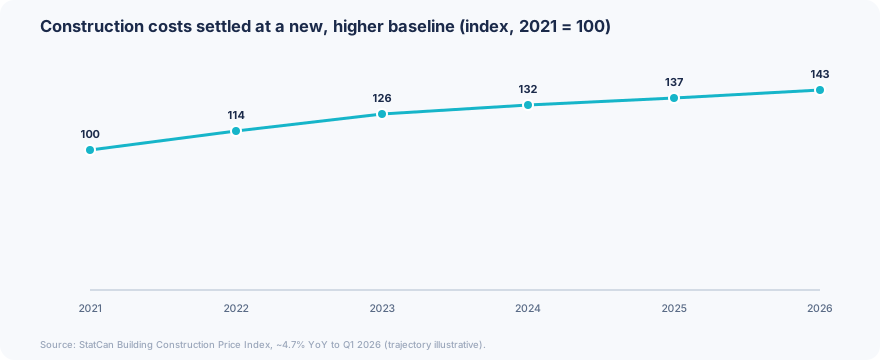
The strategic shift is well documented. A January 2026 analysis of how Canadian developers are building for 2026 describes a turn toward disciplined capital deployment, purpose-built rental, and long-term asset holds - with firms recapitalizing portfolios, integrating construction in-house for cost control, and measuring success by 'resident retention, operational performance, and durability over time' rather than a quick sale. Building costs have settled at a new, higher baseline, and the response is to own for the long run. Owning for the long run is a records discipline.
Why a hold is a records problem
The economics of a sale and a hold pull the record in opposite directions. A sale optimizes for the closing date: get the file good enough to transact, then move on. A hold optimizes for the life of the asset: the warranty you cannot find in year eight is a cost you eat, the change order you cannot trace is a dispute you lose, the commissioning record you misplaced is a system you re-diagnose from scratch. Multiply that across a portfolio of long-term holds and the difference between a governed record and a scattered one becomes the difference between a portfolio that operates efficiently and one that bleeds time and money on every building. The owner who treats the record as a 40-year asset protects the building's economics for its whole life.
How XNM helps
XNM helps developers and owner-operators bring the portfolio record into one auditable command centre - acquisition and financing agreements, construction contracts and change orders, warranties, commissioning records, and operating documents, tied together and kept current across every asset. Where it helps, the XNM-Vision platform gives ownership a portfolio view across every building, so a warranty, an obligation, or an open issue surfaces when it matters rather than when it fails. When a lender, a partner, or a buyer in a future refinancing asks for the file on an asset, the answer already exists - and because it deploys in days rather than the many months a records project usually takes, the discipline is in place across the hold, not reconstructed at sale.
Practical takeaways
Build the record for the hold, not the handover. If you intend to own the asset for decades, the file has to be one you can use for decades - not one good enough to close a sale.
Keep one record per asset, across its whole life. Acquisition, construction, warranty, and operating documents belong together, so year-ten questions start from what is known.
Treat warranties and obligations as live, not filed. A warranty you cannot find is a warranty you do not have; track them as commitments with dates, not as paper in a folder.
Give ownership one portfolio view. A portfolio of holds cannot be governed building-by-building from separate drives; one line of sight is how an owner stays ahead of cost.
Keep the owner's record independent of the builder's. The contractor hands over and leaves; the institutional record of the asset has to stay with the owner who lives with it.
FAQ
We have property management software. Isn't the building's record already covered?
Property management tools run day-to-day operations; they do not always hold one governed record tying the asset's construction history, contracts, warranties, and obligations to its operating life. The gap owners hit on a long hold is the connection between how the building was built and how it is run - exactly the link a project-to-operations handoff tends to break.
Some assets we may still sell. Why build a 40-year record for those?
Because a clean, complete record is also what makes a sale fast and a price defensible. A buyer pays more, and diligence runs faster, when the asset's file is whole. Building the record for the hold loses you nothing on the assets you sell - and protects the ones you keep.
The bottom line
Building to hold is a different business than building to sell, and it asks a different thing of the record. The developers and owner-operators who thrive on long-term holds are the ones who treat each asset's file as a 40-year record - every contract, warranty, and change order in one place, current and defensible for the life of the building. Own for the long run, and keep a record built to last as long as the asset.