From Consulted to Co-Owner: Why Equity in Major Projects Is Also a Records Responsibility

A decade ago, the question for a First Nation facing a pipeline, mine, or transmission line on its territory was whether it would be adequately consulted. Today, increasingly, the question is what share of the project it will own. That shift - from a seat at the consultation table to a stake on the balance sheet - is one of the most consequential changes in how major projects get built in Canada. And it carries a quieter consequence that rarely makes the announcement: a co-owner does not just share the returns; it shares the responsibility for the record that proves and protects the investment.
An equity stake in a major project is, in documentary terms, a transformation. As a consulted party, a nation's records were mostly about the engagement: correspondence, accommodation agreements, impact assessments. As a co-owner - holding 30%, 50%, even 100% - the nation inherits the full documentary weight of the project: financing and partnership agreements, the permit chain and its conditions, construction contracts and change orders, monitoring obligations, distributions and audit trails. The same records discipline that a developer or a Crown corporation needs to govern a capital project now lands on the nation's own development corporation - often a lean team taking on a multi-billion-dollar asset for the first time.
Recent context
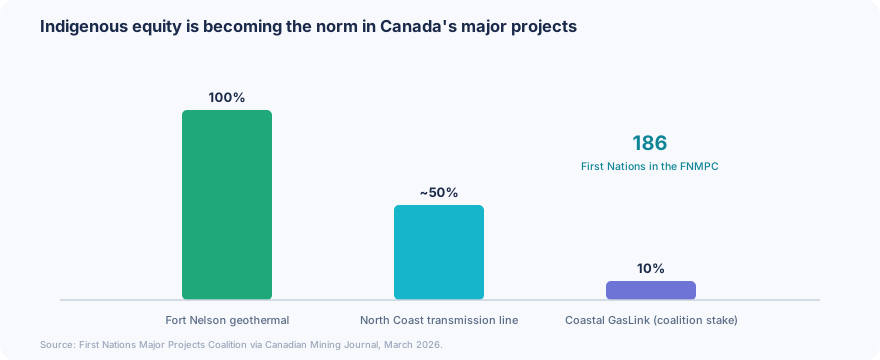
The shift to ownership is now explicit, and tied to delivery. In March 2026, the First Nations Major Projects Coalition argued that Indigenous equity can actually shorten permitting timelines by aligning community interests with a project's success - pointing to roughly 50% First Nations equity in Ontario transmission projects and the North Coast transmission line, a 100% Indigenous-owned geothermal project in Fort Nelson, and a collective stake in Coastal GasLink, with the Coalition now representing 186 First Nations. Ownership is becoming the norm, not the exception - and ownership is a records responsibility.
Why equity is a records responsibility
Ownership cuts both ways on the record. On the upside, a nation that holds and governs the project record well is a stronger partner and a faster one: when its books, permits, and obligations are in order, it can close financing, satisfy a regulator, and align with co-owners without becoming the bottleneck - which is exactly how equity speeds approvals rather than slowing them. On the downside, a co-owner that cannot produce its share of the record carries a co-owner's exposure: a missed monitoring obligation, an untracked condition, a distribution no one can reconcile. The move from consulted to co-owner is a move up in both reward and responsibility, and the record is where that responsibility is met or missed. Communities that build records capacity alongside their equity hold the asset with confidence; those that do not inherit a liability dressed as an opportunity.
How XNM helps
XNM helps First Nations, development corporations, and their industrial partners bring the project record into one auditable command centre - financing and partnership agreements, the permit chain and its conditions, construction contracts, monitoring obligations, and the distributions and audit trails that ownership requires, tied together and kept current. Where it helps, the XNM-Vision platform gives a nation's leadership a single view of where the project stands, what it is obligated to, and what it is owed - so a community can hold equity with the same governance a seasoned co-owner brings, and meet a partner, a lender, or its own members with a record that is already complete. And because it deploys in days rather than the many months a records overhaul usually takes, the capacity arrives with the equity, not years behind it.
Practical takeaways
Treat equity as a records responsibility, not just an asset. Ownership means a co-owner's share of the books, permits, and obligations - build the capacity to hold them as you take the stake.
Bring the record in-house with the equity. When the institutional record lives only in a partner's or consultant's files, a co-owner is one handoff away from a gap it must answer for.
Track conditions and obligations as live commitments. Monitoring duties and permit conditions persist for the life of the project; evidence them continuously, not at audit time.
Keep distributions and financing reconcilable. A co-owner must be able to account for what it is owed and what it owes; tie every flow to the agreement behind it.
Build governance capacity from day one. A lean development corporation taking on a major asset needs the record that lets a small team govern like a large co-owner.
FAQ
Our industrial partner manages the project. Do we really need our own record?
Yes - that is what ownership means. A partner keeps its own books for its own interests; as a co-owner you have obligations, entitlements, and accountabilities that are yours alone, across the life of the project and across partners who may change. Holding your own governed record is how equity becomes real control rather than a passive cheque.
We are a small development corporation. How do we govern a billion-dollar asset?
With the record, not the headcount. A single governed record of the project's agreements, conditions, and flows lets a lean team meet partners, lenders, and members with the discipline of a much larger organization. The record is how a small corporation holds a large asset with confidence.
The bottom line
The move from consulted to co-owner is a genuine gain in power - and a genuine gain in responsibility. The nations that turn equity into lasting prosperity are the ones that govern the project record as carefully as they negotiated the stake - every agreement, condition, and obligation in one place, current and defensible. Ownership is the upside; the record is how you hold onto it.