When the Hospital Opens, the Record Begins: The Handover Problem Health Boards Underestimate

A ribbon-cutting feels like a finish line. For a hospital board, it is closer to a starting gun. The day a new acute-care tower opens, the people who designed and built it begin to leave - and the people who must operate it for the next half-century take over a building they did not draw. What stands between those two groups is a record: the as-built drawings, equipment manuals, warranties, commissioning certificates, service contracts, and maintenance schedules that explain how the building actually works. When that handover record is complete and governed, the new operators are in control on day one. When it is scattered or missing, they are running a billion-dollar facility partly blind.
This is not a fringe concern. Health authorities and hospital boards run some of the most document-intensive capital programs in the country, and the volume is rising fast. Every new operating room, imaging suite, and energy plant arrives with its own dossier - and all of it has to land in the hands of the team that will keep the lights on, the air clean, and the equipment certified, long after the contractor's trailer is gone. The handover is where capital control is either preserved or quietly lost.
Recent context
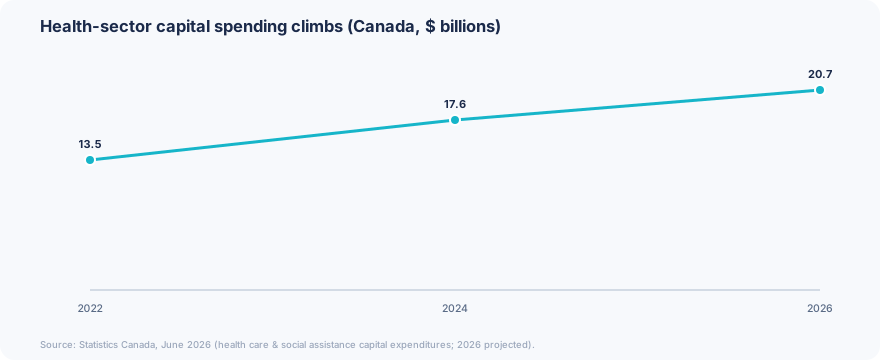
The scale behind the problem is now on the public record. Statistics Canada reported in June 2026 that capital spending in Canada's health and social-services sector is projected to reach about $20.7 billion in 2026 - roughly $16.3 billion in construction and $4.4 billion in machinery and equipment - up from $13.5 billion in 2022, a gain of about 53% in four years. Construction has consistently been around 70% of the total. That is a vast and growing flow of new buildings and equipment, each generating a handover record that someone has to own.
Why opening day is the riskiest day
A modern hospital build is not one project; it is a program that runs for more than a decade and lands in phases. British Columbia's Royal Columbian Hospital redevelopment is a clear example: a mental-health and energy centre opened in 2020, the new Jim Pattison Acute Care Tower - with roughly 50% more beds and a 75-bay emergency department - opened in 2026, and a third phase renovating existing buildings runs to 2029. Across that arc, consultants and contractors rotate on and off, design decisions are made and revised, and equipment is specified, installed, and commissioned. The institutional memory of how it all fits together lives in documents. If those documents stay on the builder's servers and in email chains, the owner inherits a building it cannot fully explain - and the first emergency repair, warranty claim, or accreditation review becomes a scramble through fragments.
How XNM helps
XNM helps health authorities and hospital boards treat the handover as a deliverable, not an afterthought - one auditable command centre where as-builts, manuals, warranties, commissioning records, and service contracts for every project live together and stay current as the program moves through its phases. Where it helps, the XNM-Vision platform gives facilities and capital teams a single portfolio view, so the owner's record is complete the day the doors open rather than reconstructed months later. When a warranty needs to be enforced, an accreditor asks for a commissioning certificate, or a board wants to see what it now owns across every site, the answer is already in place. And because it deploys in days rather than the many months a records overhaul usually takes, the control is ready when the building is.
Practical takeaways
Treat handover as a deliverable. The owner's record should be a contract requirement with a deadline, not a box of files dropped off at the end.
Capture the record as the project runs. As-builts, warranties, and commissioning certificates are easiest to collect while the trades are still on site, not a year later.
Keep the owner's copy separate from the builder's. Consultants and contractors leave; the institutional memory of the building must stay with the people who operate it.
Give facilities one portfolio view. A board running a multi-phase, multi-site program needs a single line of sight, not a different filing system per project.
Make the record audit- and accreditation-ready. Assume an accreditor or auditor will ask how the building was commissioned, and keep the answer findable in seconds.
FAQ
Isn't the handover the contractor's responsibility?
Producing the documents is; owning and using them is not. The contractor leaves; the owner runs the building for decades. If the owner cannot find, search, and trust the handover record, the contractor's diligence does the owner no good when something breaks.
We have a facilities system already. Why isn't that enough?
A facilities or asset system manages what you have already loaded into it. The gap most boards hit is the transfer itself - getting a complete, current record out of the project and into operations without losing pieces. Govern the handover, and your facilities system finally has good data to work with.
The bottom line
Record sums are flowing into hospital construction, and every dollar eventually becomes a document the owner will need. The boards that stay in control are the ones that treat opening day as the moment the record begins, not ends - because a building is only as operable as the handover behind it.