The File Is Your Defence: What Malpractice Claims Keep Teaching Law Firms About Records

Ask a lawyer what causes malpractice claims and many will picture a dramatic error of law - a missed precedent, a misread statute. The data tells a quieter story. Most claims have nothing to do with getting the law wrong. They come from the everyday machinery of practice: a message not sent, a deadline not tracked, a step not documented. And in almost every one of those claims, the firm's defence comes down to a single asset - the matter file. When the file is complete and contemporaneous, the firm can show what it did and when. When the file is thin or scattered, the firm loses an argument it should have won.
A law firm's matter file already carries an unusual load. It has to serve the client, satisfy the regulator's confidentiality and retention rules, and stand up years later if a claim arrives. That last job is the one firms tend to discount - until a claim lands and the question becomes not 'were we right?' but 'can we prove what we did?' The honest answer depends entirely on the state of the record.
Recent context
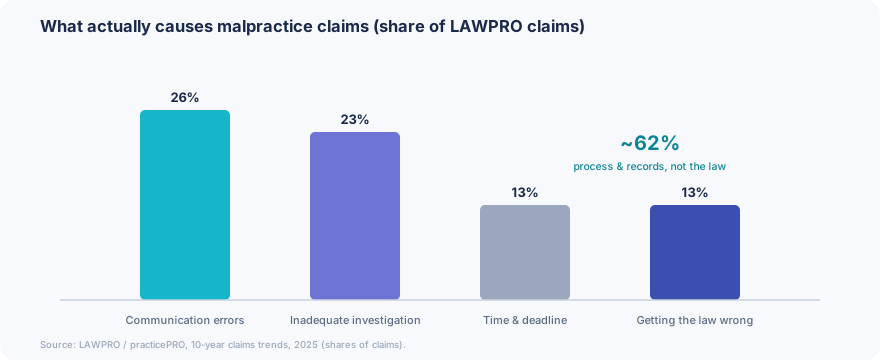
The pattern is well documented. LAWPRO's 10-year claims analysis found that communication-related errors are the single biggest cause of claims - more than a quarter of them, over 8,300 claims and roughly $270 million in the last decade - while inadequate investigation accounts for about 23%. Only around 13% of claims stem from a lawyer getting the law wrong; communication breakdowns, poor calendaring, and not digging deeply enough into a matter together make up almost 62%. These are records and process failures, not intellectual ones.
Why the file wins or loses the claim
Here is the uncomfortable through-line: in each of those leading causes, the file is the defence. When a client says they were never advised of a risk, the contemporaneous note in the file answers it - or its absence convicts you. When a deadline is alleged to have been missed, the record shows the calendar entry and the follow-up. LAWPRO has repeatedly observed that when a claim arises there is frequently inadequate documentation in the lawyer's file to back up the lawyer's version of what occurred - and real estate, the second most costly area of claims, is full of high-volume, clerk-assisted files where the partner is one step removed from the paper. A defensible file is not built after a claim; it is built, contemporaneously, on every matter, or it does not exist when you need it. The firms that survive claims are not the ones who never make mistakes - they are the ones whose records can show the mistake was not theirs.
How XNM helps
XNM helps firms make the defensible file the default - one matter-based command centre where every document, email, note, and decision for a file lives together, time-stamped and access-controlled. Where it helps, XNM-Vision keeps the record complete and contemporaneous as the matter runs, so the file that defends a claim years from now is built automatically today, not reconstructed under pressure. When a client disputes what was advised, a regulator asks about a closed matter, or an insurer needs the chronology, the record is already there. The aim is not to add process for its own sake; it is to make the file that every claim, regulator, and client question depends on a byproduct of doing the work - and to do it in days, not the months a records project usually drags into.
Practical takeaways
Document contemporaneously, not retroactively. A note written the day of the call defends you; a note reconstructed after a claim is just your word again.
Capture communication, not just documents. The biggest cause of claims is communication; the advice you gave and the instructions you received belong in the file, on the record.
Make deadlines a system. Calendaring failures drive claims; tracking should be automatic and visible, not dependent on one person's memory.
File by matter, not by drive. Everything for a matter in one place is the difference between proving what you did and reconstructing it from fragments.
Assume the file will be tested. Build every matter as if a claim, a regulator, or an insurer will one day read it - because one of them might.
FAQ
We're careful lawyers. Doesn't good work prevent claims?
Good work prevents some claims, but the data shows most arise from communication, deadlines, and documentation - not legal skill. You can do everything right and still face a claim; the difference between paying it and defeating it is whether the file proves what you did.
Won't contemporaneous documentation just slow the practice down?
Only if it is bolted on. When the record is a byproduct of the workflow - notes, emails, and deadlines captured where the work already happens - it costs almost nothing day to day and saves enormously the one time a claim arrives. The slow, expensive path is reconstructing a file after the fact.
The bottom line
Malpractice claims rarely turn on whether the lawyer knew the law. They turn on whether the firm can prove what it did - and that proof is the matter file. Before it is a compliance task or a technology project, a complete, contemporaneous record is risk management. The firms that treat the file as their defence are the ones still standing when a claim arrives.