Field Notes: How Municipalities Really Manage Capital Records

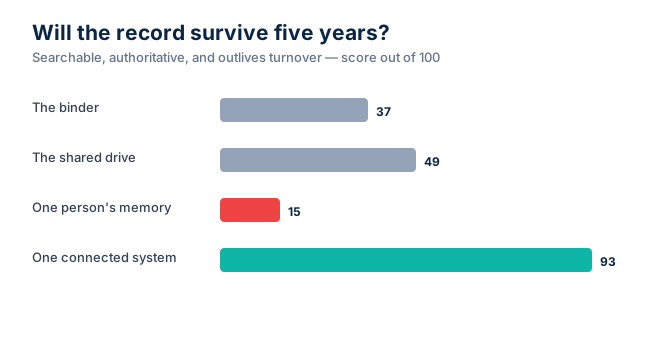
Walk into almost any city hall and ask where the record of a major capital project lives. You'll get pointed, in roughly this order, to a binder, a shared drive, and a person. That trio runs the capital memory of a billion-dollar asset base — and each leg of it fails in a completely different way.
The binder: authoritative, but unsearchable
The binder is the official record — signed, stamped, complete. It's also one physical object on one shelf. You cannot search it, you cannot be in two places with it, and if a basement floods or a department moves, it's gone. It's trustworthy precisely because it's frozen, and useless for the same reason.
The drive: searchable, but not authoritative
The shared drive is where the real work happens — drafts, photos, emails saved as PDFs, three files all named 'final.' You can search it, but you can't trust it: which version was current the day the contractor poured concrete? Nobody can say for certain. It has everything and proves nothing.
The person: fast, but mortal
And then there's the clerk, the long-serving project lead, the engineer who's been here twenty years — the one who 'knows where everything is.' They're the fastest system in the building. They're also a single point of failure with a retirement date. When they leave, a decade of context walks out with them, and no binder or drive captured it.
The point isn't more filing
Every municipality has lived a version of this: a FOIP request that takes three weeks to answer, a council question nobody can source, an asset-management plan built on guesswork because the real numbers are in a binder, a drive, and a head that don't agree. The instinct is to file harder. But the binder is already perfectly filed — and it still can't help you.
What actually fixes it is collapsing the three into one: a single place that is authoritative like the binder, searchable like the drive, and permanent in a way no person can be. Not more copies of the truth — one copy everyone can reach, that doesn't retire.
We write about how each sector lives this problem differently. Browse more in the Field Notes series.