The Change Order Nobody Could Find

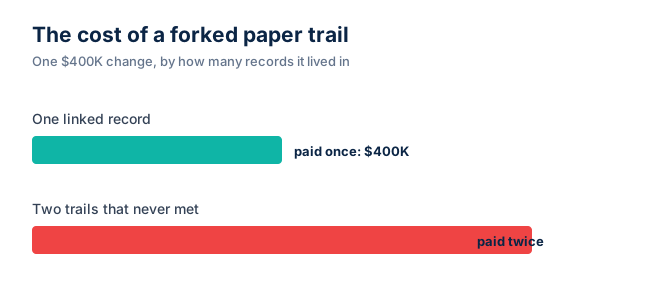
On a mid-size school addition, the same change got priced twice — and the owner paid for both. There was no fraud, no incompetence, no missing signature. There were simply two copies of one decision that never met.
It started cleanly. The site superintendent agreed to a structural change in the field and logged it in the daily log. The project manager issued an RFI; the engineer answered by email and approved it. Weeks later, the general contractor's office issued a formal change order for $400,000. Finance saw a properly signed change order and paid it. Meanwhile the field team, having 'already handled' the work, rolled it into a progress claim that quietly absorbed the same scope. The two never got reconciled, because the two trails never crossed.
One decision, two paper trails
The change itself was real and correct. The failure was that it lived in two places that didn't know about each other: the field's world of logs, photos, verbal directions and RFIs, and the office's world of contracts, change orders and invoices. Each record was internally consistent. Neither could see the other. So the cost was captured twice and only surfaced months later, during an audit, as a number nobody could explain.
Why this is normal, not exceptional
Every construction project runs at least two parallel record systems — the field and the office. When a change is born in one and formalized in the other with no single thread linking them, duplication and disputes aren't bad luck. They're the predictable result of two honest systems describing the same event in different languages, on different days, with no shared identity between them.
And the people most exposed to it are usually the ones doing everything right. A conscientious superintendent records the change in the field; a conscientious project manager formalizes it in the office. Each is being responsible; neither is wrong. The duplication is a property of the system they work inside, not a flaw in either person — which is precisely why 'just be more careful' never fixes it, and why the same gap reappears on project after project until something about the structure itself changes. On paper it looks like carelessness; in practice it is architecture.
The fix is a single thread, not more forms
You don't solve this with a stricter change-order template — both copies were filled out correctly. You solve it by giving every change ONE identity that both worlds reference: a single record the daily log, the RFI, the change order and the invoice all point back to. When a change has one home, the question 'did we already pay for this?' takes ten seconds instead of a forensic reconstruction.
A change order isn't expensive because of the change. It becomes expensive when no one can prove how many times it was recorded. Give each change one place to live, and the forked trail — and the double payment hiding inside it — simply can't form.
We take apart a different one of these every week in our Anatomy of an Overrun series.