Field Notes: Forestry Runs on Paper — and Paper Runs Out
From the road, a forestry operation looks like it runs on trucks, saws, and weather. Spend a week in the office and you learn what it actually runs on: a file. Tenure documents, cutblock approvals, road permits, environmental conditions, and the evidence that every one of them was honoured. The trees are the product. The file is the licence to keep producing them.
The condition nobody re-read
Here's how it goes wrong. A permit comes with conditions — a setback from a stream, a seasonal restriction, a reporting requirement. The work gets done well, but the condition lives in a document somebody read once, months ago. No one re-reads it at the moment it matters. The activity drifts a few metres, or a few weeks, out of bounds. Nothing visible breaks. Then a regulator asks for proof of compliance, and the gap between what was permitted and what was recorded becomes the whole story.
Renewal is a records exam
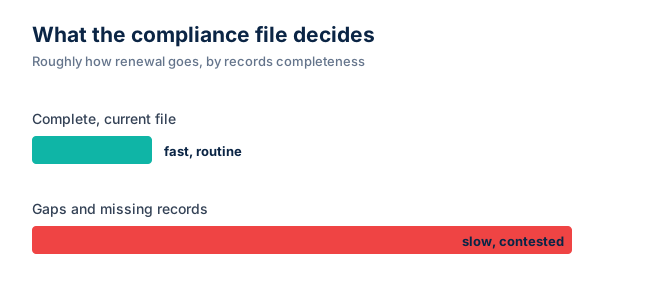
When tenure comes up for renewal, the question isn't really 'did you operate well?' It's 'can you show it?' A complete, current file — every condition tracked, every report filed, every obligation evidenced — turns renewal into a formality. A file with gaps turns it into an investigation, with the operation's future hanging on records that should have been routine.
It helps to see the file the way a regulator does. They aren't in the forest watching the work; they're at a desk, reading. To them, an obligation that isn't evidenced didn't happen, no matter how carefully it was actually carried out. A stream setback you respected but never photographed, a seasonal window you honoured but never logged, a report you completed but filed somewhere no one can produce — each is, on paper, indistinguishable from a breach. The work and the record have to travel together, because by the time anyone checks, the record is the only one of the two still in the room. And the record, unlike the forest, can be lost, overwritten, or simply never created.
Why the paper runs out
Forestry files fail in a specific way: not all at once, but at the edges. A permit condition that nobody connected to a daily activity. A report filed but never saved where the next person could find it. A road-use agreement that expired while the work continued. Each gap is small. Together they're the difference between a licence you can defend and one you merely hope holds.
The operations that never sweat a renewal aren't luckier or more careful in the field — they treat the compliance file as a living asset, not a drawer you open when someone asks. Every permit condition is tied to the activity it governs, every obligation has an owner and a date, and the proof accumulates as the work happens instead of being reconstructed after. When the file keeps up with the forest, the paper never runs out.
We write up a different sector this way each week in our Field Notes series.