One Chart: Where Capital-Project Hours Actually Go
Ask any project team where their week goes and the answer is instant: 'the work.' Track it honestly for a month, though, and a stranger picture appears. A large slice of every week isn't spent building anything. It's spent finding — and redoing what was built from something that turned out to be stale.
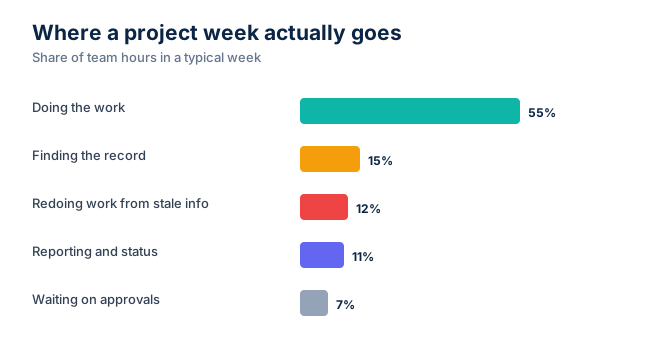
Here's a typical project week, broken down by where the hours actually land:
The silent tax is the middle three bars
Look at finding, redoing, and reporting together — roughly four hours in every ten. None of it adds a brick. Finding is the search for the current drawing, the signed change, the email where someone said yes. Redoing is what happens when that search fails and the wrong version reaches the field. Reporting is rebuilding, by hand, a status that the records could have produced on their own.
That middle wedge is almost pure waste, and it's invisible on every budget because it never gets a line item. It hides inside 'labor.' You don't see it as a cost — you experience it as a slow week, a tense meeting, a change order nobody can explain.
You can't cut the work. You can almost erase the search.
Here's the encouraging part: the biggest slice — the actual work — is fixed. You can't compress pouring concrete or reviewing a design. But the search, the rework, and the manual reporting all share one root cause: the record isn't where the work is. Fix that single thing and the middle three bars collapse together. Most teams don't need to work more hours. They need to stop spending a day and a half each week looking for what they already have.
This is the math behind every 'why are we always behind?' conversation. More numbers like it in our One Chart series.