When the Deadline Beats the File: Access and Privacy Are a Records Test for Public Agencies

Every public institution in Canada runs on a promise it does not always advertise: that when a citizen, a journalist, or a regulator asks to see a record, the institution can find it and produce it on time. That promise is getting harder to keep. Across federal institutions - departments, agencies, and Crown corporations alike - the volume of requests for personal information and the complaints about how slowly they are answered are both climbing fast. The institutions that keep the promise are not the ones with the most staff; they are the ones that can find their own records.
Crown corporations and public agencies hold some of the most sensitive and most scattered records in the country: personnel files, contracts, board minutes, capital-project approvals, correspondence with ministers, and the personal information of the citizens they serve. When those records live across email accounts, shared drives, legacy systems, and a few filing cabinets nobody has opened in years, answering a single access-to-information or privacy request becomes an archaeology project. The legislated clock keeps running while staff hunt for documents - and a request answered late is not a paperwork problem. It is a finding that the institution could not account for its own information.
Recent context
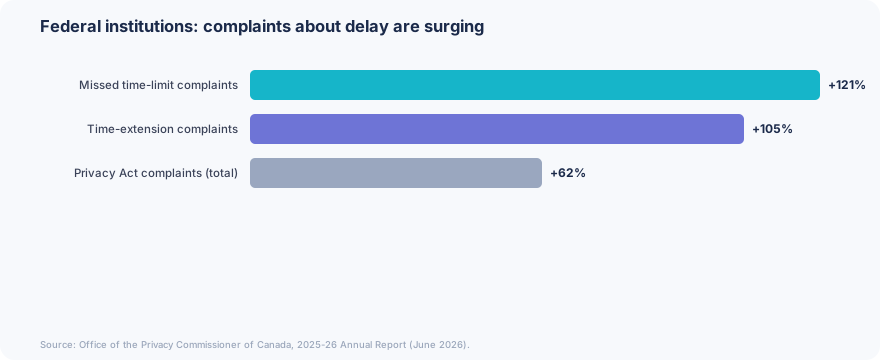
The pressure is now measured. In its 2025-26 Annual Report, released in June 2026, the Office of the Privacy Commissioner of Canada reported that complaints against federal institutions under the Privacy Act rose 62% in a single year - and the sharpest increases were about delay itself: complaints about missed time limits jumped 121%, and complaints about institutions taking time extensions rose 105%. The same report counted roughly 450 breach reports from federal institutions affecting more than 48,000 Canadians. Demand is up, patience is down, and the margin for a disorganized record is gone.
What a missed deadline is actually made of
A late response is rarely a decision to be slow. It is the sum of many small searches that took too long: a record that lived in a departed employee's inbox, a contract whose final signed version could not be distinguished from three drafts, a board package stored in a format no current system can open. Every one of those is a records problem wearing a compliance deadline. And the stakes compound: the same disorganization that makes an access request slow makes a privacy breach more likely and harder to contain, because an institution that cannot find a record also cannot always tell who has touched it. Access, privacy, and security are three views of the same underlying question - does the institution have one trustworthy account of its own information?
How XNM helps
XNM helps public agencies and Crown corporations bring their records into one auditable command centre - correspondence, contracts, approvals, and the personal information they hold, organized so the right document can be found, retrieved, and produced on time. Where it helps, the XNM-Vision platform pairs that single record with access controls and an audit trail, so the institution can see who opened what and when - the same capability that answers an access request quickly also contains a breach and satisfies a privacy review. When the Information Commissioner, a board, or a citizen asks, the answer is already in reach rather than somewhere in the archaeology. And because it deploys in days rather than the many months a records overhaul usually takes, the institution closes the gap while the deadlines are still being missed.
Practical takeaways
Treat the legislated clock as a records test. A deadline you miss is usually a document you could not find, not a decision you could not make.
Keep one authoritative version of every record. Three drafts and a signed copy in four places is how a simple request becomes a week of searching.
Make access control and audit trails the default. Knowing who touched a record answers a privacy review and contains a breach at the same time.
Retire the inbox as a filing system. Records that live in individuals' email leave with the individual; institutional memory has to outlast staff turnover.
Build the record to be produced, not just stored. Storage is not retrieval; design the system so the answer is findable on the day someone asks.
FAQ
We already have an ATIP team and a records policy. Isn't that enough?
A policy tells people what should happen; it does not make a scattered record findable. The institutions struggling most are usually the ones whose teams are skilled but whose records are spread across systems that were never designed to be searched together. The gap is the record, not the people.
Aren't rising complaints just a sign of more requests, not worse records?
Volume is part of it - but complaints about delay rose far faster than requests did, which points at capacity to find and produce, not just demand. More requests only overwhelm an institution whose records were already hard to retrieve. Fix the retrieval and volume becomes manageable.
The bottom line
For a public institution, access and privacy obligations are not a separate compliance function bolted onto the real work - they are a direct test of whether the institution can account for its own information. The agencies that meet their deadlines are the ones whose records are organized to be found. Before it is an ATIP strategy or a privacy strategy, it is a records strategy - and the clock is already running.