Funding Follows the Records: Why Municipal Asset Plans Decide Who Gets Canada's Infrastructure Billions
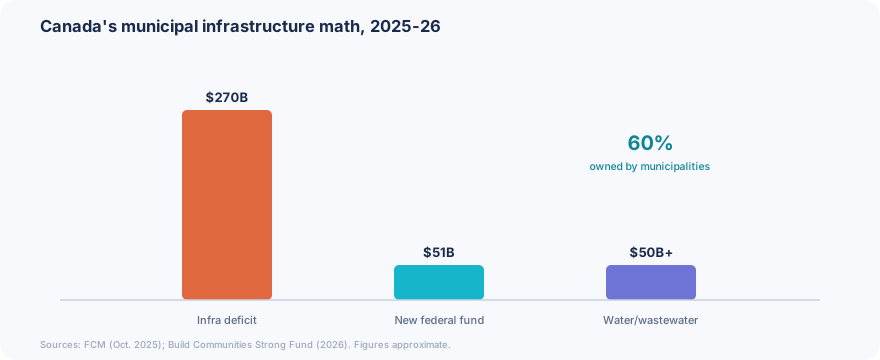
Canada is about to spend heavily on local infrastructure, and not every municipality is ready to receive it. The national infrastructure deficit - the backlog of roads, bridges, water systems, and facilities that need repair or replacement - is now estimated at roughly $270 billion, and the new federal funding arriving this year covers only a slice of it. When money is that scarce relative to need, it does not flow to the loudest council or the biggest backlog. It flows to the municipalities that can prove, in detail, what they own, what condition it is in, and what a dollar of repair will buy. That proof is a records problem.
Municipalities maintain about 60% of Canada's core public infrastructure on roughly nine cents of every tax dollar collected in the country. Stretching that thin slice across thousands of assets requires knowing each asset's age, condition, replacement cost, and maintenance history - the raw material of an asset-management plan. But for many municipalities that information is scattered: a condition assessment in a consultant's PDF, a replacement schedule in a spreadsheet on one engineer's drive, a maintenance log in a work-order system that doesn't talk to the budget. When the data is fragmented, the asset-management plan becomes a compliance document filed once and never used - instead of the live record that should drive every capital decision.
Recent context
Regulators have been pushing toward exactly this discipline. Ontario's Asset Management Planning regulation (O. Reg. 588/17) required municipalities to have approved plans for core assets by 2022, for all assets with current levels of service by 2024, and to add proposed levels of service by 2025 - a staged climb toward planning every asset by condition and cost. Meanwhile the Federation of Canadian Municipalities, reporting in late 2025, put the national infrastructure deficit at about $270 billion, and the federal Build Communities Strong Fund launched in 2026 with $51 billion over ten years - real money, but a fraction of the gap. The squeeze makes condition data decisive.
Why the records decide the funding
Most infrastructure funding now asks the same question in different words: can you show that this project is the right one? An asset-management plan answers it - but only if the records underneath are current and defensible. A municipality that can produce a condition-rated inventory, a lifecycle cost for each asset, and a maintenance history makes a fundable case in an afternoon. A municipality whose data lives in twelve disconnected places spends weeks assembling a weaker version of the same story, and competes at a disadvantage for every dollar. The deficit is too large and the money too tight for the gap between those two municipalities to stay small. Good records are no longer back-office hygiene; they are the difference between funded and deferred.
How XNM helps
XNM helps municipalities turn a pile of scattered asset information into one auditable command centre - condition assessments, replacement schedules, maintenance logs, contracts, and the capital decisions they justify, kept together and current. Where it helps, the XNM-Vision platform gives a CAO or asset-management lead a portfolio view across every asset class, so the asset-management plan is a living record the municipality can query, not a document it rebuilds from scratch each grant cycle. When a funding program asks for proof, the proof already exists; when council asks what a deferral really costs, the answer is on the record. And because it deploys in days rather than the many months a records project usually takes, a municipality can be funding-ready for this year's programs, not next year's.
Practical takeaways
Make the asset-management plan a live record, not a filed document. A plan you rebuild every grant cycle is a plan that's always out of date when it matters.
Rate every asset by condition, not just count it. Funders fund the worst-condition, highest-consequence assets; you can only point to them if you've recorded them.
Connect condition data to cost. A condition rating with no replacement or lifecycle cost beside it can't justify a budget line.
Keep the record in one place, not twelve. The weeks you spend assembling a grant application are the weeks your data should have saved you.
Treat funding-readiness as a standing state. The municipalities that win don't scramble when a program opens; their proof is always current.
FAQ
We filed our asset-management plan to meet the regulation. Isn't the requirement met?
Filing the plan meets the letter of the rule; it does not make you funding-ready. The regulation's real intent is a living practice - condition and cost data you actually maintain and use to decide. A plan that's accurate the day you file it and stale a year later won't carry a grant application, even if it satisfied the deadline.
We're a small municipality without a big asset-management team. Is this realistic?
It's more important, not less. Small municipalities own the same kinds of assets with a fraction of the staff, so the leverage from a single organized record is greater. The goal isn't a bigger team; it's one place where the asset data lives so a small team can produce it on demand.
The bottom line
Canada's infrastructure money is real, but it is far smaller than the need - and that scarcity turns records into strategy. The municipalities that get their share are the ones that can prove, asset by asset, what they have and what it will cost. An asset-management plan is only as good as the records beneath it, and the funding follows the proof. Before it is a funding strategy, it is a records strategy - and the gap won't wait.