Doubling Community Housing Is a Capacity Test: Why the Record Is the Non-Profit's Real Constraint

Canada has settled on an ambitious goal for non-market housing, and the goal is not really in dispute. What is in dispute - quietly, in every non-profit board meeting and every foundation grant review - is who has the capacity to actually build it. Community housing in Canada is delivered largely by non-profit societies, housing co-operatives, and the foundations that fund them: mission-driven organizations running on lean teams and braided funding. Asking that sector to double in size is asking small organizations to deliver large capital programs - and the constraint they hit first is not money or will. It is the capacity to manage the work without losing the thread.
A community housing project is a dense bundle of records long before it is a building: funding agreements with conditions attached, development pro formas, construction contracts, draw schedules, compliance filings, and the reporting that every funder requires on its own template and timeline. A non-profit running three or four projects at once, with a handful of staff and high turnover, is holding all of that across spreadsheets, shared drives, and individual inboxes. When a key person leaves, the project memory can leave with them - and a missed reporting deadline or an untracked funding condition can put the next tranche of money at risk. For a lean organization, that is not an inconvenience; it is existential.
Recent context
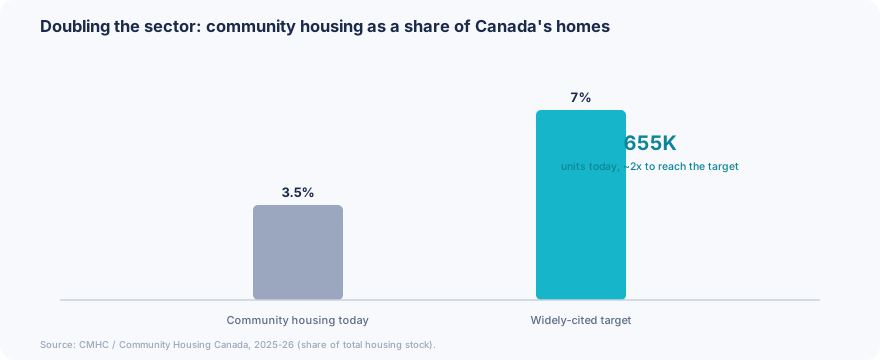
The scale of the ask is now explicit. CMHC describes a community housing sector of 655,000 units - just 3.5% of Canada's housing stock - and points to widespread calls to roughly double non-market housing to about 7%, even as up to one-third of renters spend more than 30% of their income on shelter. The same research flags sector capacity and sustainability, not ambition, as the binding challenge. Doubling the sector means asking its organizations to deliver and account for far more capital than they ever have.
Why capacity is a records problem
For a non-profit, capacity is not just how many people you have; it is how much your organization can deliver and account for without dropping a thread - and that is decided by the record. A small team with a single governed record of every project can punch far above its size: it can answer a funder instantly, hand a clean file to an auditor, onboard a new hire into a project in an afternoon, and run four developments with the discipline of a much larger shop. A team whose record is scattered spends its scarce hours reconstructing what it already knew, lives in fear of the missed deadline, and cannot grow without breaking. The record is not back-office overhead; it is the multiplier that turns a lean team into a capable developer.
How XNM helps
XNM helps housing non-profits and foundations turn a lean team into a capable delivery organization - one command centre where every project's funding agreements, contracts, draw schedules, compliance filings, and funder reporting live together, current and audit-ready. Where it helps, the XNM-Vision platform gives an executive director one view across every development and every funder deadline, so a reporting obligation or a funding condition surfaces before it threatens a tranche, and institutional memory survives staff turnover. When a funder, an auditor, or a board asks where a project stands and whether conditions were met, the answer already exists - and because it deploys in days rather than the many months a records project usually takes, the capacity arrives in time to take on the next build.
Practical takeaways
Treat the record as capacity, not paperwork. For a lean team, a single governed record is what lets a few people deliver like many.
Track every funding condition as an obligation. A grant condition no one is watching can cost you the next tranche; tie each one to the project it funds.
Never let project memory live in one person's head. High turnover is a fact of non-profit life; the record, not the staffer, should hold what the project knows.
Make funder reporting a by-product, not a scramble. If the record is current, a report is an export; if it is scattered, every deadline is a fire drill.
Stay audit-ready by default. Funders and auditors will ask; keep every project's file in a state where the answer is already there.
FAQ
We are small and grant-funded. Isn't a records system a luxury we can't afford?
It is closer to the opposite: a lean organization is exactly the one that cannot afford lost time and missed deadlines. A governed record reclaims the hours your team now spends reconstructing information and protects the funding a single missed condition could cost - which is why it tends to pay for itself fastest in the smallest shops.
Each funder wants its own reports. Can one record really serve them all?
Yes - that is the point. When the underlying project record is complete and current, producing any funder's report becomes a matter of drawing from one source rather than rebuilding from many. One governed record is what makes many reporting obligations manageable.
The bottom line
Doubling community housing is a capacity test, and capacity is a records discipline before it is a headcount. The non-profits and foundations that will deliver are the ones whose record turns a small team into a capable developer - every funding agreement, contract, and report in one place, current and defensible. Before it is a housing strategy, it is a records strategy - and for a lean organization, the record is the capacity.