In a Tenure Reckoning, Your Records Are Your Claim: Forestry's Quiet Records Test
A forest licence is a promise on paper before it is a stand of timber. The right to harvest in British Columbia rests on a chain of documents - tenure agreements, cutting permits, road permits, harvest histories, silviculture obligations, and the consultation records that increasingly sit alongside them. For decades those records were treated as administrative background, the quiet paperwork behind the visible business of logging. That is about to change, because the province is reopening the question of who holds the right to cut - and when tenure is reopened, the record stops being background and becomes the claim itself.
Forestry companies and, increasingly, the First Nations gaining tenure run some of the most records-dependent operations in the resource economy. Every cubic metre harvested traces back to an authorization; every authorization carries obligations - reforestation, road maintenance, reporting - that persist long after the trees are gone. When those records are scattered across legacy systems, consultants' files, and the memory of long-serving staff, a licence holder cannot quickly prove what it is entitled to, what it has done, and what it still owes. In a stable system that is a tolerable weakness. In a reallocation, it is a liability - and a First Nation taking on tenure for the first time needs that records capacity from day one.
Recent context
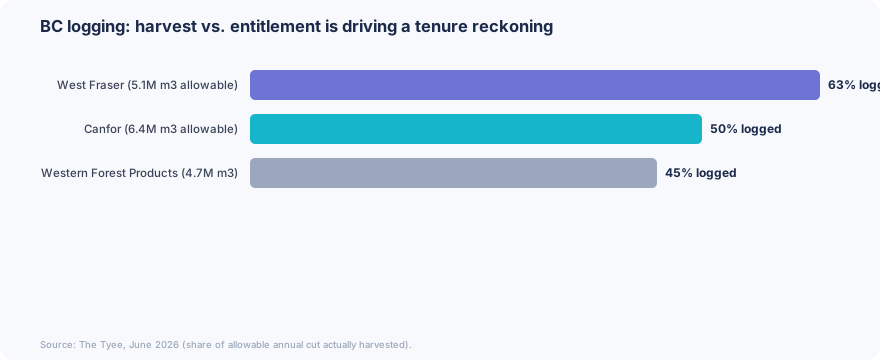
The reckoning is now in the open. A June 2026 analysis in The Tyee describes major BC companies holding allowable annual cuts far above what they actually log - with the largest harvesting only roughly half of their entitlement, the top three controlling 39% of committed timber, and timber-supply reviews the article calls flawed for two decades - against a 2025 commitment by the Forests Minister to reclaim unused fibre rights and broaden First Nations participation. A wide gap between entitlement and harvest is exactly the kind of pressure that reopens tenure.
Why reallocation is a records test
When a government reopens who holds the right to a public resource, the question it asks every party is documentary: what are you entitled to, what have you done with it, and what do you still owe? The licence holder who can answer instantly - harvest history, permit compliance, silviculture obligations met, consultation conducted, all in one place - defends its position from a position of strength. The one whose record is fragmented argues from memory and hope. The same logic runs the other way: a First Nation receiving tenure inherits not just the right to harvest but the obligation to manage and account for it, and the communities that build a governed record from the start are the ones that hold the asset with confidence. Reallocation does not reward the loudest claim; it rewards the provable one.
How XNM helps
XNM helps forestry licence holders and First Nations bring the tenure record into one auditable command centre - tenure agreements, cutting and road permits, harvest histories, silviculture and reporting obligations, and consultation records, tied together and kept current. Where it helps, the XNM-Vision platform gives woodlands and tenure managers a single view of every authorization, what it requires, and whether the requirement was met, so a reallocation review, a ministry request, or a partner's question meets a record that is already assembled. For a community taking on tenure, it provides the governance and institutional memory to manage the asset from day one - and because it deploys in days rather than the months a records overhaul usually takes, the readiness is in place before the reckoning arrives, not after.
Practical takeaways
Treat your tenure record as your claim. When the right to cut is reopened, the party that can prove entitlement, performance, and obligations holds the strongest position.
Keep obligations as live commitments, not closed files. Reforestation and reporting duties outlive the harvest; track and evidence them continuously, not at audit time.
Tie every cubic metre to its authorization. Harvest you cannot link to the permit that allowed it is a gap that surfaces precisely when tenure is under review.
Build records capacity before you take on tenure. A community gaining a licence needs the governance from day one; the record is how a new holder manages with confidence.
Keep consultation records with the operational ones. In a system reweighting toward First Nations participation, the consultation trail is part of the claim, not a side file.
FAQ
We have managed our tenure for years. Why is records control suddenly urgent?
Because the rules of the game are changing. A record that was adequate when tenure was stable becomes a liability the moment a government reopens allocation and asks every holder to prove entitlement and performance. The urgency is not new risk in your operations; it is a new test of the record you already have.
We are a First Nation receiving tenure for the first time. Where do we start?
Start with the record, before the first harvest. Taking on tenure means taking on obligations - reforestation, reporting, compliance - that must be tracked from day one. A governed record built at the outset is what lets a community manage the asset on its own terms rather than inheriting someone else's gaps.
The bottom line
BC's move to reclaim and reallocate logging rights is, underneath the politics, a records test. The licence holders who keep their position and the communities who gain it will be the ones who can prove their claim - every permit, harvest record, and obligation in one place, current and defensible. In a reallocation, the strongest argument is not the loudest; it is the one you can document.