The Largest Capital Plan in History Is a Delivery Problem: What Crown Agencies Need to See

There is a moment in every infrastructure cycle when the hard question stops being how much to spend and becomes whether you can actually deliver it. Canada's provinces have reached that moment. When a government commits the largest capital plan in its history, the headline is the dollar figure - but the real test arrives later, in the unglamorous work of moving hundreds of projects from announcement to ribbon-cutting, on time and on budget, while a legislature, an auditor, and the public watch every one of them. That test is won or lost on oversight, and oversight is a records problem.
Provincial agencies and Crown corporations sit at the centre of that delivery machine. They steward portfolios of dozens or hundreds of projects at once - each with its own approvals, contracts, change orders, funding agreements, and milestone schedule - and they answer for the whole portfolio to ministers, boards, and the Auditor General. The single hardest thing about that job is not any one project; it is holding a current, defensible line of sight across all of them at the same time. When that line of sight is assembled from status decks, email updates, and a patchwork of program drives, the agency is governing a historic plan on a foundation that cannot bear its weight.
Recent context
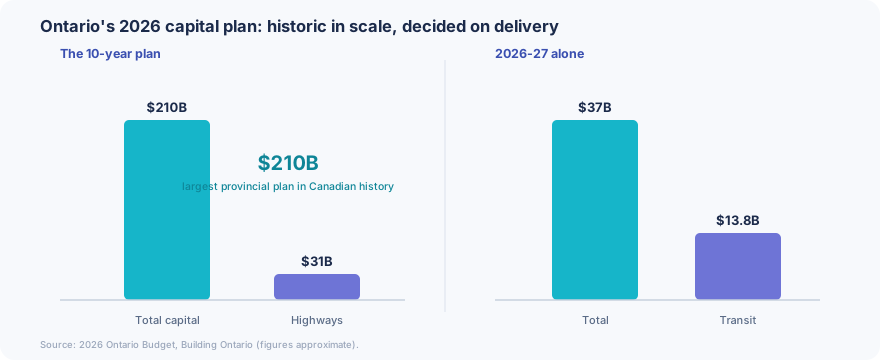
The scale is now explicit. The 2026 Ontario Budget sets out a ten-year capital plan of more than $210 billion - described as the most ambitious provincial capital plan in Canadian history - including about $37 billion in 2026-27 alone and roughly $31 billion for highways over the decade, with the budget itself signalling a shift in emphasis from announcing infrastructure to accelerating its delivery. That shift is the whole story: the dollars are decided; the delivery is the unfinished work.
Why delivery is a records problem
A capital plan does not fail in a single dramatic moment. It erodes - a project that slips two quarters, a change order that escapes the running total, a funding condition no one tracked until a transfer was clawed back. Each of those is a document and a decision, and at portfolio scale they are invisible unless the agency can see them in one place. The governments that deliver their plans are the ones whose agencies can answer, on demand, what every project's status is, what has changed, and who approved it. The ones that struggle are not short of ambition or money; they are short of a single, trustworthy record of where the portfolio actually stands. Announcing is easy; delivering is an oversight discipline.
How XNM helps
XNM helps provincial agencies and Crown corporations bring the delivery record into one auditable command centre - approvals, contracts, change orders, funding agreements, and milestone schedules, tied together and kept current across the whole portfolio. Where it helps, the XNM-Vision platform gives executives and boards a single portfolio view, so a slipping schedule or an unmet funding condition surfaces before it becomes a public problem. When a minister, the Auditor General, or the legislature asks where the plan stands and what changed, the answer already exists - and because it deploys in days rather than the many months a records overhaul usually takes, the oversight is in place while the plan is still being delivered, not reconstructed afterward.
Practical takeaways
Treat delivery as the constraint, not the budget. Once the money is committed, the risk moves to execution; govern the portfolio as tightly as you governed the funding case.
Give leadership one portfolio view. Hundreds of projects cannot be overseen from hundreds of status decks; one line of sight is the difference between governing and hoping.
Track funding conditions as obligations. A grant condition no one is watching is a clawback waiting to happen; tie every dollar to the terms attached to it.
Keep the running total of change orders visible. Scope creep across a portfolio is invisible until year-end unless it is tracked continuously; review it monthly.
Make the portfolio audit-ready by default. Assume the Auditor General will ask, and keep every project's record in a state where the answer is already there.
FAQ
Each project already reports its status. Isn't that oversight?
Project-level reporting tells you about projects one at a time; it does not give leadership one current, comparable view of the whole portfolio. The gap agencies hit is consolidation and defensibility across hundreds of projects - the ability to answer a portfolio question instantly, not to chase dozens of separate updates.
We use multiple delivery partners and contractors. How does one record work?
That is exactly why the owner needs its own. Partners and contractors come and go and each keeps its own files; the agency's accountability spans all of them and outlives any one of them. A single owner-held record is how the portfolio stays governable as partners change.
The bottom line
A historic capital plan is a promise to deliver, and delivery is an oversight discipline before it is a construction one. The provincial agencies and Crown corporations that keep their plans on track are the ones that can see every project in one place - approvals, contracts, change orders, and milestones, current and defensible. The dollars make the headline; the records decide whether the plan is built.