The Engagement File Is the Product: What Audit Inspections Keep Telling Accounting Firms

For an accounting firm, the work product is not the opinion letter - it is the file behind it. Every audit, every assurance engagement, every tax position is ultimately a record: the evidence gathered, the judgments made, who reviewed them, and when. That file has to satisfy a client today, withstand a regulator's inspection tomorrow, and stand up in a dispute years from now. When it is complete, contemporaneous, and easy to navigate, the firm's exposure is low. When it is scattered across working-paper drives, email threads, and a reviewer's memory, the firm is one inspection away from a finding.
This is not an abstract risk. Canada's audit regulator has spent years pointing at the same soft spots, and the profession's own quality reminders keep returning to documentation, supervision, and review - not because auditors reach wrong conclusions, but because the file too often cannot fully evidence the right ones. A defensible engagement record is the difference between a clean inspection and a remediation plan.
Recent context
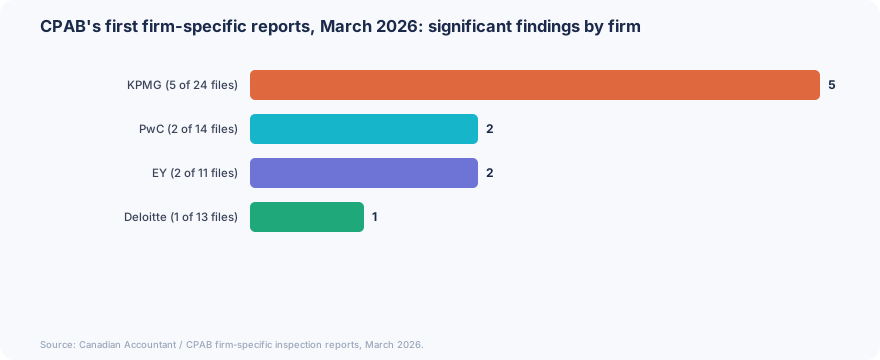
The watchdog has now made the comparison public. In March 2026, the Canadian Public Accountability Board published its first firm-specific inspection reports, showing significant findings even among the largest firms - five in the files it inspected at one Big Four firm, and one to two at the others - across areas such as business combinations, inventory, long-lived assets and revenue. Audit documentation, supervision and review remain a recurring theme. For the first time, clients and audit committees can compare firms directly on inspection results.
Why findings are really about the file
A significant inspection finding rarely means the auditor was wrong. Far more often it means the file could not demonstrate that the auditor was right - the procedure was performed but not documented, the review happened but left no trace, the judgment was sound but its basis was not captured before the deadline passed. That is a records problem wearing a quality-control costume. And it is getting harder, not easier: firms are pushing more work through AI tools, inspection disclosure is now public and firm-by-firm, and clients increasingly ask to see how an engagement was run. Every one of those pressures lands on the same thing - whether the firm can produce a complete, governed engagement record on demand.
How XNM helps
XNM helps firms make the engagement file the system, not an afterthought - one governed record per engagement where every document, working paper, approval, and review sign-off lives together, access-controlled and retention-aware. Where it helps, XNM-Vision keeps the file contemporaneous and audit-ready, so a CPAB inspection, a client question, or a years-later dispute meets a record that is already complete rather than one reconstructed under pressure. The point is not another working-paper repository on top of the existing ones; it is a single, defensible record of how each engagement was actually run - and, because it deploys in days rather than the months a records project usually takes, the discipline is in place before the next inspection cycle.
Practical takeaways
Make the file the deliverable, not the byproduct. Treat the engagement record as the product you ship; the opinion is only as strong as the evidence behind it.
Document contemporaneously, not at archive time. A review that leaves no trace before the deadline is, to an inspector, a review that did not happen.
Centralize the engagement, don't scatter it. Working papers, approvals, and sign-offs in one governed place is the difference between answering an inspection and reconstructing it.
Make retention automatic. Disputes and inspections surface years later; your retention rules should run by themselves, not depend on memory.
Keep an audit trail of every review. Who reviewed what and when should be a fact the system records, not a recollection.
FAQ
We already use audit software and working-paper tools. Isn't that enough?
Those tools store working papers; they do not always give you one governed, access-controlled, retention-aware record of the whole engagement that an inspector and a court can both rely on. The gap firms hit at inspection is usually completeness and traceability of the file as a whole, not the existence of individual papers.
Inspections target the big firms. Does this matter for a mid-size practice?
More, not less. Smaller firms face the same standards with thinner review layers and less margin for a remediation cycle. A governed engagement record is how a mid-size practice gets large-firm defensibility without large-firm overhead.
The bottom line
Inspection results are, underneath the numbers, a verdict on records. The firms that clear inspections cleanly are the ones whose engagement files were complete, contemporaneous, and defensible before anyone came looking. Before it is an audit-quality strategy, it is a records strategy - and the file, not the letter, is the product.