You Can't Fix What You Can't See: The Records Gap Behind Campus Deferred Maintenance

Deferred maintenance is the quietest line item in public education and the most dangerous, because it grows in the dark. A roof reaches the end of its life, a boiler limps past its rated service date, a building envelope starts to fail - and none of it shows up as a crisis until it shows up as one. School districts and post-secondary institutions run sprawling portfolios of aging buildings, and the single hardest thing about managing them is not finding the money. It is seeing the problem clearly enough to spend the money well. That visibility is a records question before it is a budget question.
Every building on a campus is a thick stack of documents: original drawings, renovation histories, equipment warranties, condition assessments, inspection reports, and the contracts behind every past repair. When those records are spread across a facilities office, a dozen consultants' reports, and the institutional memory of staff who are retiring, the institution loses the one thing it needs to govern a backlog - a current, ranked, defensible picture of what is failing, what it will cost, and what happens if it waits. Without that picture, capital planning becomes a guessing game, and the backlog compounds.
Recent context
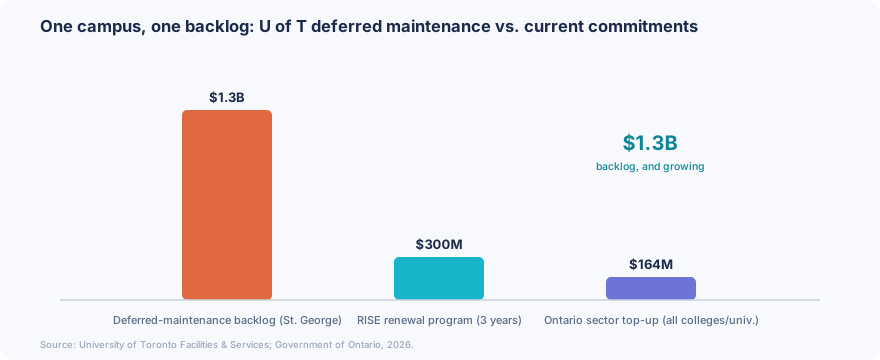
The scale is now on the public record. The University of Toronto reports a deferred-maintenance backlog of $1.3 billion and growing on its St. George campus - driven by aging buildings from the construction booms of the 1960s and early 2000s, rising construction costs, and extreme weather - and has launched a $300-million, three-year renewal program in response, while Ontario has added $164 million across all its colleges and universities. The backlog dwarfs the response, and that gap is the norm across the sector, not the exception.
Why a backlog is a records problem
A deferred-maintenance backlog is, at bottom, an inventory of documented conditions. Every dollar in it should trace to an assessment that says what is wrong, how urgent it is, and what it will cost to fix - and the institutions that manage their backlog well are the ones that can produce that inventory on demand, ranked and current. The ones that struggle are not short of problems; they are short of a single, trustworthy record of them. When the condition data is fragmented, leaders cannot defend a priority list to a board, cannot make the case for funding with evidence, and cannot tell a deferred risk from an active one until a ceiling comes down. The backlog is real, but the blindness is optional.
How XNM helps
XNM helps districts and institutions bring the facilities record into one auditable command centre - condition assessments, warranties, drawings, contracts, and the renewal history of every building, tied together and kept current across the whole portfolio. Where it helps, the XNM-Vision platform gives facilities and finance leaders a single ranked view of the backlog, so the case for capital is built on evidence rather than anecdote, and a deferring risk is visible before it fails. When a board, a ministry, or an auditor asks what is most urgent and why, the answer already exists - and because it deploys in days rather than the many months a records project usually takes, the visibility arrives in time to shape the next budget.
Practical takeaways
Treat the backlog as an inventory, not a number. A single dollar figure cannot be governed; a ranked list of documented conditions can.
Keep one record per building, not per project. Drawings, warranties, and condition history belong together, so the next repair starts from what is known.
Make the priority list defensible. A board funds what it can see evidence for; a ranked, sourced backlog is the strongest case you can make.
Capture condition data once, reuse it everywhere. Assessments commissioned and then lost are paid for twice; keep them in the record for the building's whole life.
Protect institutional memory. When the staff who know the buildings retire, the record - not their recollection - is what should remain.
FAQ
We have a facilities management system. Isn't the backlog already tracked?
A work-order system tracks tasks; it does not always give you one governed record per building tying condition assessments, warranties, and renewal history to the dollars at stake. The gap most institutions hit is a defensible, ranked picture of the whole backlog, not the logging of individual jobs.
Funding is the real constraint. Why focus on records?
Because records are how scarce funding gets spent well. When every dollar of backlog traces to a documented condition, leaders can target the most urgent risks, defend the choice, and show funders the evidence - turning a fixed budget into the maximum risk reduction it can buy.
The bottom line
A deferred-maintenance backlog is a record before it is a repair bill. The districts and institutions that keep control of their buildings are the ones that can see them clearly - every condition, warranty, and assessment in one place, ranked and defensible. You cannot fix what you cannot see, and what you cannot see is, almost always, a record you could not pull together.