You Can't Renew the Pipes You Can't See: Buried Assets Are a Records Problem

The most valuable thing a municipal water utility owns is almost entirely invisible. The distribution mains, the trunk sewers, the collectors and force mains that carry a community's water and waste run for kilometres underground, out of sight for decades at a time. A road announces its own condition; a buried pipe does not. The only way a utility knows whether a main is thirty years from failure or one cold snap away from a break is the record it keeps - inspection histories, break records, material and installation dates, condition assessments. When that record is thin, the renewal plan is not a plan; it is a guess dressed up as one. And you cannot renew, cost, or defend the replacement of pipes you cannot see.
This is the quiet crisis underneath the headline numbers. Municipalities own the bulk of Canada's water and wastewater systems, and those systems are aging faster than they are being renewed. The condition of a buried network is knowable only through disciplined record-keeping, because you cannot walk the line and look. That makes the water utility uniquely dependent on its records: the asset inventory, the condition data, the break and repair history, and the capital decisions that tie them together. Where those live in one current, trustworthy place, a director of public works can prioritize the next dollar with confidence. Where they live in a retiring operator's memory and a decade of paper work orders, the utility is renewing blind.
Recent context
The renewal gap is now measured, and it is widening. Statistics Canada reported in June 2025 that at the end of 2022, owners of core public infrastructure estimated $294.4 billion was needed to rehabilitate or replace assets to good condition - yet only $31.3 billion, about 11% of that need, was actually invested in renewal that year. Over the same period, the share of assets in good or very good condition slipped from 59% in 2020 to 55% in 2022. Canada's first National Infrastructure Assessment, released later in 2025, put roughly $126 billion of public infrastructure in poor or very poor condition, with more than 11% of water and wastewater assets in that category. The pipes are getting older; the funding is not keeping pace.
The renewal gap starts as a records gap
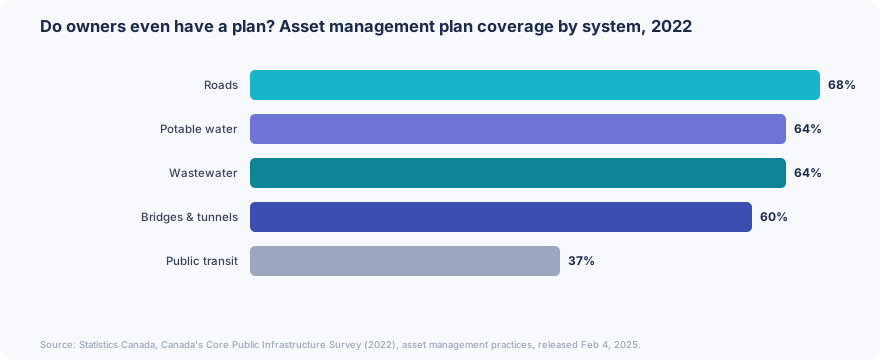
It is tempting to frame this purely as a funding shortfall, and the shortfall is real. But money spent against a weak record buys less renewal than the same money spent against a strong one - and for buried assets, the record is where the problem starts. Statistics Canada's own data shows that even for the systems municipalities manage most formally, a large minority of owners had no documented asset management plan in 2022: 64% had one for potable water and 64% for wastewater, meaning better than one owner in three did not. You cannot rank which main to replace first, justify the cost to a council, or defend a grant application without a current condition record underneath it. That is why the national assessment leads its recommendations with standardized data, asset management, and transparent risk assessment - not just more capital. The renewal gap and the records gap are the same gap seen from two angles.
How XNM helps
XNM helps a utility pull the buried-asset record into one auditable command centre - the inventory of mains and collectors, inspection and condition data, break and repair history, material and installation records, and the capital decisions built on them, tied together and kept current. Where it helps, the XNM-Vision platform gives a director of public works or a municipal CFO a single line of sight across the network, so the renewal list is built on condition evidence rather than the last main that broke. When a funding application, an auditor, or a council committee asks why this pipe and why now, the answer already exists in a defensible form. And because it stands up in days rather than the many months a records overhaul usually takes, the visibility arrives in time to shape the next capital budget - and to keep the institutional knowledge of a retiring operator with the utility rather than leaving with them.
Practical takeaways
Treat the condition record as the asset it protects. A buried network you cannot inspect on demand is only as manageable as the record you keep of it; let the record lapse and every renewal decision becomes a guess.
Tie break and repair history to the renewal list. Every failure is data - keep break records, inspections, and material ages in the same place the capital plan is built, so the worst pipes rise to the top on evidence.
Make the capital file grant-ready by default. Funding programs and auditors will ask why this project and why now; keep the condition record in a state where the justification is already there.
Give leadership one network view. A council and CFO overseeing an underground network need a single, current picture of its condition - not a binder per department refreshed once a year.
Capture operator knowledge before it retires. Much of what a utility knows about its buried lines lives with long-serving crews; move that knowledge into the record before it walks out the door.
FAQ
We inspect our system on a schedule. Isn't that our condition record?
Inspections generate the data; the record is what turns that data into decisions. If inspection results, break histories, and material ages live in separate systems or in an operator's notes, no one can see the network's condition as a whole or prioritize against it. The value is in a living record where condition data, repair history, and capital decisions update together - so the renewal list reflects the network as it is now, not as it was at the last one-off survey.
Isn't this really just a funding problem?
Funding is part of it, but the record is the part a utility controls. New money spent against a thin condition record buys less renewal than the same money spent against a clear one, because you cannot direct it to the pipes that need it most. Getting the record right is how a utility makes every dollar - existing or new - reach the right main.
The bottom line
A water utility's hardest problem is that its most important assets are the ones it cannot see, and the only way to see them is to keep a disciplined record. The renewal gap that Statistics Canada and the National Infrastructure Assessment have now measured is, underneath, a records gap: you cannot prioritize, fund, or defend the renewal of a network you have not documented. The utilities that close the gap will be the ones that can see their own pipes - through the record - before the next one breaks.