On Time Is On the Record: Why a Transit Expansion Runs on Its Documents

A transit expansion opens on a date a politician has already promised. From the ground-breaking on, every quarter is a contest between the schedule on the announcement board and the record underneath it - the drawings, change orders, permits, and funder reports that say what was actually built, approved, and paid for. When that record is whole and current, the schedule holds. When it is scattered across contractors, consultants, and agency inboxes, the schedule quietly slips - not because the tunnelling got harder, but because the document that authorizes the next step cannot be found in time.
A major transit or rail program is one of the most records-intensive undertakings a public agency will ever run. A single line braids together hundreds of design packages, tens of thousands of change orders and requests for information, environmental and building permits, utility relocations, real-estate takings, third-party agreements with municipalities and railways, and the funder reporting that keeps senior-government dollars flowing. Each of those is a gate: the next crew cannot pour, bore, or energize until the current, approved document clears. When the director of capital delivery cannot see, in one place, which document is current and what it is waiting on, the program does not fail loudly. It leaks time - a week here for a superseded drawing, a month there for a permit no one can locate - until the opening date on the billboard is no longer real.
Recent context
Ontario's transit build offers a live illustration. Independent cost tracking of Metrolinx projects, updated in February 2026, shows the Eglinton Crosstown LRT baseline rising from $12.2 billion in 2019 to $13.1 billion, the Ontario Line carrying a $29.5-billion baseline, and - the tracker's central complaint - no overall budget figure published for any single project, leaving outside observers no way to verify what a program is actually tracking against. Alongside that, the agency has scaled its GO Expansion to a 'minimum viable product' and written off hundreds of millions in signalling upgrades no longer needed. Whatever the cause in any one case, the through-line is visibility: a program is only as controllable as the record it can produce on demand.
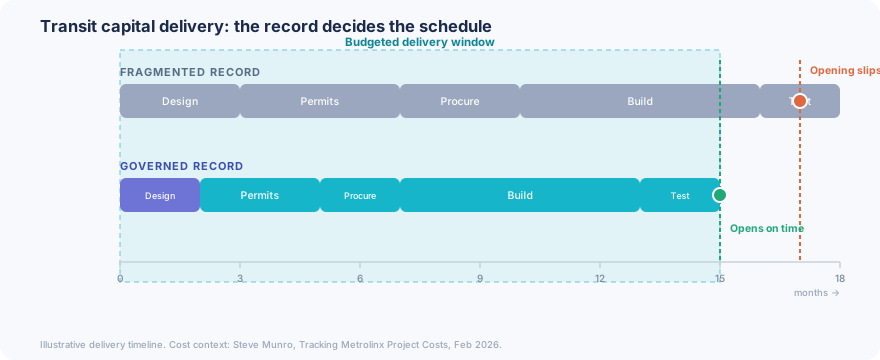
Schedule slips are usually a records problem wearing a hard hat
It is tempting to treat a slipped transit opening as an engineering story - difficult ground, a stubborn utility, a contractor dispute. Some of it is. But strip the megaproject down and most avoidable delay traces to a document that was wrong, missing, stale, or unapproved at the moment a decision depended on it. A change order that sits unlogged becomes a claim two years later. A permit condition buried in an email becomes a stop-work order. A drawing revision that never reached the field becomes rework and a schedule hit. None of these are exotic. They are the ordinary failure modes of a record spread across too many systems, and they compound: the bigger the program and the more parties on it, the more the schedule depends on any one person being able to find the current, authoritative version of a document on the day it is needed. Funder reporting raises the stakes again - senior-government contributions arrive against milestones and claims that must be evidenced, and a reimbursement that cannot be substantiated is cash flow the program does not get.
How XNM helps
XNM helps a capital-delivery team pull the whole program record into one auditable command centre - design packages and their revision history, change orders and RFIs, permits and their conditions, third-party agreements, and the milestone evidence behind every funder claim, tied to the project and kept current. Where it helps, XNM-Vision gives the director of capital delivery a single line of sight across the program, so the current version of any document is unmistakable, the trail behind it is preserved, and the answer to 'what is this milestone waiting on' exists before the steering committee asks. When a funder, an auditor, or a minister's office asks what was approved, when, and at what cost, the substantiation is already assembled rather than reconstructed from inboxes under deadline. And because it stands up in days rather than the many months a document-control overhaul usually takes, the visibility arrives in time to protect the current phase, not the post-mortem.
Practical takeaways
Make the current document unmistakable. On a program with thousands of drawings and change orders, 'which version is live' should never be a question; one source of truth per package is what keeps a crew from building the wrong thing.
Treat the funder record as cash flow. Senior-government reimbursements arrive against evidenced milestones; keep the substantiation assembled as you go, because a claim you cannot prove is money the program does not receive.
Log the change order the day it happens. Unlogged changes become disputes and claims years later; a complete, time-stamped change record is both schedule protection and legal defence.
Give delivery leadership one program view. A director overseeing dozens of interfaces needs a single, current picture of what each milestone is waiting on - not a status deck refreshed manually once a month.
Keep permits and their conditions where the work is planned. A permit condition lost in an inbox becomes a stop-work order; tie every approval and its conditions to the activity it governs.
FAQ
We already run a program-management information system. Isn't that enough?
A PMIS tracks schedule and cost; it rarely governs the underlying document record - which revision is authoritative, which permit condition is outstanding, which change order was actually approved. The delays that hurt happen in the gap between 'the schedule says we're at 60%' and 'the current, approved document for the next activity is in hand.' The value is a governed record the schedule can actually stand on.
Won't tightening the record slow a program that's already behind?
The opposite. The time a program loses is in hunting for the current drawing, reconciling conflicting sets, redoing work built on a stale one, and rebuilding a funder claim from scattered files. A single governed record removes those frictions; the discipline pays for itself the first time it prevents one stop-work order or substantiates one claim on time.
The bottom line
A transit expansion is judged on a date and a number, but it is delivered on a record. The programs that open on time are not the ones with the easiest ground; they are the ones whose delivery team could always see what was current, what was approved, and what the next milestone was waiting on. The schedule is a promise. The record is how a capital-delivery director keeps it.