The Port Runs on the Record: Why Capital Growth and Compliance Share One File
A container that lands at a Canadian port touches the record long before it touches a truck. The berth it arrives at was permitted, dredged, monitored, and reported on; the terminal behind it was built under an environmental assessment whose conditions outlive construction by decades; the land it crosses carries obligations to regulators, First Nations, and the public that do not lapse when the ribbon is cut. Trade volume is what people see. The record is what makes the volume legal, financeable, and repeatable - and for a port authority, growing one without governing the other is how a good year becomes a compliance problem.
Ports are among the most record-intensive infrastructure a country runs. A single capital program braids together capacity forecasts, engineering, tenant agreements, federal permits, species-at-risk and fisheries authorizations, monitoring commitments, and financing. Two things then hold for the life of the asset: the capital case has to be defensible to the boards and lenders who fund it, and the compliance file has to be producible to the regulators who can pause it. Both are the same record viewed from two directions - and when it is scattered, a port pays twice, in slower approvals and in the standing risk that a permit condition cannot be evidenced when someone asks.
Recent context
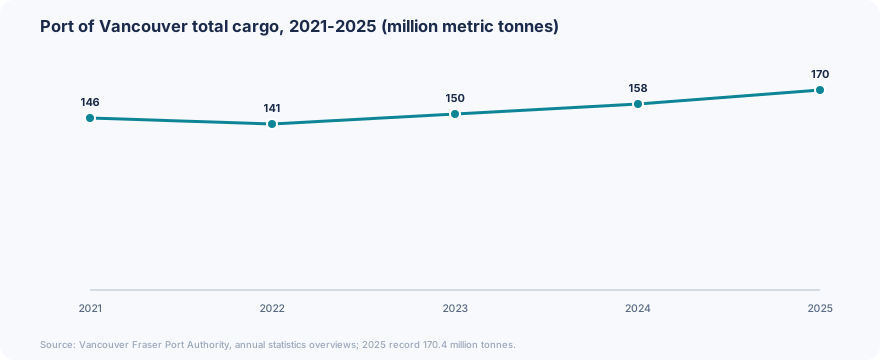
The growth driving all of this is real and recent. The Vancouver Fraser Port Authority reported that the Port of Vancouver moved a record 170.4 million tonnes in 2025, an eight percent increase over 2024, with its four container terminals handling 3.8 million TEUs - above the previous 2021 record. That growth sits behind capital programs such as the Roberts Bank Terminal 2 expansion, whose federal Fisheries Act authorization, tied to Species at Risk Act conditions, moved toward a decision expected by October 2026 - a reminder that a port's biggest projects advance one permit and one evidentiary record at a time.
Capital is the spike; compliance is the permanent file
The two halves of a port's record run on different clocks. Capital investment is spiky: a terminal, a berth deepening, a rail upgrade lands as a discrete program with a start, a peak, and a close. Compliance is flat and permanent: the environmental conditions attached to that terminal - habitat offsets, water-quality monitoring, noise and air limits, reporting cadences - run for the operating life of the asset and often beyond. A capital file can, in theory, be closed out; a compliance file effectively never is. When the two are kept apart, the knowledge built during a project - why a condition was set, what was promised, who signed off - drains away as the team disbands, and years later someone reconstructs it under a regulator's timeline. Keeping capital and compliance in one governed record carries that knowledge forward instead.
How XNM helps
XNM helps a port authority pull the capital and compliance record into one auditable command centre - capacity and investment cases, engineering and as-builts, permits and their conditions, monitoring commitments and the evidence against them, tenant and financing files, all tied to the project and kept current. Where it helps, XNM-Vision gives a Director of Infrastructure a single line of sight from the trade-volume case that justifies a project to the permit conditions that will outlive it - so a capital submission stands up to a board or lender, and a compliance question meets a producible record rather than a search. It stands up in days rather than the months a records program usually takes.
Practical takeaways
Treat trade growth as a capital signal with a paper trail. Volume drives the next terminal - keep the forecast, the case, and the approvals that follow it in one place the board can audit.
Keep permit conditions where the project lives. An authorization is only met if you can evidence it; store conditions and their monitoring against the asset, not in a consultant's binder.
Plan for a compliance file that never closes. Capital programs end; environmental obligations run for the asset's life - design the record to outlast the project team.
Make the capital case audit-ready by default. Boards and lenders will ask why this project and why now; keep the answer in a defensible, current form before they ask.
Capture project knowledge before the team disbands. Why a condition was set and what was promised should stay with the port, not leave with the people who negotiated it.
FAQ
We already report to our regulators on schedule. Isn't compliance handled?
Reporting on schedule proves the cadence, not the depth. The exposure shows up when a condition set years ago has to be evidenced now - the original commitment, the monitoring behind it, and the decisions in between. If that trail lives across departments, consultants, and past project teams, on-time reporting still sits on a record you would have to reconstruct under pressure. Compliance is handled when the evidence is producible, not just when the report went out.
Does tying capital and compliance together slow projects down?
It does the opposite where it counts. The delays in port projects cluster around approvals and financing, and both move faster when the case and the conditions are already assembled and current. A single governed record shortens the back-and-forth with regulators and lenders; the discipline pays for itself the first time it turns a scramble for evidence into a file you can simply produce.
The bottom line
A port's growth and its licence to grow are written in the same record. Trade volume drives the capital, the capital creates obligations, and those obligations outlive every project that produced them. The ports that expand cleanly are the ones that can show the board why a project pays and show a regulator that every condition is met - from one current, defensible file. For a Director of Infrastructure, the record is not overhead on the expansion. It is the asset that makes the expansion hold.