The Last Two Percent: Why Rural Broadband Lives or Dies on Its Record

A fibre crew splices the final drop to a farmhouse at the end of a gravel road, and on the program's coverage map one more dot turns from amber to green. It is a good day. But the dollars behind that green dot depend on something far less photogenic than a splice enclosure: the record that proves the site was eligible, that the subsidy paid for exactly this address, and that the household can now actually buy service at 50/10. A provincial connectivity program is not judged by the fibre in the ground. It is judged by whether the fibre in the ground can be proven.
Canada's rural and remote broadband push is one of the most heavily co-funded infrastructure efforts in the country, and every dollar arrives with a reporting obligation attached. A program director does not manage one project; they manage thousands of individual sites, each with an eligibility determination, a funding agreement, a construction milestone, a completion certificate, and a coverage claim - multiplied across federal partners, provincial treasuries, and the internet service providers who actually turn the shovels. When the record of what was funded, what was built, and what was connected lives in scattered spreadsheets, ISP progress emails, and a GIS layer that lags the field by months, the program's own coverage number becomes a matter of faith rather than proof.
Recent context
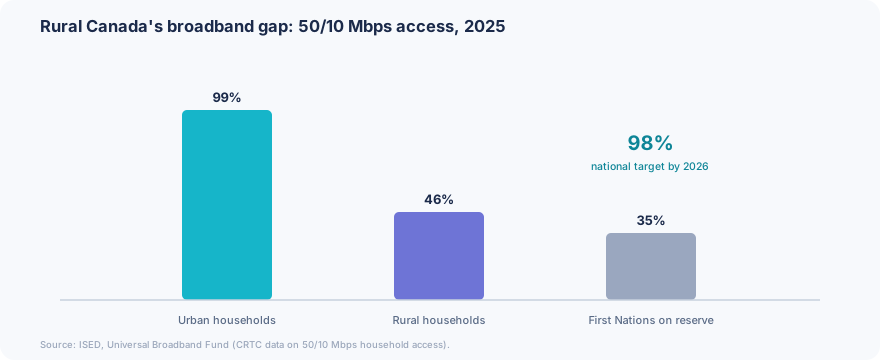
The national commitment is explicit and audited. Innovation, Science and Economic Development Canada reports that the $3.225-billion Universal Broadband Fund is built around a hard target: high-speed access at 50/10 Mbps for 98% of Canadian households by 2026 and 100% by 2030. Provincial programs are the delivery arm of that promise, co-funding builds site by site - and each connection has to be substantiated to release the money and to move the national number. The last stretch is the hardest and the most scrutinized: the rural and remote addresses that make up the final few percent are exactly the ones where proof of coverage is most contested.
Coverage is a claim before it is a connection
It is tempting to treat a broadband program as an engineering problem - trench, splice, light the fibre, done. But the funder does not pay for trenches; it pays for connected, serviceable households, and it pays only when the claim is substantiated. That is where programs get into trouble. A site marked 'complete' in a contractor's update is not the same as a site with a signed completion certificate, a verified serviceable-address count, and a coverage polygon that matches what was actually built. When those three do not reconcile, subsidy claims stall, clawback risk rises, and the program's public coverage figure drifts from reality. The gap is widest exactly where the need is greatest: only about 46% of rural households and 35% of First Nations households on reserve have 50/10 access today, against nearly 99% in cities - so the sites that most need to count are the ones whose records are hardest to keep straight.
How XNM helps
XNM helps a connectivity program pull the whole site-level record into one auditable command centre - eligibility determinations, funding agreements, construction milestones, completion certificates, serviceable-address counts, and the coverage claims tied to each, kept current as thousands of sites move through the pipeline. Where it fits, the XNM-Vision platform gives a program director a single line of sight from a funder's target down to an individual address, so a subsidy claim, a progress report, or an auditor's sample can be substantiated from one governed record rather than reassembled from ISP inboxes. When a federal partner asks which sites moved this quarter and on what evidence, the answer already exists in a defensible form - and because it stands up in days rather than the many months a reporting overhaul usually takes, the visibility arrives in time to protect this year's claims, not next year's.
Practical takeaways
Make the connected site the unit of record. Program credibility lives at the address level; a coverage number you cannot decompose into substantiated sites is a number you cannot defend.
Tie the subsidy claim to its evidence. A completion certificate, a serviceable-address count, and a coverage polygon should sit with the claim they justify, not in three different systems.
Reconcile the map to the field, not the field to the map. A GIS layer that lags construction by months quietly overstates coverage; keep the record current so the map reflects what is actually lit.
Assume every dollar will be sampled. Co-funders audit; keep each site in a state where the eligibility, the build, and the connection can be produced on request.
Keep the ISP evidence inside the program. Providers turn the shovels, but the accountability is the program's; capture their progress evidence where the program controls it, not only in their systems.
FAQ
We already report coverage to our funders. Isn't that enough?
A report is a snapshot; the record is what makes it true a year later. Reports assembled at deadline from provider updates can look complete and still fail an audit if the underlying site evidence cannot be produced. The value is in a living, site-level record where eligibility, construction, and connection status update together - so the coverage figure you report is one you can substantiate on any day, not just reconstruct at reporting time.
Isn't the hard part the construction, not the paperwork?
Construction is hard, but the paperwork is what releases the money and proves the promise. A perfectly built site that cannot be substantiated does not advance the funder's target or the subsidy claim. Getting the record right is how a program converts fibre in the ground into coverage it can prove and money it can keep.
The bottom line
A 98% coverage target is a records commitment before it is a construction schedule. The programs that hit it - and keep the funding they draw down - are the ones that can trace every point of coverage back to a substantiated site: eligible, built, connected, and provable. You cannot claim what you cannot prove, and for a connectivity program the record is the proof.