The Project Closeout Package, Field-Tested

Six months after handover, the new facilities manager needed the warranty on a rooftop unit that had just failed. It took her four days and three phone calls to learn it had already expired, because the paperwork proving the install date was in a box nobody had labelled.
A closeout package is the difference between handing over a building and handing over a building someone can actually operate. Most are assembled in a panic in the final week, as a pile of PDFs named final_final_v3. This one will be different. By the end you'll have a field-tested list of what actually belongs in a closeout package, and the one organizing principle that makes it usable a year later, not just complete on day one.
"Complete" and "usable" are not the same thing
You can hand over every document and still fail the handover. A closeout package that's a 4 GB zip of unnamed scans is technically complete and practically useless. The test isn't whether a document exists, it's whether the next owner can find the one they need, under pressure, without calling you. Field-tested means someone who wasn't on the project can operate the asset from the package alone.
What actually belongs in the package
As-builts and record drawings. The drawings that match what was actually built, not what was designed, marked up, reconciled, and dated. There's a whole failure mode in as-builts that don't match reality, and it's worth its own read.
Warranties and their start dates. Every warranty is worthless without a provable start date. Tie each one to the commissioning or acceptance record that proves when the clock started.
O&M manuals, organized by system. Operations and maintenance docs grouped by building system, not by whichever vendor happened to send them.
Commissioning and testing records. Proof each system was tested and accepted, with the actual results, not just a signature page.
Permits, inspections, and occupancy. The regulatory chain that proves the building is legal to occupy and operate.
Subcontractor and supplier directory. Who built what, with current contact info, so year-two repairs don't start with detective work.
Lien waivers and final payment records. Proof the project is financially closed and clean of claims. The reason a lien surprises an owner is almost always a gap here.
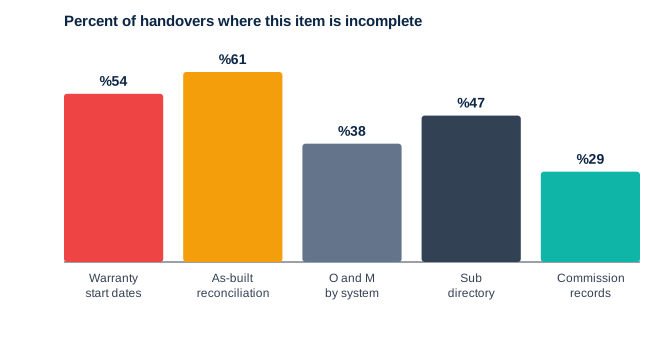
The organizing principle that makes it usable
Field-tested closeout packages share one habit: they're organized around the questions the next operator will actually ask, not the folders the project team happened to create. "Where's the warranty for the rooftop unit?" should be one obvious path, not a scavenger hunt across a commissioning folder, a vendor email, and a payment record. Build the package as if the person opening it is stressed, unfamiliar, and in a hurry, because in a year, they will be.
The deeper move is to stop treating closeout as an event. A package assembled in the final week is reconstructed from memory and scattered files. A package that's a by-product of a project run on a live record is already ninety percent done when the ribbon is cut, because the warranties, approvals, and as-builts were captured as they happened.
Do this before your next handover
Take your last closeout package and run the four-day test: pick one warranty and time how long it takes a colleague who wasn't on the project to find its start date. If it's more than two minutes, your package is complete but not usable. This is exactly the gap XNM-VISION was built to close, a project's records assembling themselves into a handover as the work happens, not after. But even if you never touch our software, the two-minute test will tell you more about your closeout than any completeness checklist.
The closeout package is the last record of a project, andthe as-built is the one most likely to lie to you. Here's how that happens.