Field Notes: Forestry Tenure, Compliance, and the File
A forest licence is worth millions. It can be suspended over a file that's out of date.
In forestry, the tenure, the licence or agreement that grants the right to harvest on public land, is the single most valuable thing a company holds. And it rests on a stack of obligations most people outside the industry never see: cut control, silviculture reporting, road maintenance, stumpage, and environmental and cultural-heritage commitments. Miss enough of them, or fail to prove you met them, and the regulator can suspend or cancel the licence. By the end of these field notes you'll see why the file that protects a tenure is a compliance record long before it's a paperwork chore, and why "we did it" and "we can prove we did it" are two entirely different assets.
The tenure is a promise you have to keep proving
A forest tenure isn't a one-time grant. It's a continuing relationship with a regulator, built on recurring obligations, each with its own deadline, standard, and evidence requirement. Silviculture obligations run for years after harvest; you're responsible for the stand being successfully reestablished, and for reporting it. Annual cut control has to stay within limits across a control period. Road use and deactivation carry maintenance and safety duties. Each of these is a promise, and each promise generates a record that proves you kept it.
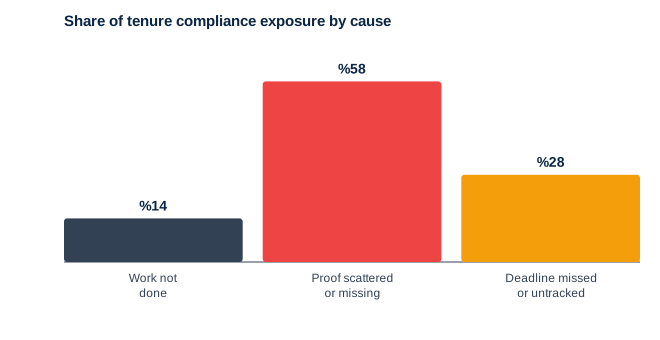
The failure mode usually isn't that a company skips the work. It's that the proof scatters. A silviculture survey sits in a consultant's report, a road inspection in a field crew's notes, a stumpage submission in an accounting system, so that when the regulator asks, the answer is a scramble across three organizations instead of one file.
What lives in the file that protects the licence
Cut control records reconciled to the licence limits, per control period
Silviculture obligations with their milestones, survey results, and free-growing declarations
Road maintenance, inspection, and deactivation records tied to each road permit
Stumpage and scaling submissions with their supporting data
Environmental and cultural-heritage commitments, and the evidence each was honoured
Correspondence with the regulator, every request, response, and approval, dated
Why the file, not the fieldwork, is the risk
Here's the counterintuitive part. In most tenure problems, the underlying work was done. The trees were planted, the road was maintained, the survey was completed. The company was exposed not because it failed the obligation but because it couldn't assemble the proof fast enough when it was asked. And in a compliance review, "we can't find it right now" and "we didn't do it" look identical from the regulator's side of the table.
The field-notes takeaway
Treat the tenure file the way you'd treat the licence itself, because functionally, it is the licence. Keep every obligation, its deadline, and its evidence in one place tied to the tenure, updated as the work happens, not reconstructed before an audit. The company that can answer any tenure question in an afternoon isn't more diligent in the field than its competitors. It just decided that proof is part of the job, not an afterthought, and that decision is what keeps a multi-million-dollar licence from resting on a file that's out of date.
Every regulated sector lives this same tension between doing the work and proving it,here's how it plays out across other fields.