One Chart: The Risk Curve of Undocumented Decisions

One undocumented decision is a shrug. Fifty is a lawsuit waiting for a trigger.
Every project runs on decisions: approve this change, accept this substitution, waive that requirement, proceed at risk. Individually, an undocumented decision feels harmless. You made a reasonable call, everyone in the room agreed, work continued. The problem isn't any single one. It's that they accumulate, and the risk they carry doesn't add up in a straight line, it curves. By the end you'll understand why the hundredth undocumented decision is far more dangerous than the first, and where on that curve most troubled projects actually sit.
Why risk curves instead of climbs
If undocumented decisions were merely additive, you could tolerate a lot of them, each one a small, fixed risk. But they interact. Decision 40 depends on decision 12, which quietly contradicted decision 6, none of which were written down. When something finally goes wrong, a failure, a dispute, an audit, you're not trying to recover one lost decision. You're trying to reconstruct a web of them, from memory, often after the people who made them have moved on. The cost of reconstruction rises faster than the count, because each missing decision makes the others harder to place.
There's a second reason the curve bends. Undocumented decisions don't just multiply the work of reconstruction; they multiply the disagreement about it. Two people who were both in the room will remember the same call differently a year later, in perfectly good faith. With one lost decision, that's a quick conversation. With forty, every reconstruction meeting becomes a negotiation over the past, and the answers you finally write down are softer, hedged, and easier for an opponent to pick apart. The record you rebuild under pressure is never as strong as the one you could have captured for free.
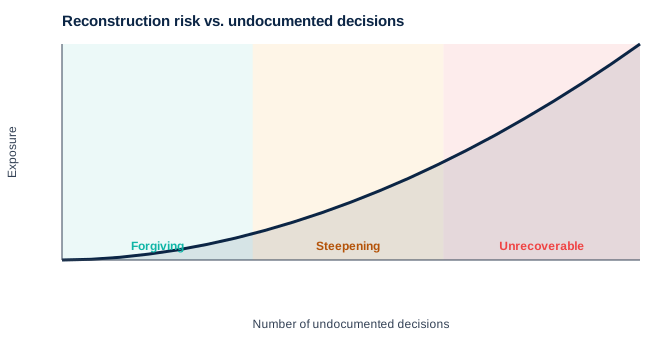
That's the shape of the curve below: flat and forgiving at first, then steepening, until a project reaches a zone where no one can confidently say why key things were done the way they were.
Reading the three zones
The forgiving zone. A handful of undocumented calls. You can still reconstruct them from memory and a few emails. Most projects live here early and feel fine, which is exactly why the habit sets in.
The steepening zone. Dozens of undocumented decisions, interacting. Reconstruction now takes real time and starts producing disagreements about what was actually decided. This is where "let me get back to you" enters every status meeting.
The unrecoverable zone. The decision history is effectively lost. When an audit, claim, or failure hits, the honest answer to "why was this done?" is "we're not sure." This is the zone where projects lose disputes they should have won.
The one move that flattens the curve
You don't flatten this curve by making fewer decisions, you can't, and shouldn't. You flatten it by documenting decisions at the moment they're made, so the count of undocumented ones never climbs into the steep part. A decision captured when it happens costs about thirty seconds. The same decision reconstructed a year later, under dispute, can cost weeks, and sometimes it can't be reconstructed at all. The curve is why the cheapest possible time to record a decision is always right now, and the most expensive is exactly when you finally need it.
This is the same compounding that turns a small change into a runaway overrun,see how eleven days cost two million.