Your Software Is Only as Good as Your Records

Automate a broken process and you don't get a fixed process. You get broken, faster.
There's a seductive promise in every new system: buy the software, and the chaos gets organized. Dashboards, automation, AI that answers questions about your projects. But there's a hard law underneath all of it, and no vendor likes to say it out loud: software is only as good as the records you feed it. Garbage in doesn't get cleaned by automation, it gets multiplied, formatted nicely, and served back to you with a confidence it hasn't earned. By the end you'll know why the most important work happens before the software, and what "good records" actually means in practice.
Automation is a multiplier, not a corrector
A dashboard doesn't know your data is wrong. It renders whatever it's given, beautifully. An AI assistant that answers "what's the status of the north site?" is only as right as the records behind that answer, and it will phrase a wrong answer with exactly the same fluency as a right one. That's the trap. Manual chaos at least looks like chaos. Automated chaos looks like control. The failure gets harder to see precisely because the output is polished.
This is why so many software rollouts disappoint. The organization expected the tool to fix the underlying mess. Instead the tool faithfully reflected the mess, duplicated records, missing approvals, three versions of the truth, and now the mess had a professional interface.
What "good records" actually means
Good records aren't about volume, or even neatness. They have a few concrete properties:
Single source of truth: one authoritative version of each document, not five copies drifting apart
Attributable: every record shows who created it, who approved it, and when
Complete at capture: the record is made when the work happens, not reconstructed later
Findable: a specific record can be located in seconds by someone who wasn't there
Connected: a decision links to the change it approved, the document it relied on, the payment it triggered
Feed a system records with those properties and automation earns its promise: the dashboard is trustworthy, the AI answer is grounded, the audit is a query instead of a fire drill. Feed it anything less and you've simply automated your uncertainty.
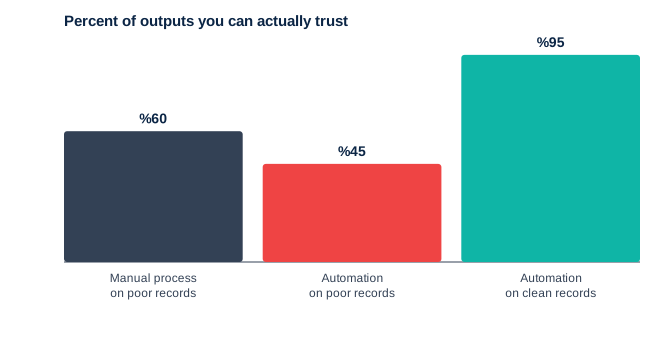
Do the unglamorous work first
The instinct is to fix records by buying better software. It's backwards. The records discipline comes first; the software amplifies whatever discipline you already have. That's the honest version of the pitch, and it's the one XNM-VISION is built on: a system that captures records cleanly as the work happens, so the automation on top has something true to work with. But even if you never buy a tool, the order matters. Get the record right, then automate it. Do it the other way around and you'll spend a year learning that garbage in stays garbage, it just travels faster.
This is why data quality is the real foundation under every dashboard,and why your files, not your software, decide what's possible.