The Lien That Surprised the Owner

The building was done. The final inspection had passed. The owner was weeks away from refinancing when the notice arrived: a builder's lien registered against the property, for $47,000 the owner was certain had already been paid.
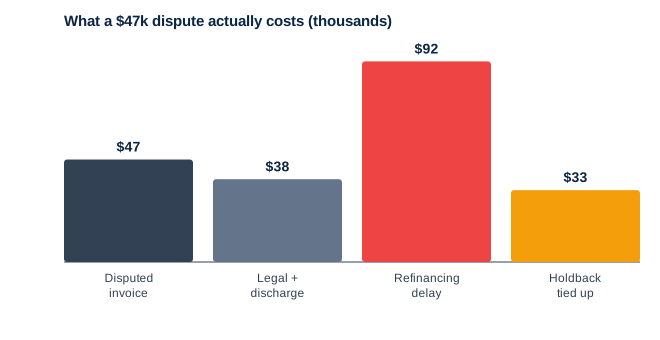
Here is what made it worse. The owner wasn't wrong, exactly. The money had moved. A progress payment covering that subcontractor's work had gone to the general contractor months earlier. But somewhere between the GC and the sub, a dispute over a change had frozen part of the payment, and no one had told the owner. By the time the lien hit the title, a $47,000 disagreement had quietly become a problem that would delay a multi-million-dollar refinancing. Why it surprised the owner is the whole point of this piece, and it is a records problem long before it is a legal one.
A lien isn't a surprise, it's a signal you missed the earlier signals
A construction lien, a builder's lien in most of Canada, is a legal claim registered against a property by someone who supplied labour or materials and says they weren't paid. It is a powerful, deliberately blunt instrument: it attaches to the title, not to the person who owes the money. That is why an owner who paid the general contractor in full can still end up with a lien from a sub the owner never contracted with and may never have met.
The lien itself is loud. What precedes it is quiet. An unresolved change order. A disputed backcharge. A holdback that was never formally released. An invoice sitting in a status no one is watching. Every lien has a paper trail leading up to it. The owner who's surprised isn't the owner who didn't pay, it's the owner who couldn't see the dispute forming because it lived in someone else's inbox.
The three records that would have caught it
The payment-to-waiver chain. Every progress payment to a GC should tie to lien waivers, or statutory declarations, from the subs and suppliers that payment covers. If you pay the GC but can't point to a waiver from each sub, you've paid without proof the money reached the people who can lien you.
The change-order register. Most sub disputes trace to a change nobody formally priced or approved. A live register showing every change, its status, and who signed off turns "we disagree about that extra" into a documented, dated position instead of a he-said standoff.
The holdback ledger. Holdback, the percentage retained until the lien period expires, has to be tracked per contract with real release dates. A holdback released early, or a lien period miscounted, is how a project everyone considered closed quietly reopens.
None of these are exotic. They are records most projects generate anyway. They just live in separate places, held by separate people, so no single view shows the risk building. And the cost of that blindness compounds.
What to do before the notice arrives
The move isn't to hire more lawyers. It's to make the payment trail visible while the project is still running. Tie every payment to its waivers. Keep the change register current, not reconstructed after the fact. Track holdback and lien periods with real dates, in one place the owner and the GC can both see. When those three records live together, a forming dispute shows up as a status, flagged, dated, attributable, weeks before it can harden into a claim on your title.
A lien that surprises you is really a decision you couldn't see. The owners who never get surprised aren't luckier, or more litigious. They just refuse to let the payment story scatter across a dozen inboxes, and they treat "who got paid for what, and who signed to prove it" as a live record, not a year-end reconstruction.
If you want the discipline that keeps disputes visible before they harden,start with how a clean project stays clean and work forward from there.