From Pro-Forma to Handover: Why a Multi-Funder Housing Project Is Only as Strong as Its Record

An affordable-housing project begins as a pro-forma - a spreadsheet of assumptions about land, construction cost, rents, and the layers of capital that have to line up before a shovel moves. It ends, if all goes well, as occupied homes with a mortgage, an operating budget, and a reporting obligation that can run for fifty years. Between those two points sit construction, handover, lease-up, and a long tail of compliance - and the one thread that has to run unbroken through all of it is the record. For an executive director or director of development, the record is not administrative overhead layered on top of the real work. It is the spine the project stands on.
What makes affordable housing distinct is the capital stack. A single building can combine a federal construction loan, a provincial or municipal grant, a land contribution, deferred development charges, and philanthropic or community-bond capital - each with its own eligibility rules, draw schedules, milestone certifications, and reporting cadence. Every funder wants proof: that the money went where it was promised, that the units are affordable to the households the program targets, and that the project stays that way for the full term of the agreement. When that proof lives in scattered spreadsheets, email threads, and the memory of whoever ran the file at the time, the organization carries risk it cannot see - a drawdown it cannot substantiate, a milestone it cannot evidence, a report it assembles from scratch every quarter.
Recent context
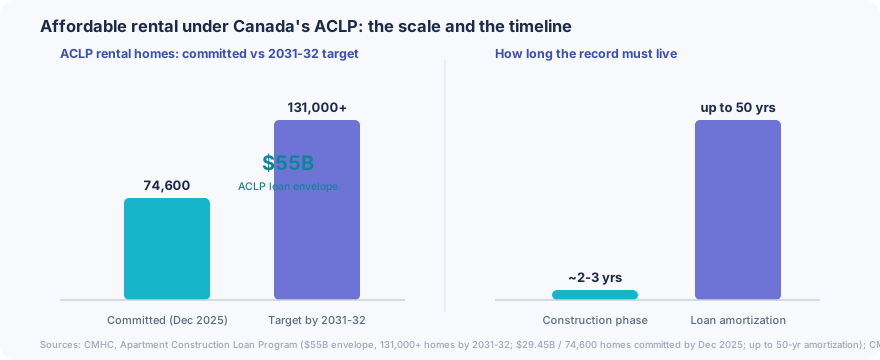
The federal capital behind this sector is large and long-dated. CMHC's Apartment Construction Loan Program is a $55-billion envelope aiming to support more than 131,000 rental homes across Canada by 2031-32, and as of December 2025 CMHC had committed about $29.45 billion in loans toward more than 74,600 homes. These are low-cost construction loans that can amortize over as much as 50 years - which means the reporting relationship a developer enters does not end at occupancy; it begins there and runs for decades. The record has to be built to last as long as the loan.
The record is the project's connective tissue
It is easy to think of a housing project as a construction problem bracketed by a financing problem, but the reality is one continuous record problem. The pro-forma assumptions become the budget; the budget becomes the draw requests; the draw requests need milestone evidence; the milestones feed the funder reports; and the funder reports continue long after handover into affordability monitoring and operating compliance. Break the chain anywhere and the cost surfaces later: a delayed drawdown because a certification cannot be found, a funder query that takes weeks because the supporting documents are scattered, an annual compliance report rebuilt from memory because no one kept the file current. A multi-funder project multiplies every one of these risks by the number of agreements in the stack. The organizations that carry projects cleanly from pro-forma to handover are the ones whose record was governed from the first assumption, not reconstructed under a reporting deadline.
How XNM helps
XNM helps affordable-housing developers and non-profits keep the whole project record in one auditable command centre - the pro-forma and budget, the capital-stack agreements, draw requests and milestone certifications, construction documents, handover records, and the long tail of affordability and operating reports, organized by project and kept current. Where it helps, XNM-Vision gives an executive director or director of development a single line of sight from the first pro-forma to the latest compliance filing, so a draw request is substantiated the day it is made and a funder query is a lookup rather than a scramble. When CMHC, a provincial agency, or a philanthropic funder asks for proof, the evidence already exists in a defensible form. And because it stands up in days rather than the months a records overhaul usually takes, the discipline is in place before the next draw, not after the next audit.
Practical takeaways
Treat the pro-forma as the start of the record, not a throwaway. The assumptions you model become the budget you report against - keep them connected instead of re-entering the numbers at every stage.
Map every funder's reporting clock up front. A capital stack has as many reporting cadences as it has funders; know each one before construction, not when the first report is due.
Tie milestone evidence to draw requests. A drawdown you cannot substantiate is a delayed drawdown - keep the certification with the request so proof is never a search.
Build the record to outlast construction. Affordability and operating obligations can run for decades; the project file has to survive handover, staff turnover, and every funder review that follows.
Make compliance reporting a lookup, not a rebuild. If you assemble each report from scratch, you are paying for the same work every quarter - a current record turns reporting into export.
FAQ
Each funder has its own portal and template. Doesn't that already organize our reporting?
Funder portals capture what you submit to them, one program at a time; they do not give you a single view of the project across every funder. When agreements overlap - and in a capital stack they always do - you still need one place that ties the pro-forma, the draws, the milestones, and every reporting stream together. That governed project record is what keeps overlapping obligations from becoming conflicting ones.
We're a small team. Isn't a full project record more than we can maintain?
A small team is exactly why the record matters, because there is no depth to absorb a scramble. The maintenance cost of a governed record is small and continuous; the cost of reconstructing one under a funder deadline is large and lands at the worst possible moment. Keeping the file current as you go is how a lean organization carries a complex, multi-funder project without carrying hidden risk.
The bottom line
An affordable-housing project is a promise made to many funders at once, held together over decades. The pro-forma, the construction, the handover, and the long years of compliance are not separate jobs; they are one record that either holds or breaks. The developers and non-profits that deliver - and keep delivering - are the ones whose record ran unbroken from the first assumption to the last report. The capital stack is complex; the record is how you make it stand up.