The Deferred-Maintenance Backlog Is a Records Problem — and So Is Your Next Research Grant

Two numbers sit on a facilities vice-president's desk that should never be read apart. One is the deferred-maintenance backlog on aging campus and research buildings - the roofs, labs, chillers, and mechanical systems that keep sliding down the priority list. The other is the research-facility capital a university competes for, grant by grant, to keep its scientists at the front of their fields. They look like opposite problems: one is about holding the past together, the other about building the future. In practice they are the same problem wearing two hats, and both come apart in the same place - the record of what the institution owns, what condition it is in, and what has been promised to whom.
A university's physical plant is one of the largest and most complex asset portfolios in any Canadian city: teaching space, residences, and - increasingly the hardest to steward - research facilities crammed with specialized systems, containment, cooling, and instrumentation that each carry their own condition curve, warranty, and compliance file. The record that describes all of it - as-built drawings, condition assessments, maintenance histories, capital plans, grant agreements, and the project files behind each renovation - is the operating manual for the whole campus. When it is scattered across faculties, facilities management, the research office, and a decade of consultants' servers, the institution loses the one thing it needs to make good decisions: a single, current line of sight.
Recent context
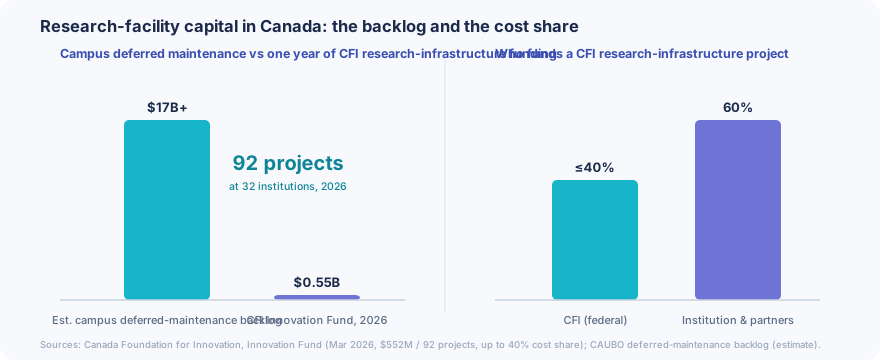
The capital that modernizes research space is real and competitive. The Canada Foundation for Innovation announced in March 2026 an investment of more than $552 million through its Innovation Fund, supporting 92 research-infrastructure projects at 32 higher-education institutions across the country - with the CFI typically covering up to 40% of a project's cost and the institution and its partners securing the remaining 60%. Against that, Canada's campus deferred-maintenance backlog has been estimated in the range of $17 billion and climbing. Every grant dollar has to be reconciled and reported; every backlog dollar has to be prioritized - and neither can be done from memory.
The backlog and the grant are the same records problem
It is tempting to treat deferred maintenance as an operations issue and research capital as a research-office issue, and to let each run on its own spreadsheets. But both collapse onto the same question: does the institution have a current, trustworthy record of its assets and its projects? On the maintenance side, you cannot defensibly rank a $17-billion backlog - which lab air-handler fails first, which roof is one winter from a leak over an irreplaceable instrument - without condition data that is live rather than three assessments old. On the grant side, a CFI-funded build is a cost-shared, multi-party project with reporting obligations that outlast the ribbon-cutting; the institution's ability to draw funds, satisfy an audit, and account for in-kind and partner contributions is only as good as the project file it can produce. The same missing record shows up as a mis-prioritized backlog in one office and a reconciliation scramble in the other.
How XNM helps
XNM helps universities pull the facilities and research-capital record into one auditable command centre - as-built drawings, condition assessments, maintenance and warranty files, capital plans, grant agreements, and the project files behind each renovation, tied together and kept current. Where it helps, the XNM-Vision platform gives a VP Facilities or AVP Capital Projects a single line of sight across the whole portfolio, so the deferred-maintenance list is built on live condition data and every grant-funded project carries its own defensible file from award through final report. When a funder, an internal auditor, or a board committee asks what was approved, what was spent, and what condition an asset is in, the answer already exists in a form that stands up. And because it comes together in days rather than the many months a records overhaul usually takes, the visibility arrives in time to shape the capital plan you are writing now, not the one after it.
Practical takeaways
Read the backlog and the grants on one page. Deferred maintenance and research-facility capital compete for the same buildings and the same staff; managing them from separate records guarantees they work against each other.
Keep condition data live, not periodic. A backlog ranked on assessments that are years old quietly mis-prioritizes every renewal dollar; the record has to update as the building ages.
Make every grant-funded project a self-contained file. A cost-shared build has reporting that outlasts construction - keep the agreement, drawings, spend, and partner contributions together from day one.
Treat research-facility compliance as part of the record. Containment, cooling, and instrumentation carry their own warranty and compliance obligations; losing them in a shared drive is a risk, not a filing habit.
Capture institutional memory before it retires. When a long-serving facilities engineer leaves, the history of a specialized lab should stay with the university, not walk out with them.
FAQ
We have a facilities condition assessment on file. Isn't that our record?
An assessment is a snapshot; the record is what keeps it true. A condition assessment ages the day it is delivered, and a backlog ranked on stale data mis-prioritizes quietly. The value is in a living record where condition, work history, and capital decisions update together - so the renewal list reflects the campus as it is now, not as it was at the last survey.
Research grants have their own reporting portals. Why add anything?
Funder portals capture what you submit; they do not assemble the underlying project file for you. When a draw request, an audit, or a partner reconciliation lands, you still need the drawings, contracts, change orders, and in-kind records in one place. A governed project file is what turns a reporting deadline into a lookup instead of a scramble.
The bottom line
A $17-billion backlog and a $552-million grant round look like opposite stories, but they fail in the same place - the record. The universities that steward their research infrastructure well are the ones that can see their whole portfolio at once: every asset, its condition, every grant-funded project, and the decisions shaping both, in one current and defensible record. You cannot renew what you cannot see, and you cannot account for what you cannot find.